159190-45-1
中文名称
L-N6-(1-IMINOETHYL)LYSINE DIHYDROCHLORIDE
英文名称
L-N6-(1-IMINOETHYL)LYSINE DIHYDROCHLORIDE
CAS
159190-45-1
分子式
C8H18ClN3O2
分子量
223.7
MOL 文件
159190-45-1.mol
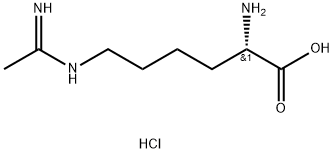 159190-45-1 结构式

基本信息
中文别名
化合物 T25749 英文别名
L-NIL HCLL-NIL DIHYDROCHLORIDE
L-N6-(1-Iminoethyl)lysine
OQIBCXRAFAHXMM-KLXURFKVSA-N
L-N6-(1-IMINOETHYL)-LYSINE 2HCL
L-N6-(1-IMINOETHYL)LYSINE, DIHCL
L-Lysine ω-acetamidine dihydrochloride
L-N6-(1-IMINOETHYL)LYSINE DIHYDROCHLORIDE
N6-(1-IMINOETHYL)-L-LYSINE DIHYDROCHLORIDE
L-Lysine, N6-(1-iMinoethyl)-, (Hydrochloride) (1:2)
物理化学性质
储存条件-20°C
溶解度DMF: 15 mg/mL; DMSO: 15 mg/mL; Ethanol: 1 mg/mL; PBS: 30 mg/mL; Water: 50 mg/ml
形态白色至类白色固体
生物来源synthetic (organic)
水溶解性water: 50mg/mL, clear, colorless
InChI1S/C8H17N3O2.2ClH/c1-6(9)11-5-3-2-4-7(10)8(12)13;;/h7H,2-5,10H2,1H3,(H2,9,11)(H,12,13);2*1H/t7-;;/m0../s1
InChIKeyOQIBCXRAFAHXMM-KLXURFKVSA-N
SMILESCl.Cl.CC(=N)NCCCC[C@H](N)C(O)=O
安全数据

警示词警告
危险性描述H315-H319-H335
危险品标志Xi
危险类别码36/37/38
安全说明37/39-26-36
WGK Germany3
存储类别11 - Combustible Solids
危险性类别Eye Irrit. 2
Skin Irrit. 2
STOT SE 3
Skin Irrit. 2
STOT SE 3
常见问题列表
生物活性
L-NIL dihydrochloride 是诱导型一氧化氮合成酶 (iNOS) 的抑制剂,其对 miNOS 的 IC50 值为3.3 μM。靶点
IC50: 3.3 μM (mouse inducible NO synthase), 92 μM (rat brain constitutive NO synthase).
体外研究
L-NIL produces a concentration-dependent inhibition of both the mouse inducible NOS (miNOS) and the rat brain constitutive NOS (rcNOS) and is considerably more potent for miNOS. The IC 50 values for L-NIL with miNOS and rcNOS are 3.3 and 92 pM, respectively, indicating that L-NIL is 28-fold more selective for miNOS. In addition, L-NIL has approximately 6-fold greater potency for miNOS than either L-NMA or L-NNA.
体内研究
L-NIL (10 and 30 mg/kg, IP) prevents the inflammation, oxidative stress and autophagy induced by renal IR in mice.
| Animal Model: | Adult male Balb/c (20-25 g). |
| Dosage: | 10 and 30 mg/kg. |
| Administration: | Intraperitoneally at the end of CLP and at 6 h after sepsis induction. |
| Result: |
Led to a negligible increase in plasma NGAL compared to sham mice.
Led to a significant decrease in both TLR4 and IL1βprotein contents and clusterin transcript. Showed an increase in NFAT5 mRNA levels, as compared with mice treated with vehicle. Promoted a decrease in AR protein expression, as compared with animals treated with vehicle. |