Tricalciumbis(orthophosphat) Chemische Eigenschaften,Einsatz,Produktion Methoden
R-Sätze Betriebsanweisung:
R36/37/38:Reizt die Augen, die Atmungsorgane und die Haut.
S-Sätze Betriebsanweisung:
S26:Bei Berührung mit den Augen sofort gründlich mit Wasser abspülen und Arzt konsultieren.
S36:DE: Bei der Arbeit geeignete Schutzkleidung tragen.
S24/25:Berührung mit den Augen und der Haut vermeiden.
S22:Staub nicht einatmen.
Beschreibung
Calcium Phosphate is the calcium salt of phosphoric acid with widely used applications. It occur abundantly in nature in several forms and are the principal minerals for the production of phosphate fertilizers and for a range of phosphorus compounds. For example, the tribasic variety (precipitated calcium phosphate), Ca3(PO4)2, is the principal inorganic constituent of bone ash. The acid salt Ca(H2PO4)2, produced by treating mineral phosphates with sulfuric acid, is employed as a plant food and stabilizer for plastics. It is a natural constituent of mammals, and it is a component of bone replacement transplants in much higher amounts with no toxicological problems.
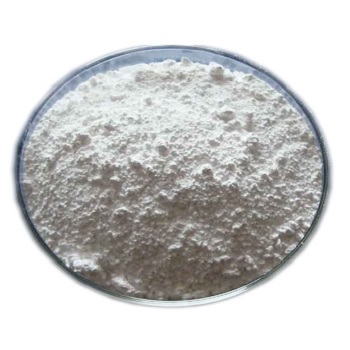
Calcium phosphates are the largest group of artificial bone graft substitutes. This is mainly due to their close resemblance to the mineral components of bone. This Product can be used as a countermeasure for exposure to strontium and radium radionuclides. Upon oral uptake, calcium phosphate competes for and blocks the absorption of radium (Ra-226) and strontium (Sr-90) in the gastrointestinal (GI) tract.
Chemische Eigenschaften
Tricalcium phosphate is white solid, insoluble in water; reactive with silicon oxide and carbon at electric furnace temperature yielding phosphorus vapor; reactive with H2SO4 to form, according to the proportions used, phosphoric acid, or dicalcium hydrogen phosphate, CaHPO4, white solid, insoluble; or calcium dihydrogen phosphate, Ca(H2PO4)2·H2O, white solid, soluble. pKsp = 28.70.
Physikalische Eigenschaften
White amorphous powder; refractive index 1.63; density 3.14 g/cm
3; melts at 1,670°C; insoluble in water; KSP 1.0x10
-25; soluble in acids.
Occurrence
Tribasic calcium phosphate occurs in nature as minerals, oxydapatite, whitlockite, voelicherite, apatite, phosphorite. It has many industrial applica tions. Some are similar to the monobasic and dibasic salts. It is used in fertil izers, dental products, ceramics and polishing powder. Some other important applications are in plastics as a stabilizer; as an anticaking agent; as a nutri ent supplement in cattle food; for clarifying sugar syrup; as a mordant in dye ing textiles; and as a buffer to control pH.
Verwenden
Tribasic calcium phosphate occurs in nature as minerals, oxydapatite, whitlockite, voelicherite, apatite, phosphorite. It has many industrial applications. Some are similar to the monobasic and dibasic salts. It is used in fertilizers, dental products, ceramics and polishing powder. Some other important applications are in plastics as a stabilizer; as an anticaking agent; as a nutrient supplement in cattle food; for clarifying sugar syrup; as a mordant in dyeing textiles; and as a buffer to control pH.
synthetische
Tribasic calcium phosphate is obtained from naturally occurring minerals for fertilizer applications. The compound may be prepared in the laboratory by the reaction of sodium phosphate with calcium chloride with excess of ammonia. Also, it can be prepared by treatment of calcium hydroxide with phosphoric acid:
2H3PO4 + 3Ca(OH)2 → Ca3(PO4)2 + 6H2O
Allgemeine Beschreibung
β-tri-Calcium phosphate belongs to the category of calcium-phosphate based ceramics, which has been involved in the preparation of a new biosynthetic material possessing morphogenetic activity that is used as a bone implant.
Industrielle Verwendung
Calcium phosphate [Ca
3(PO
4)
2] finds applications as a supplement for animal feed, as a fertiliser, in the manufacture of glass and in dental products.
Tricalciumbis(orthophosphat) Upstream-Materialien And Downstream Produkte
Upstream-Materialien
Downstream Produkte