


Inhibitor refers to substance that can hinder the chemical reactions, biological reactions (including immune response) and biological activity. In present time, commonly used inhibitors include immunosuppressants and inhibitors. 1. Immunosuppressive agents: immunosuppressants system refers to drug that can reduce the immune response. It can selectively suppress certain steps of the immune response and immune cells. Immune response refers to the body’s response to a variety of pathogenic substances. Some reactions are favorable to the body and can enhance the body's resistance to disease; some have adverse effects on the body and can cause tissue damage or disorders of physiological functions (allergy). Therefore, patients suffering from allergic reactions being harmful to the body should be subject to the treatment of immunosuppressant to affect the related immune processes and reduce the immune response of the body. For the treatment of various autoimmune diseases and weakening the tissue incompatibility, it has been developed of a variety of immunosuppressive agents, some of which have been widely used in clinical practice. Commonly used immunosuppressants include glucocorticoids (prednisone, prednisolone, etc.), alkylating agents (nitric oxide mustard, cyclophosphamide, thiotepa, busulfan, etc.), and antimetabolites (6- mercaptopurine, azathioprine, methotrexate, etc.). The mechanism of immunosuppressants, though not entirely clear, but is characterized by the following several aspects: ① most kinds of immunosuppressants can simultaneously inhibit cellular and humoral immunity and can be used for organ transplantation and autoimmune disease. ②Its inhibitory effect is strong for the primary immune response while the inhibitory effect against secondary response is weak. ③It can simultaneously act on normal and pathological immunity, therefore, can often lead to some complications. ④These drugs often have strong with serious adverse reactions. 2. Enzyme
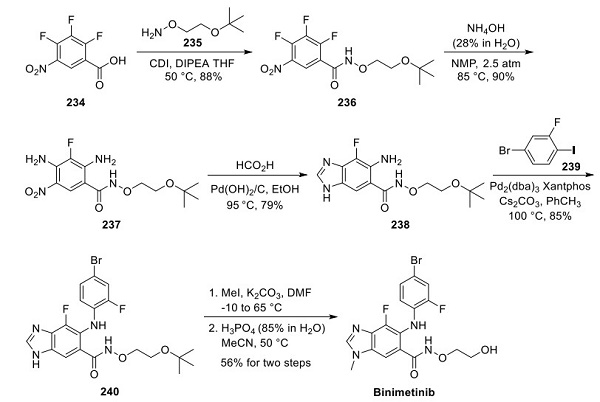
The synthesis method of Binimetinib
Binimetinib is a non-ATP competitive mitogen-activated protein kinase 1/2 (MEK1/2) inhibitor discovered by Array BioPharma.
Dec 27,2023 Inhibitors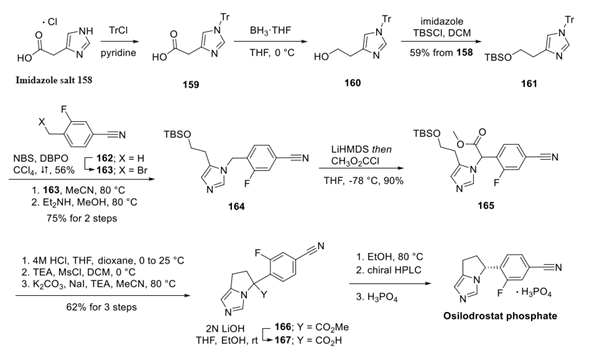
Osilodrostat Phosphate: Synthesis and Introduction
Osilodrostat Phosphate (LCI 699) is prepared using imidazole salt as raw material and by reduction, alkylation, saponification and other reactions.
Dec 27,2023 Inhibitors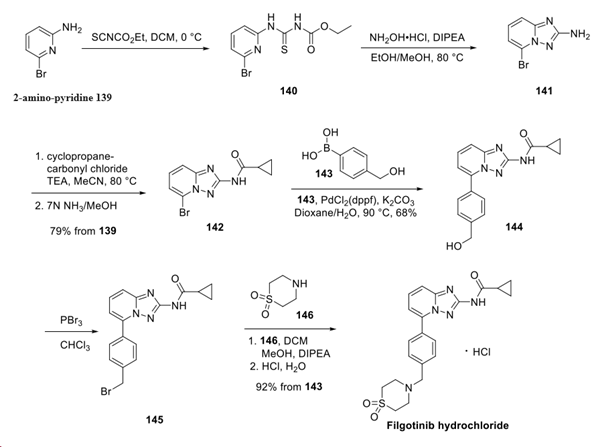
How is Filgotinib synthesised?
Filgotinib is prepared using 2-aminopyridine as raw material by condensation, cyclisation, coupling and other reactions.
Dec 27,2023 Inhibitors
What is Apalutamide
Apalutamide is a next-generation oral androgen receptor (AR) inhibitor that Janssen is developing for the treatment of prostate cancer.
Dec 26,2023 Inhibitors
A cinacalcet analog-Evocalcet
Evocalcet, a novel oral calcimimetic agent, is an allosteric modulator that acts on the calcium-sensing receptors on the membrane of parathyroid cells to suppress parathyroid hormone (PTH) secretion.
Dec 26,2023 Inhibitors
Synthesis of Delgocitinib
Delgocitinib is synthesised using bromolactone as raw material by chemical reaction.
Dec 26,2023 Inhibitors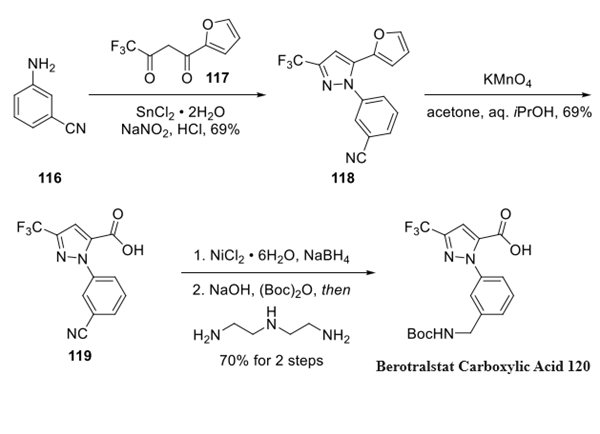
Synthesis of Berotralstat Dihydrochloride
The method for the synthesis of berotralstat dihydrochloride relies on two fragments, berotralstat carboxylic acidFragment and chiral dibenzylamine.
Dec 26,2023 Inhibitors
Tirbanibulin: Synthesis and Introduction
Tirbanibulin, a first-in-class dual inhibitor of tyrosine-protein kinase CSK, more commonly termed Src kinase, was developed by Athenex Inc.
Dec 26,2023 Inhibitors
The synthetic route of Elobixibat
Elobixibat is an IBAT inhibitor that modulates the enterohepatic circulation of BAs. Elobixibat Sulfone is the early stage intermediate of Elobixibat.
Dec 25,2023 Inhibitors
An orally active HIF-PHD inhibitor: Roxadustat
Roxadustat is an orally administered small molecule drug that prevents the enzymatic degradation of HIF-1α by inhibiting the PHD enzymes.
Dec 25,2023 Inhibitors