| Identification | Back Directory | [Name]
(2-BROMOETHYNYL)TRIISOPROPYLSILANE | [CAS]
111409-79-1 | [Synonyms]
Bromoethynyl-triisopropyl-silane
(2-BROMOETHYNYL)TRIISOPROPYLSILANE
(2-triisopropylsilyl)ethynyl bromide
2-bromoethynyl-tri(propan-2-yl)silane
[2-Bromoethynyl]tris[propan-2-yl]silane
Silane, (bromoethynyl)tris(1-methylethyl)-
Silane, (2-bromoethynyl)tris(1-methylethyl)- | [Molecular Formula]
C11H21BrSi | [MDL Number]
MFCD11036302 | [MOL File]
111409-79-1.mol | [Molecular Weight]
261.27 | [Chemical Properties]
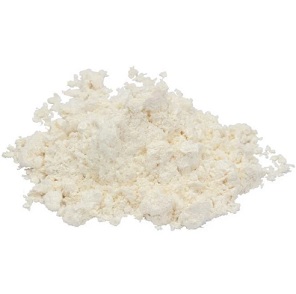
Bismuth oxychloride is a white Lustorus powder, It is an inorganic white pigment commonly used in foundations, blushes and other color cosmetics. Bismuth oxychloride usually comes in two forms: diamond and pearl finishes. The diamond is shimmery and the pearl is more matte.
Bismuth is the least toxic of its periodic table neighbors like lead, tin, antimony and polonium. Bismuth in itself is not safe for use in cosmetics, and must be refined and combined with other elements to produce bismuth oxychloride.
Bismuth occurs naturally, but in very small amounts. Most of the bismuth produced in the USA is as a by-product from refining lead, tin, copper, silver and gold ores.
Once the bismuth has been harvested, it is further refined through several processes to remove dangerous elements like lead. Then it is chlorinated, which gives us bismuth chloride (BiCl3). It still poses a severe risk at this point, smelling of hydrochloric acid. When bismuth chloride is combined with water, it starts to decompose and part of the chlorine is replaced by oxygen from the water. This process is called hydrolysis. The remaining compound is bismuth, chlorine and oxygen = Bismuth oxychloride.
|
| Questions And Answer | Back Directory | [Synthesis]
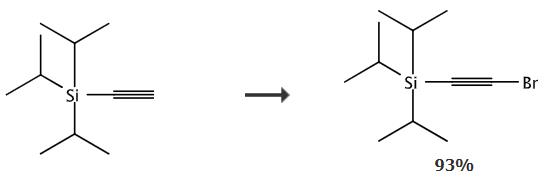
N-bromosuccinimide (3.2 gm, 18 mmol) and silver nitrate (252 mg, 1.5 mmol) were added to an alkyne (15 mmol) in a stirred solution of acetone (50 mL). The reaction mixture was stirred at room temperature for 3 hours. The reaction was quenched with cold water (50 mL) and extracted with n-pentane (100 mL x 3). The combined organic fractions were dried over anhydrous Na2SO4 and concentrated under reduced pressure. The crude product was purified by silica gel column chromatography (0.5% ethyl acetate in hexane solution) to give (2-bromoethynyl)triisopropylsilane. |
| Chemical Properties | Back Directory | [Boiling point ]
240.5±9.0 °C(Predicted) | [density ]
1.073±0.06 g/cm3(Predicted) | [refractive index ]
1.49 | [form ]
clear liquid | [color ]
Colorless to Red to Green | [InChI]
InChI=1S/C11H21BrSi/c1-9(2)13(8-7-12,10(3)4)11(5)6/h9-11H,1-6H3 | [InChIKey]
HNNUBQWDWJNURV-UHFFFAOYSA-N | [SMILES]
[Si](C#CBr)(C(C)C)(C(C)C)C(C)C | [CAS DataBase Reference]
111409-79-1 |
| Hazard Information | Back Directory | [Description]
(Bromoethynyl)triisopropylsilane is an important sterically hindered organosilicon protective agent, mainly used to protect various types of hydroxyl groups, especially in multifunctional hydroxyl compounds. It can be selectively protected and deprotected for the synthesis of nucleosides, nucleotides and sugar compounds. | [Uses]
(Bromoethynyl)triisopropylsilane could be used as an alkynylating reagen to synthesize the palladium-catalyzed primary amine-directed C(sp2)–H alkynylation of biaryl-2-amines[1].
| [References]
[1] Jiang, Guangbin et al. “Palladium-catalyzed primary amine-directed regioselective mono- and di-alkynylation of biaryl-2-amines?.” Chemical Communications 14 (2018): 1746–1749. |
|
| Company Name: |
Energy Chemical
|
| Telephone: |
400-0056266 |
| Website: |
www.energy-chemical.com |
| Company Name: |
Infinity SCI
|
| Telephone: |
400-106-2016 17800804092 |
| Website: |
http://www.infsci.com |
|