| Identification | Back Directory | [Name]
Secretin | [CAS]
17034-35-4 | [Synonyms]
SECRETIN
Secretine
Secretin【ox】
Secretin-Kabi
secretin acet
Secretin (pig)
Human Secretin
Secretin actate
SECRETIN ACETATE
Porcine secretin
SECRETIN, PORCINE
Secretin USP/EP/BP
SECRETIN, PORCINE (1-27)
Secretin Acetate , pcine
Secretin Acetate, porcine
Synthetic porcine secretin
Secretin porcine, ≥97% (HPLC)
HSDGTFTSELSRLRDSARLQRLLQGLV-NH2
SECRETIN HEXAASPARTATE, PORCINE
HSDGTFTSELSRLRDSARLQRLLQGLV-NH3
Secretin(trifluoroacetate salt)
SECRETIN HUMAN (27 AMINO ACIDS)
SECRETIN, PORCINE SYNTHETIC >97%
SECRETIN(TRIFLUOROACETATE SALT);
Secretin (porcine) Hydrochloride
SECRETIN PORCINE (27 AMINO ACIDS)
Secretin (porcine) Hydrochloride (GMP)
SECRETIN FROM PORCINE DUODENAL MUCOSA PA
secretin from porcine duodenal mucosa*partially P
HIS-SER-ASP-GLY-THR-PHE-THR-SER-GLU-LEU-SER-ARG-LEU-ARG-ASP-SER-ALA-ARG-LEU-GLN-ARG-LEU-LEU-GLN-GLY-LEU-VAL-NH2
H-HIS-SER-ASP-GLY-THR-PHE-THR-SER-GLU-LEU-SER-ARG-LEU-ARG-ASP-SER-ALA-ARG-LEU-GLN-ARG-LEU-LEU-GLN-GLY-LEU-VAL-NH2
H-HIS-SER-ASP-GLY-THR-PHE-THR-SER-GLU-LEU-SER-ARG-LEU-ARG-ASP-SER-ALA-ARG-LEU-GLN-ARG-LEU-LEU-GLN-GLY-LEU-VAL-NH3
HIS-SER-ASP-GLY-THR-PHE-THR-SER-GLU-LEU-SER-ARG-LEU-ARG-ASP-SER-ALA-ARG-LEU-GLN-ARG-LEU-LEU-GLN-GLY-LEU-VAL-NH2 PORCINE
H-His-Ser-Asp-Gly-Thr-Phe-Thr-Ser-Glu-Leu-Ser-Arg-Leu-Arg-Asp-Ser-Ala-Arg-Leu-Gln-Arg-Leu-Leu-Gln-Gly-Leu-Val-NH2 hydrochloride salt | [EINECS(EC#)]
241-105-3 | [Molecular Formula]
C130H220N44O41 | [MDL Number]
MFCD00133810 | [MOL File]
17034-35-4.mol | [Molecular Weight]
3055.41 |
| Questions And Answer | Back Directory | [Structure]
In 1970, the aa sequence of secretin was determined by
Mutt to be a polypeptide comprising 27 aa residues. Secretin belongs to the secretin/glucagon superfamily,
which shares significant structural and conformational
homology. The family includes the vasoactive intestinal
peptide (VIP), the pituitary adenylate cyclase activating
peptide (PACAP), the growth hormone-releasing hormone (GHRH), peptide histidine isoleucine (PHI) or peptide histidine methionine (PHM), glucagon, glucagon-like
peptide 1 (GLP-1), glucagon-like peptide 2 (GLP-2), and
the gastric inhibitory peptide (GIP). Secretin is highly
conserved among mammalian species, but the sequence
identity in nonmammalian species up to birds is lower
than in mammals. Secretin-like sequences
have not been found in teleost and lungfish genomes. Porcine secretin, Mr 3055; human secretin, 3039; chicken
secretin, 3073. Soluble in water, physiological saline solution, and aqueous organic solvents. Stable in dilute hydrochloric acid at -20°C, but unstable in aqueous solution.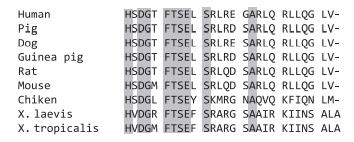 | [Gene, mRNA, and precursor]
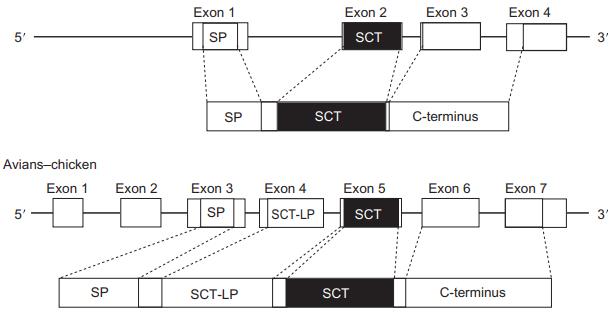
Human secretin is derived from a 121-aa residue secretin precursor consisting of a signal peptide, a short
N-terminal peptide, secretin, and a C-terminal peptide.
The human secretin precursor gene, SCT, location
11p15.5, consists of four exons, and the secretin coding
region is exon 2. The chicken SCT gene consists of seven exons. Exons 1 and 2 are noncoding, exon 4
encodes the secretin-like peptide, and exon 5 encodes the
secretin peptide.
 | [Synthesis and release]
Secretin is synthesized and secreted by S cells in the
small intestine, and neurons in the brain. Secretin release
is mainly stimulated by gastric acid delivered into the
duodenal lumen. In addition, secretin is released by
digested products of fat and protein. In canine duodenal
mucosal explants, somatostatin did not alter the basal
secretion of secretin but inhibited secretin secretion stimulated by pH 4.5. GABA stimulated both basal and
pH 4.5-induced secretin secretion. In the brain, the
estrogen-related receptor α upregulates the SCT promoter and gene expression. | [Receptors]
The receptor of secretin (SCTR) is a seventransmembrane GPCR that belongs to a subclass of the
family B . The human SCTR consists of 440
aa residues that contain a large N-terminal extracellular
domain. Cys residues and disulfide bonds in the extracellular domain have been suggested to play a key role in
agonist binding. The pathway is mainly coupled to the Gs protein.
Secretin activates adenylate cyclase and stimulates the
production of cAMP. | [Biological functions]
Using northern blotting analysis, human SCTR mRNA
was detected in the pancreas, intestine, colon, kidney,
lung, and liver. Secretin stimulates the secretion of bicarbonate, water, and electrolytes from the ductal epithelium. In the stomach, secretin acts as an enterogastrone
that inhibits gastric acid release and gastric emptying.
In the kidney, secretin regulates urine output and activates adenylyl cyclase in rats. In the brain, SCTR is widely
distributed in the hippocampus, central amygdala, thalamus, hypothalamus, posterior pituitary, cerebellum, and
medulla oblongata. Secretin regulates social interaction,
water and food intake, motor coordination, and spatial
and motor learning behaviors. The zebrafish secretin
receptor has been shown to be nonbioactive. | [Clinical implications]
The stimulatory effect of secretin on pancreatic secretion has been used in a range of clinical applications.
Zollinger-Ellison syndrome is caused by a gastrin-secreting tumor (gastrinoma), and the secretin test has
been used for the diagnosis of the syndrome. In the
secretin test, the gastrin level is raised after intravenous
secretin administration in Zollinger-Ellison syndrome
patients, but not in healthy individuals. Secretin is elevated in Zollinger-Ellison patients and in patients with
duodenal ulcers. Secretin levels are low in patients with
pernicious anemia and achlorhydria. A clinical trial of
secretin in autism has been carried out, but the clinical
efficacy remains unreliable. |
| Chemical Properties | Back Directory | [density ]
1.50±0.1 g/cm3(Predicted) | [storage temp. ]
2-8°C
| [solubility ]
H2O: soluble
| [form ]
powder
| [color ]
White to off-white | [Sequence]
His-Ser-Asp-Gly-Thr-Phe-Thr-Ser-Glu-Leu-Ser-Arg-Leu-Arg-Asp-Ser-Ala-Arg-Leu-Gln-Arg-Leu-Leu-Gln-Gly-Leu-Val-NH2 | [CAS DataBase Reference]
17034-35-4 |
| Hazard Information | Back Directory | [Description]
Secretin was the first hormone identified. It is a secretagogue of pancreatic digestive juices from the porcine duodenum, used to aid in the diagnosis of gastrinoma. Secretin was discovered by Bayliss and Starling in
1902 as a secretagogue of pancreatic juices from the porcine duodenum. It was the first hormone identified. | [Uses]
Stimulates pancreatic and gastric secretions to aid in the diagnosis of pancreatic exocrine dysfunction and the diagnosis of gastrinoma. | [Brand name]
SecretinKabi (KabiVitrum, Sweden). | [General Description]
Secretin is a 27-amino-acid polypeptide that is structurallysimilar to glucagon. The presence of acid in the small intestineis the most important physiological stimulus for the secretionof secretin. The primary action of secretin is on pancreatic acinarcells that regulate the secretion of water and bicarbonate.Secretin also promotes the secretion of pancreatic enzymes, toa lesser extent. Secretin inhibits the release of gastrin and,therefore, gastric acid. It also increases stomach-emptyingtime by reducing the contraction of the pyloric sphincter. | [Clinical Use]
Recombinant human secretin (SecreFlo, ChiRhoStim)
is approved for use in stimulating gastrin secretion to
aid in the diagnosis of gastrinoma. |
|
| Company Name: |
Jinan Putubio Tech Co., Ltd.
|
| Telephone: |
+86 (531) 8099-2215 |
| Website: |
www.chemicalbook.com/ShowSupplierProductsList16923/0_EN.htm |
|