| Identification | Back Directory | [Name]
Nitrosobenzene | [CAS]
586-96-9 | [Synonyms]
nob
Nitrosobenzol
NITROSOBENZENE
nitroso-benzen
benzene,nitroso-
1-Nitrosobenzene
Nitrosobenzene,NOB
Nitrosobenzene >=97% | [EINECS(EC#)]
209-591-1 | [Molecular Formula]
C6H5NO | [MDL Number]
MFCD00002059 | [MOL File]
586-96-9.mol | [Molecular Weight]
107.11 |
| Chemical Properties | Back Directory | [Appearance]
light yellow solid | [Melting point ]
65-69 °C(lit.)
| [Boiling point ]
59 °C18 mm Hg(lit.)
| [density ]
1.1697 (rough estimate) | [refractive index ]
1.5389 (estimate) | [storage temp. ]
2-8°C
| [solubility ]
Chloroform (Sparingly), Methanol (Slightly) | [form ]
Solid | [color ]
White to Brown | [Stability:]
Stable. Incompatible with strong oxidizing agents. | [BRN ]
605688 | [InChIKey]
NLRKCXQQSUWLCH-UHFFFAOYSA-N | [CAS DataBase Reference]
586-96-9 | [NIST Chemistry Reference]
Benzene, nitroso-(586-96-9) | [EPA Substance Registry System]
Nitrosobenzene (586-96-9) |
| Questions And Answer | Back Directory | [Synthesis]
Nitrosobenzene can be obtained by oxidation of aniline. 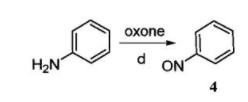
Aniline (2.043 g, 21.84 mmol) was added to a 250 mL round-bottom flask and dissolved in dichloromethane (50 mL). Potassium persulfate complex salt (27.378 g, 44.48 mmol) was dissolved in water (100 mL) and slowly added to the dichloromethane reaction solution. The reaction was stirred at room temperature, and the reaction solution gradually turned green. The reaction was monitored by TLC, and the reaction was stopped after 1 hour. The reaction solution was extracted with dichloromethane, and the dichloromethane phase was collected. The solvent was evaporated to dryness to obtain intermediate 4, i.e., Nitrosobenzene (green solid). |
| Hazard Information | Back Directory | [Chemical Properties]
light yellow solid | [Uses]
Spin trap reagent. Has been used in the study of oxidative DNA damage and nitroso-compound-induced respiratory burst in neutrophils3,4. | [Definition]
ChEBI: A nitroso compound that is the nitroso derivative of benzene; a diamagnetic hybrid of singlet O2 and azobenzene. | [storage]
Store at -20°C | [Purification Methods]
Steam distil nitrosobenzene, then crystallise it from a small volume of EtOH with cooling below 0o, dry it over CaCl2 in a dessicator at atmospheric pressure, and store it under N2 at 0o. Alternatively it can be distilled onto a cold finger cooled with brine at ~-10o in a vacuum at 17mm (water pump), while heating in a water bath at 65-70o [Robertson & Vaughan J Chem Educ 27 605 1950]. [Beilstein 5 IV 702.] |
|
| Company Name: |
J & K SCIENTIFIC LTD.
|
| Telephone: |
18210857532 18210857532 |
| Website: |
https://www.jkchemical.com |
| Company Name: |
Energy Chemical
|
| Telephone: |
400-0056266 18918157536; |
| Website: |
http://www.energy-chemical.com |
| Company Name: |
T&W GROUP
|
| Telephone: |
021-61551611 13296011611 |
| Website: |
www.trustwe.com/ |
|