| Identification | Back Directory | [Name]
dicarbonylcyclopentadienyl(dimethylsulfoniummethylide)iron | [CAS]
72120-26-4 | [Synonyms]
dicarbonylcyclopentadienyl(dimethylsulfoniummethylide)iron
Dicarbonyl(cyclopentadienyl)[(dimethylsulfonium)methyl]iron Tetrafluoroborate | [Molecular Formula]
C10H7BF4FeO2S | [MOL File]
72120-26-4.mol | [Molecular Weight]
333.87 |
| Chemical Properties | Back Directory | [Melting point ]
129-130 °C | [density ]
1.57 g cm-3 | [solubility ]
insol or slightly sol most solvents at rt; sol very polar solvents such as nitromethane at rt; sol other polar solvents (e.g. dioxane) at reflux. | [form ]
powder or crystals | [color ]
yellow-orange |
| Hazard Information | Back Directory | [Uses]
Dicarbonyl(cyclopentadienyl)[(dimethylsulfonium)methyl]iron Tetrafluoroborate is used as a stable precursor of a cationic carbene, or methylene, complex of iron; reacts directly with alkenes to give cyclopropanes.[1] | [Preparation]
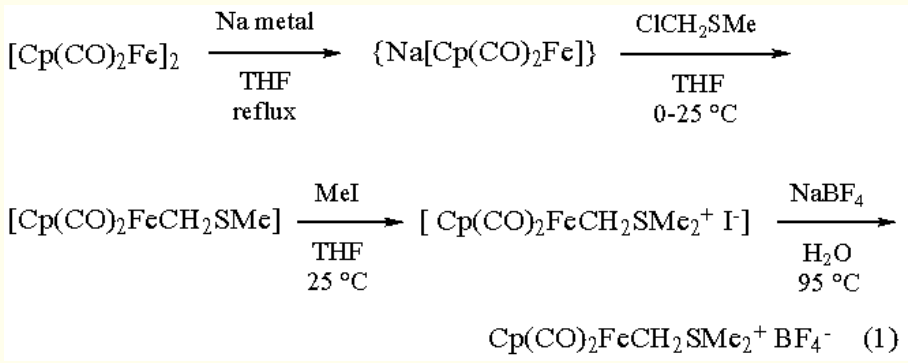
the preparation of Dicarbonyl(cyclopentadienyl)[(dimethylsulfonium)methyl]iron Tetrafluoroborate has gone through several revisions and improvements since its introduction in 1979. The most
recently improved preparations[2] are satisfactory for large-scale applications and have been adapted for commercial use. In a one-pot operation, the
stable, crystalline, dinuclear complex [Cp(CO)2Fe]2 is reductively cleaved with sodium dispersion to generate a THF solution of the highly
nucleophilic sodium ferrate, Na[Cp(CO)2Fe]. This species is immediately alkylated with chloromethyl methyl sulfide, and the resulting iron alkyl,
Cp(CO)2FeCH2SMe, is subjected to S-alkylation with methyl iodide. Finally, the resulting sulfonium salt, initially produced as an iodide, is subjected
to in situ anion exchange and simultaneous crystallization by treatment with hot aqueous NaBF4, followed by cooling to give the reagent as a yellow-orange, or amber-colored, crystalline solid (eq 1) which has been characterized spectroscopically and by single-crystal X-ray diffraction.[3] The anion
exchange is performed in order to assure that a nonnucleophilic counterion is present during the subsequent cyclopropanation reactions; a nucleophilic
anion such as iodide may apparently intercept reactive intermediates on the pathway leading to the desired cyclopropane products. A remarkable
property of the reagent is its unusually high stability compared to most other organometallic reagents. This point is especially clear from the fact that it
can be recrystallized from hot water exposed to the air.
 | [storage]
Dicarbonyl(cyclopentadienyl)[(dimethylsulfonium)methyl]iron Tetrafluoroborate is stable indefinitely as a solid, even when exposed to air; slowly decomposes in solution if exposed to air for long
periods of time (although reactions with alkenes can be done in the presence of air and even moisture); decomposes upon heating to release dimethyl
sulfide (stench). Use in a fume hood.
| [Purification Methods]
Dicarbonyl(cyclopentadienyl)[(dimethylsulfonium)methyl]iron Tetrafluoroborate is recrystallised from nitromethane, acetone, or other polar solvents. | [References]
1. (a) Brandt, S.; Helquist, P. JACS 1979, 101, 6473. (b) O'Connor, E. J.; Brandt, S.; Helquist, P. JACS 1987, 109, 3739.
2. (a) Mattson, M. N.; Bays, J. P.; Zakutansky, J.; Stolarski, V.; Helquist, P. JOC 1989, 54, 2467. (b) Mattson, M. N.; O'Connor, E. J.; Helquist, P. OS 1992, 70,
177.
3. O'Connor, E. J. Helquist, P. JACS 1982, 104, 1869. |
|
|