| Identification | Back Directory | [Name]
Chlorinated rubber | [CAS]
9006-03-5 | [Synonyms]
khkvv
CR-10
kch749
kch770
kch771
parlon
pergut
kch1116
adekacr5
parlons5
rabal100
rabal100p
parlons20
perguts10
perguts20
perguts40
perguts90
parlons10
alloprene
adekacr10
adekacr20
adekacr40
chlortex20
chlortex40
c-raban1hb
hardlen15l
adekacr150
parlons125
parlons300
parlon300cp
nbcoatcr503
alloprener10
alloprener20
alloprener40
chlorofans10
superchlonecr5
superchlonecr10
superchlonecr20
adbond1000clear
RUBBER CHLORINATED
Chlorinated rubber
POLYISOPRENE, CHLORINATED
Chlorinated natural rubber
Chlorinated rubber anticorrosive paint
Chlorinated rubber anti-corrosion paint
chlorinated rubber - carbon tetrachloride free | [Molecular Formula]
[C10H11Cl7]n | [MDL Number]
MFCD00677789 |
| Chemical Properties | Back Directory | [Definition]
An elastomer (natural
rubber or a polyolefin) to which 65% of chlorine
has been added to give a solid, film-forming resin.
White, amorphous powder available in viscosity
grades from 5 to 125 c P, the figures indicating vis-
cosity of a 20% solution in tol | [density ]
1.43-1.50 | [Fp ]
135-140°C (dec.) | [EPA Substance Registry System]
Rubber, chlorinated(9006-03-5) |
| Hazard Information | Back Directory | [Hazard]
Do not dry-mill chlorinated rubber with
zinc oxide; mixture reacts violently at 216C. Do
not use in baked enamels.
| [Chemical Properties]
Chlorinated rubber is typically prepared by treating a solution of masticated
natural rubber in chloroform or carbon tetrachloride with chlorine at
80-100°C until sampling indicates the product has a chlorine content of
about 65%. During this time, hydrogen chloride is evolved. After the passage
of chlorine has been stopped, the solution is refluxed until the evolution of hydrogen chloride ceases; this results in a product of good stability. The
chlorinated rubber is then isolated by precipitation with methanol. | [Uses]
Chlorinated rubber is used for rust and corrosion prevention of steel products. It is widely used in anti-corrosion coatings and various strong adhesives. It can also be used as an impact modifier, permanent plasticizer, cold-resistant additive for polyethylene plastics, flame retardant for polyolefins, and modifier for various rubber compounds. | [Preparation]
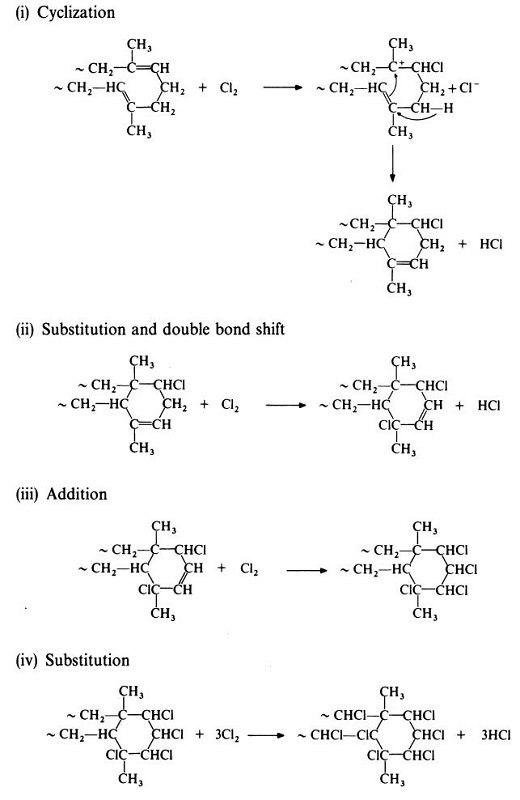
The reaction of natural rubber and chlorine is complex and possibly
involves the following sequence£o
|
|
| Company Name: |
Rhawn Reagent
|
| Telephone: |
400-400-1332688 18019345275 |
| Website: |
http://www.rhawn.cn |
| Company Name: |
Wuhan canos Technology Co., Ltd
|
| Telephone: |
027-83238443 15327105076 |
| Website: |
https://www.chemicalbook.com/ShowSupplierProductsList134838/0_EN.htm |
|