215030-90-3
中文名称
4-[(1E)-2-[5,6-Dihydro-5,5-dimethyl-8-(2-phenylethynyl)-2-naphthalenyl]ethenyl]benzoicacid
英文名称
4-[(1E)-2-[5,6-Dihydro-5,5-dimethyl-8-(2-phenylethynyl)-2-naphthalenyl]ethenyl]benzoicacid
CAS
215030-90-3
分子式
C29H24O2
分子量
404.5
MOL 文件
215030-90-3.mol
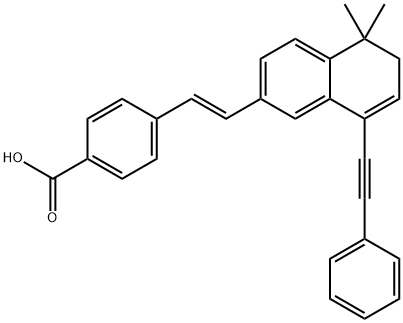 215030-90-3 结构式

基本信息
中文别名
化合物 T14689 英文别名
BMS 493BMS204, 493
4-[(1E)-2-[5,6-Dihydro-5,5-dimethyl-8-(2-phenylethynyl)-2-naphthalenyl]ethenyl]benzoicacid
4-[(1E)-2-[5,6-Dihydro-5,5-dimethyl-8-(phenylethynyl)-2-naphthalenyl]ethenyl]-benzoic acid
(E)-4-[2-[5,6-Dihydro-5,5-dimethyl-8-(2-phenylethynyl)naphthalen-2-yl]ethen-1-yl]benzoic acid
Benzoic acid, 4-[(1E)-2-[5,6-dihydro-5,5-dimethyl-8-(2-phenylethynyl)-2-naphthalenyl]ethenyl]-
物理化学性质
沸点605.4±55.0 °C(Predicted)
密度1.21±0.1 g/cm3(Predicted)
储存条件2-8°C
溶解度二甲基亚砜:≥20mg/mL
酸度系数(pKa)4.27±0.10(Predicted)
形态粉末
颜色淡黄色至黄色
InChI1S/C29H24O2/c1-29(2)19-18-24(14-10-21-6-4-3-5-7-21)26-20-23(13-17-27(26)29)9-8-22-11-15-25(16-12-22)28(30)31/h3-9,11-13,15-18,20H,19H2,1-2H3,(H,30,31)/b9-8+
InChIKeyYCADIXLLWMXYKW-CMDGGOBGSA-N
SMILESCC1(C)CC=C(C#Cc2ccccc2)c3cc(\C=C\c4ccc(cc4)C(O)=O)ccc13
常见问题列表
生物活性
BMS493 是一种反向泛视黄酸受体 (RARs) 激动剂。BMS493 增加了 RARs 与核共抑制因子的相互作用,还可阻止视黄酸诱导的分化。靶点
|
RAR
|
体外研究
BMS493 (100 nM; 6 days; ALDHhi UCB cells) treatment shows a twofold increase in the number of ALDHhi cells available for transplantation compared with untreated controls. Newly expanded ALDHhi cells shows increased numbers of CD34 and CD133-positive cells, as well as a reduction in CD38 expression, a marker of hematopoietic cell differentiation.
Cell Viability Assay
| Cell Line: | ALDHhi UCB cells |
| Concentration: | 100 nM |
| Incubation Time: | 6 days |
| Result: | Showed a twofold increase in the number of ALDHhi cells available for transplantation compared with untreated controls. |
体内研究
Intrapancreatic transplantation of cell progeny after expansion of ALDHhi cells with or without BMS493 shows no reduction of hyperglycemia in Streptozotocin-treated NOD/SCID mice. Thus, Umbilical cord blood (UCB)-derived ALDHhi cells effectively lost islet regenerative capacity during ex vivo expansion.