26046-90-2
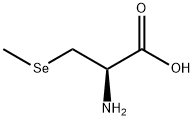 26046-90-2 结构式

基本信息
甲基硒代半胱胺酸
3-甲基硒代-L-丙氨酸
3-(甲基硒基)-L-丙氨酸
SE-甲基硒代-L-半胱氨酸
SE-(甲基)硒基-L-半胱氨酸
3-(甲基硒基)-L-氨基丙羧酸
3-甲基硒代-L-D-Α-氨基羧酸
SE-(甲基)硒基-L-半胱氨酸
METHYLSELENO-L-CYSTEINE
L-Se-Methylselenocysteine
SE-METHYLSELENO-L-CYSTEINE
3-(METHYLSELENO)-L-ALANINE
3-(Methylselanyl)-L-alanine
SELENIUMMETHYLSELENOCYSTEINE
SE-METHYLSELENO-L-CYSTEINE 98%
Se-methylseleno-L-cysteine,98%
L- selenium - methyl selenocysteine
物理化学性质
安全数据


常见问题列表
3-(甲基硒基)-L-丙氨酸又叫L-硒甲基硒代半胱氨酸,常用作硒营养强化剂。它是第21种人体必需氨基酸—L-硒代半胱氨酸的硒甲基化衍生物,它广泛存在于黄芪、大蒜、洋葱和椰菜等植物以及富硒酵母中,具有化学结构明确、毒性小、生物利用率高、补硒效果好等优点,不仅对多种肿瘤(如乳腺癌,前列腺癌,肝癌等)有预防作用,而且对癌症治疗有辅助作用,具有广阔的应用前景。
2002年,硒-甲基硒代半胱氨酸被美国FDA认定为最新一代硒源类饮食补充剂;2009年3-(甲基硒基)-L-丙氨酸被我国卫生部批准为新型营养强化剂(食品添加剂新品种2009年第11号公告)。
L‑硒‑甲基硒代半胱氨酸是第三代有机硒营养强化剂,天然含硒氨基酸,高纯白色结晶粉末,水溶性好、生物利用度高、安全性优。
2-氨基-3-甲基硒基丙酸是DMBA诱导的乳腺肿瘤的抑制剂。
L‑硒‑甲基硒代半胱氨酸分子结构明确、生物利用率远优于无机硒和酵母硒,无需体内转化即可直接参与硒蛋白合成。它代谢路径清晰、不易在体内蓄积,安全性更高适合长期应用,同时理化性质稳定、耐高温耐加工,适配食品、保健品、饲料等多类生产工艺;产品纯度高、杂质与重金属控制严格,水溶性好、配方兼容性强,兼具抗氧化、增强免疫、护肝调理等多重功效,是高端富硒功能性产品升级的优选硒原料。
Se-Methylselenocysteine (100-400 μM; 3 days) induces apoptosis in SKOV-33 cells.
Se-Methylselenocysteine (100-400 μM; 3 days) induces caspase-3 mediated apoptosis.
Apoptosis Analysis
| Cell Line: | SKOV-3 cells |
| Concentration: | 100, 200, 400 μM |
| Incubation Time: | 3 days |
| Result: | Resulted in a markedly increased accumulation of Sub-G1 phase, which occurred in both SeMSC concentration and culture time-dependent. |
Western Blot Analysis
| Cell Line: | SKOV-3 cells |
| Concentration: | 100, 200, 400 μM |
| Incubation Time: | 3 days |
| Result: | Resulted in a decrease in the expression of the 32 kDa form of procaspase-3. |
L-硒-甲基硒代半胱氨酸应用场景十分广泛,可作为食品营养强化剂添加于富硒谷物、乳制品、饮品及调味品中,也常用于保健食品、特医膳食、中老年营养制剂的原料配制。它也可作为高端饲料添加剂用于畜禽水产养殖,提升机体免疫与养殖效益,还可应用于医药中间体、生化试剂及抗氧化配方研发,凭借水溶性好、稳定性强、合规性高的特点,适配固体压片、液态口服液、膨化加工等多种生产剂型。
Se-Methylselenocysteine (0.2 mg/mouse; p.o.; daily for 14 days) potentiates the antitumour activity of CDDP and Cyclophosphamide in nude mice bearing human FaDu and A253 head and neck xenografts.
Alzheimer's disease (AD) mice are treats with Se-Methylselenocysteine (0.75 mg/kg BW per day) in their drinking water for 10 months. Se-Methylselenocysteine reduces oxidative stress and neuro-inflammation; Se-Methylselenocysteine modulates the distribution and levels of several metal ions; Se-Methylselenocysteine decreases amyloid-β peptide (Aβ) generation by inhibiting the expression of its precursor protein APP and β-secretase (BACE1), and attenuates tau hyperphosphorylation and neurofibrillary tangles (NFT) formation via promoting protein phosphatase 2A (PP2A) activity, thereby preserving synaptic proteins and neuron activities and finally improving spatial learning and memory deficits in AD model mice.
| Animal Model: | Female athymic nude mice (bearing human A253 and FaDu squamous cell carcinoma xenografts) |
| Dosage: | 0.2 mg/mouse |
| Administration: | p.o.; daily for 14 days (7 days before and 7 days after Cyclophosphamide or CDDP in a total of 14 days) |
| Result: |