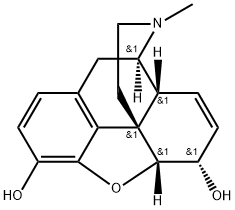

基本信息
中文别名
吗啡假嗎啡
吗啡杂质
嗎啡[鹼]
吗啡 溶液
甲醇(吗啡)
盐酸吗啡杂质
盐酸吗啡杂质(6个)
甲醇测试标样(吗啡)
英文别名
rmshocus
morph
morpho
msemma
dreamer
Morfina
Morphia
Morphin
roxanol
所属类别
生物化工:中草药成分物理化学性质
熔点255°C
沸点427.77°C (rough estimate)
密度1.0864 (rough estimate)
折射率1.5400 (estimate)
闪点11 °C
储存条件−20°C
溶解度乙醇(微溶)、甲醇(微溶)
酸度系数(pKa)8.21(at 25℃)
形态固体
颜色白色至淡黄色
水溶解性0.4mg/L(25 ºC)
BCS Class1,3
主要应用forensics and toxicology
InChI1S/C17H19NO3/c1-18-7-6-17-10-3-5-13(20)16(17)21-15-12(19)4-2-9(14(15)17)8-11(10)18/h2-5,10-11,13,16,19-20H,6-8H2,1H3/t10-,11+,13-,16-,17-/m0/s1
InChIKeyBQJCRHHNABKAKU-KBQPJGBKSA-N
SMILESCN1CC[C@]23[C@H]4Oc5c(O)ccc(C[C@@H]1[C@@H]2C=C[C@@H]4O)c35
CAS 数据库57-27-2
安全数据


警示词危险
危险品标志F,T
安全说明7-16-36/37-45
危险品运输编号UN 1230 3/PG 2
WGK Germany2
REACH 注册登记Active
存储类别3 - Flammable liquids
危险性类别Acute Tox. 3 Dermal
Acute Tox. 3 Inhalation
Acute Tox. 3 Oral
Flam. Liq. 2
STOT SE 1
Acute Tox. 3 Inhalation
Acute Tox. 3 Oral
Flam. Liq. 2
STOT SE 1
毒性An alkaloid of the opium poppy that
makes up between 9% and 14% of good grades of opium.
Morphine is usually used clinically as an analgesic in the form
of the sulfate or hydrochloride salt. The most important acute
toxic effect of large doses of morphine is depression of the
respiratory centers in the medulla and pons. Morphine and
related drugs also cause somnolence, coma, cold clammy skin,
bradycardia, and hypotension. Initial doses of morphine seem
to stimulate the chemoreceptor trigger zone to induce emesis,
with subsequent doses blocking the vomiting center, hence
blocking emesis. Morphine also has profound effects on the
gastrointestinal tract, increasing the tone of the intestinal tract,
but decreasing the propulsive or spasmodic reflexes, thus
resulting in constipation. Morphine stimulates the nucleus of
the third cranial nerve to produce miosis, making pinpoint
pupil a diagnostic sign both in morphine overdose and
morphine addiction. Morphine causes a variety of effects on
the CNS and is highly addictive. Many behavioral changes are
seen, ranging from euphoria to sedation. These behavioral
effects contribute to the problem of abuse with all of the opiates.
Tolerance and dependence occur with repeated dosing,
with increasingly larger doses being needed to obtain the original
effect. Abrupt withdrawal after chronic use can lead to
physiological rebound in these same systems. Therapy for
acute overdosage involves physiological support (establishment
of adequate respiratory exchange), gastric lavage, and use of
narcotic antagonists. Morphine and related compounds act by
binding to specific high-affinity receptors concentrated in the
nervous system, but also located elsewhere in the body. In the
nervous system, the endogenous ligands for these morphine
receptors are the opioid peptides that include the enkephalins,
endorphins, and dynorphins. The multiple and complex actions
of morphine are due, in part, to the fact that it acts as an agonist
at many of these classes of receptors. Paregoric (camphorated
tincture of opium) is used as an antidiarrheal. Paregoric is
a schedule III drug under the US Controlled Substances Act
and may produce physical dependence.