


Ferulic Acid
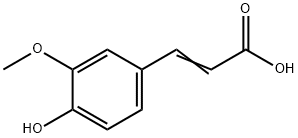
- CAS No.
- 1135-24-6
- Chemical Name:
- Ferulic Acid
- Synonyms
- Ferulate;4-HYDROXY-3-METHOXYCINNAMIC ACID;Ferulic;3-METHOXY-4-HYDROXYCINNAMIC ACID;FERULLIC ACID;ferulaic acid;erulic Acid;Forulic acid;FERULIC ACID pure;TIMTEC-BB SBB000326
- CBNumber:
- CB0337151
- Molecular Formula:
- C10H10O4
- Molecular Weight:
- 194.18
- MOL File:
- 1135-24-6.mol
- MSDS File:
- SDS
- Modify Date:
- 2026/10/10 22:43:55
| Melting point | 168-172 °C(lit.) |
|---|---|
| Boiling point | 250.62°C (rough estimate) |
| Density | 1.316(20.0000℃) |
| vapor pressure | 0Pa at 25℃ |
| refractive index | 1.5168 (estimate) |
| storage temp. | 2-8°C |
| solubility | DMSO (Slightly), Methanol (Slightly) |
| form | powder |
| pka | 4.58±0.10(Predicted) |
| color | slightly yellow |
| Water Solubility | soluble |
| Cosmetics Ingredients Functions |
ANTIOXIDANT ANTIMICROBIAL |
| InChIKey | KSEBMYQBYZTDHS-HWKANZROSA-N |
| LogP | 1.51 |
| CAS DataBase Reference | 1135-24-6(CAS DataBase Reference) |
| NIST Chemistry Reference | Cinnamic acid, 4-hydroxy-3-methoxy-(1135-24-6) |
| EPA Substance Registry System | Ferulic acid (1135-24-6) |
SAFETY
Risk and Safety Statements
| Symbol(GHS) |  GHS07 |
|||||||||
|---|---|---|---|---|---|---|---|---|---|---|
| Signal word | Warning | |||||||||
| Hazard statements | H315-H319-H335 | |||||||||
| Precautionary statements | P305+P351+P338 | |||||||||
| Hazard Codes | Xi | |||||||||
| Risk Statements | 36/37/38 | |||||||||
| Safety Statements | 26-36-37/39 | |||||||||
| WGK Germany | 3 | |||||||||
| RTECS | UD3365500 | |||||||||
| TSCA | TSCA listed | |||||||||
| HazardClass | IRRITANT | |||||||||
| HS Code | 29162090 | |||||||||
| Hazardous Substances Data | 1135-24-6(Hazardous Substances Data) | |||||||||
| Toxicity | mouse,LD,intraperitoneal,> 350mg/kg (350mg/kg),BEHAVIORAL: CHANGES IN MOTOR ACTIVITY (SPECIFIC ASSAY)BEHAVIORAL: ATAXIABEHAVIORAL: REGIDITY,Indian Journal of Pharmaceutical Sciences. Vol. 49, Pg. 77, 1987. | |||||||||
| REACH Registrations | Active | |||||||||
| NFPA 704 |
|
Ferulic Acid price More Price(8)
| Manufacturer | Product number | Product description | CAS number | Packaging | Price | Updated | Buy |
|---|---|---|---|---|---|---|---|
| Sigma-Aldrich(India) | 90034 | 4-Hydroxy-3-methoxycinnamic acid mixture of isomers, analytical standard | 1135-24-6 | 100MG | ₹7696.58 | 2022-06-14 | Buy |
| ottokemi | H 1638 | 4-Hydroxy-3-methoxycinnamic acid, mixture of isomers 98% | 1135-24-6 | 100gm | ₹5301 | 2022-05-26 | Buy |
| SRL | 60096 | Ferulic Acid pure, 98% | 1135-24-6 | 5Gms | ₹830 | 2022-05-26 | Buy |
| ottokemi | H 1634 | 4-Hydroxy 3-methoxy cinnamic acid 98% | 1135-24-6 | 1gm | ₹2007 | 2022-05-26 | Buy |
| ottokemi | H 1638 | 4-Hydroxy-3-methoxycinnamic acid, mixture of isomers 98% | 1135-24-6 | 1gm | ₹47097 | 2022-05-26 | Buy |
Ferulic Acid Chemical Properties,Uses,Production
Description
Ferulic acid is widely found in plants, especially in artichoke, eggplant and corn bran. In addition, it is also present in a variety of Chinese herbal medicines, such as angelica, dome, motherwort, snow ganoderma lucidum and so on.
Chemical Properties
Ferulic acid is a pale yellow solid, It belongs to the family of hydroxycinnamic acids. It is an abundant phenolic phytochemical found in plant cell wall components. Natural sources of ferulic acid are leaves and seeds of many plants, such as cereals, coffee, apples, artichokes, peanuts, oranges, pineapples and wine.
Physical properties
Appearance: light yellow crystalline powder. Solubility: slightly soluble in cold water; soluble in hot water, with poor stability in aqueous solution; easily decomposed when encounter light; soluble in ethanol and ethyl acetate; slightly soluble in ether; insoluble in benzene and petroleum ether. Melting point: 170–173°C.
History
Ferulic acid was first isolated from the medicinal plants ferulic in 1866. The biologi_x005fcal activity of ferulic acid was not revealed until 1957 when the pioneering study of Preziosi P in Italy showed for the first time the efficacy of ferulic acid in regulating blood lipids and diuretic . In 1979, Lin Mao and others isolated ferulic acid from the Chinese medicine angelica and reported that ferulic acid had the inhibitory effect on platelet aggregation . Since then, more and more medicinal efficacy of ferulic acid has gradually been recognized.
Uses
ferulic acid is a plant-derived anti-oxidant and free-radical scavenger, it protects the skin against uVB-induced redness. When incorporated into formulas with ascorbic acid and tocopherol, ferulic acid can improve their stability and double the photoprotection capacities offered by the formulation. In clinical studies, ferulic acid exhibits good permeation capacities through the stratum corneum, which can be attributed to its lipophilic properties.
Definition
A plant growth inhibitor.
Indications
This product is mainly used for the treatment of atherosclerosis, coronary heart disease and ischemic cerebrovascular disease.
Pharmacology
Orally administered ferulic acid completely prevents the formation of skin tumors, reverts the status of phase I and phase II detoxication agents, lipid peroxidaton byproducts and antioxidants to near-normal ranges in 7,12-DMBA-treated mice (Alias et al., 2009). The observation demonstrate that orally administered ferulic acid has potent suppressive effects on cell proliferation during DMBA-induced skin carcinogenesis.
Ferulic acid also has the capacity to prevent UV-induced damage to cells. Ferulic acid is often added as an ingredient to anti-aging supplements. When ferulic acid was incorporated into a formulation of α-tocopherol and/or ascorbic acid, the topical delivery of the vitamins was improved. There was enhanced chemical stability and the photoprotection to solar-simulated irradiation doubled (Lin et al., 2005; Cassano et al., 2009). For example, Murray et al. (2008) applied a stable topical formulation (containing 1% α-tocopherol, 15% L-ascorbic acid, and 0.5% ferulic acid) to normalappearing human skin and a pig skin model. These were then irradiated with solar-simulated UV. The results showed the complex of antioxidants provided substantial UV photoprotection against erythema, sunburnt cells, thymine dimmers, p53 as well as UV-induced cytokine formation including IL-1α, IL-6, IL-8, and IL-10, and TNF-α (Murray et al., 2008).
Pharmacokinetics
In clinical practice, Honghua and clopidogrel are often combined with FA-containing herbs to treat cardiovascular disease. Li et al. found that Ferulic acid (FA) was rapidly absorbed with a low bioavailability after a single oral administration. The pharmacokinetics profile of FA in rats was partly altered by the coadministration of FA with Honghua or clopidogrel. FA was rapidly absorbed following oral administration with a mean time to peak plasma concentration (T(max)) of 0.03 h. The corresponding maximum plasma concentration (C(max)) and the area under the concentration-time curve (AUC) were 8174.55 ng/L and 2594.45 h ng/mL, respectively. Coadministration of Honghua and clopidogrel resulted in a 63.5% and 79.7% increase in the AUC, respectively. The C(max) of FA was significantly increased by coadministration with clopidogrel (74.3%, p<0.01). Moreover, the T(max) of FA when coadministered with Honghua or clopidogrel was 3 and 3.76 times slower than when administered alone. The coadministrations also altered other pharmacokinetic parameters estimated for FA, but no statistically significant differences were observed[1].
Clinical Use
At present, there are sodium ferulate tablets and ferulic acid injection used in clinic.
Sodium ferulate tablets are mainly used for the adjuvant therapy of atherosclerosis,
coronary heart disease, cerebrovascular disease, glomerular disease, pulmonary
hypertension, diabetic vascular disease, vasculitis and other vascular disorders.
Ferulic acid can also be used for the treatment of migraine headache and vascular
headache. Ferulic acid injection is mainly used for the treatment of ischemic cardiovascular and cerebrovascular disease. In addition, sodium ferulate combined with
atorvastatin can be used for the treatment of pulmonary hypertension, diabetic
nephropathy and chronic glomerulonephritis in clinic .
Ferulic acid is also used in combination with other drugs to treat other diseases.
Side effects
Ferulic acid serums and creams are generally safe for most skin types. However, it's not safe for everyone.
Sensitive skin. This can cause: Mild redness, Irritation.
Allergic to bran or oatmeal. People may also have an allergy to ferulic acid serums derived from bran or oats. Symptoms tend to be mild and may include: Redness, Swelling, Itching, Rash, and Peeling.
Purification Methods
Crystallise ferulic acid from H2O. [Beilstein 10 H 436, 10 IV 1776.]
References
[1] Wang, Mi Ningsheng . "Pharmacokinetics of ferulic acid and potential interactions with Honghua and clopidogrel in rats." Journal of Ethnopharmacology (2011).
Ferulic Acid Preparation Products And Raw materials
Raw materials
1of2
chevron_rightPreparation Products
1of2
chevron_right| Supplier | Tel | Country | ProdList | Advantage | Inquiry |
|---|---|---|---|---|---|
| GLR Innovations | +91 9891111994 | Beijing, India | 4525 | 58 | Inquiry |
| Vidya Herbs Pvt Ltd | +91 80 4172 2212 | Beijing, India | 164 | 58 | Inquiry |
| Biomed Ingredients Pvt Ltd | +91 8806668458 | Beijing, India | 247 | 58 | Inquiry |
| Vardhaman P Golechha | 9704422000 | Telangana, India | 292 | 58 | Inquiry |
| chakrachem Lifesciences | +91 9902744663 | Hyderabad, India | 451 | 58 | Inquiry |
| Dr. ASCRO Bio Sciences Private Limited | +undefined-7382260502 +undefined-+91 9182680914 | Telangana, India | 51 | 58 | Inquiry |
| Madin Life Sciences Pvt Ltd | +91-9014759900 | Telangana, India | 230 | 58 | Inquiry |
| Laurus Labs Ltd | +91-4066594333 +91-4039804333 | Telangana, India | 50 | 58 | Inquiry |
| VASIN BIO LIFE SCIENCES PVT LTD | 9491644688 | Hyderabad, India | 2090 | 58 | Inquiry |
| Alkali Metals Ltd. | 91-40-23445961 | Hyderabad, India | 285 | 58 | Inquiry |
| Supplier | Advantage |
|---|---|
| GLR Innovations | 58 |
| Vidya Herbs Pvt Ltd | 58 |
| Biomed Ingredients Pvt Ltd | 58 |
| Vardhaman P Golechha | 58 |
| chakrachem Lifesciences | 58 |
| Dr. ASCRO Bio Sciences Private Limited | 58 |
| Madin Life Sciences Pvt Ltd | 58 |
| Laurus Labs Ltd | 58 |
| VASIN BIO LIFE SCIENCES PVT LTD | 58 |
| Alkali Metals Ltd. | 58 |
Related articles
- Antithrombotic effects, mechanisms and side effects of Ferulic Acid
- Ferulic Acid (FA) is an important polyphenol found in many traditional Chinese medicines (e.g., Ligusticum chuanxiong and Radi....
- Jan 9,2025
- Ferulic Acid: An Overview of Its Synthesis, Composition, Applications, and Storage
- Ferulic acid, a key phenolic compound, plays a crucial role in the biosynthesis of plant cell walls.
- Nov 20,2024
- The performance of ferulic acid
- Ferulic acid (F.A) is a derivative of cinnamic acid (cinnamic acid) with the chemical name 4-hydroxy-methoxycinnamic acid
- Feb 22,2022
Related Qustion
- Q:Is ferulic acid the same as vitamin C?
- A:
- Mar 27,2026
1135-24-6(Ferulic Acid)Related Search:
1of4
chevron_right