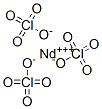
form :Liquid Water Solubility :Insoluble in water. CAS DataBase Reference :17522-69-9
Safety Information
Symbol(GHS):
Signal word:
Hazard statements:
Code
Hazard statements
Hazard class
Category
Signal word
Pictogram
P-Codes
H272
May intensify fire; oxidizer
Oxidising liquids;Oxidising solids
Category 2 Category 3
Danger Warning
P210, P220, P221P280, P370+P378,P501
H315
Causes skin irritation
Skin corrosion/irritation
Category 2
Warning
P264, P280, P302+P352, P321,P332+P313, P362
H319
Causes serious eye irritation
Serious eye damage/eye irritation
Category 2A
Warning
P264, P280, P305+P351+P338,P337+P313P
H335
May cause respiratory irritation
Specific target organ toxicity, single exposure;Respiratory tract irritation
Category 3
Warning
Precautionary statements:
P220
Keep/Store away from clothing/…/combustible materials.
P221
Take any precaution to avoid mixing with combustibles/…
P305+P351+P338
IF IN EYES: Rinse cautiously with water for several minutes. Remove contact lenses, if present and easy to do. Continuerinsing.
P405
Store locked up.
Description
Neodymium(III) perchlorate used in the preparation of complexes of phosphine oxides. Two three-dimensional frameworks composed of doubly interpenetrating networks of the same topology but different stereoisomeric structures have been constructed from self-assembly of the chiral building block, Δ- or Λ-[Nd(ntb)2]3+.
All products displayed on this website are only for non-medical purposes such as industrial applications or scientific research, and cannot be used for clinical diagnosis or treatment of humans or animals. They are not medicinal or edible.
According to relevant laws and regulations and the regulations of this website, units or individuals who purchase hazardous materials should obtain valid qualifications and qualification conditions.