| Company Name: |
Alfa Aesar |
| Tel: |
400-6106006 |
| Email: |
saleschina@alfa-asia.com |
| Company Name: |
Energy Chemical |
| Tel: |
400-0056266 |
| Email: |
sales8178@energy-chemical.com |
- Ethyl caproate
-
- $5.00
-
2026-10-10
- CAS:123-66-0
- Min. Order: 1kg
- Purity: ≥98%
- Ethyl Hexanoate
-
- $5.00
-
2026-05-28
- CAS:123-66-0
- Min. Order: 1KG
- Purity: 99%
- Supply Ability: 10000kg
- Ethyl Hexanoate
-

- $1.50
-
2026-05-15
- CAS:123-66-0
- Min. Order: 1g
- Purity: 99.0% Min
- Supply Ability: 100 Tons
|
| Product Name: | Ethyl Hexanoate | | Synonyms: | Caproic acid ethyl;esterHexanoic acid,ethyl ester;CAPROIC ACID ETHYLESTER WITH GC;Caproic acid ethyl ester, Ethyl caproate;Hexanoic acid ethyl;2-Ethylhexanoic acidanion;Ethyl hexanoate,Caproic acid ethyl ester, Ethyl caproate;ethyl caproate ,ethyl hexoate。 | | CAS: | 123-66-0 | | MF: | C8H16O2 | | MW: | 144.21 | | EINECS: | 204-640-3 | | Product Categories: | | | Mol File: | 123-66-0.mol | 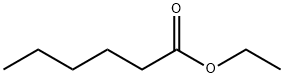 |
| | Ethyl Hexanoate Chemical Properties |
| Melting point | -67°C | | Boiling point | 168 °C (lit.) | | density | 0.869 g/mL at 25 °C (lit.) | | vapor density | 5 (vs air) | | vapor pressure | 4hPa at 25℃ | | FEMA | 2439 | ETHYL HEXANOATE | | refractive index | n20/D 1.407 | | Fp | 121 °F | | storage temp. | Flammables area | | solubility | 0.63g/l | | form | Liquid | | color | Clear colorless | | Odor | at 1.00 % in dipropylene glycol. sweet fruity pineapple waxy green banana | | Odor Type | fruity | | biological source | synthetic | | explosive limit | 0.9%(V) | | Water Solubility | INSOLUBLE | | Thermal Conductivity | 0.137 W/(m·K) at 25 ℃ | | JECFA Number | 31 | | Merck | 14,3777 | | BRN | 1701293 | | Henry's Law Constant | 1.9×10⁻² mol/(m3Pa) at 25℃, Plyasunov et al. (2004) | | Dielectric constant | 4.5700000000000003 | | Cosmetics Ingredients Functions | PERFUMING | | InChI | 1S/C8H16O2/c1-3-5-6-7-8(9)10-4-2/h3-7H2,1-2H3 | | InChIKey | SHZIWNPUGXLXDT-UHFFFAOYSA-N | | SMILES | CCCCCC(=O)OCC | | LogP | 2.96 at 22.4℃ | | CAS DataBase Reference | 123-66-0(CAS DataBase Reference) | | NIST Chemistry Reference | Hexanoic acid, ethyl ester(123-66-0) | | EPA Substance Registry System | Ethyl hexanoate (123-66-0) |
| Hazard Codes | Xi | | Risk Statements | 10-36/37/38-R36/37/38-R10 | | Safety Statements | 16-26-36-S36-S26-S16 | | RIDADR | UN 3272 3/PG 3 | | WGK Germany | 1 | | RTECS | MO7735000 | | TSCA | TSCA listed | | HazardClass | 3 | | PackingGroup | III | | HS Code | 29159000 | | Storage Class | 3 - Flammable liquids | | Hazard Classifications | Flam. Liq. 3 | | toxicity | Both the acute oral LD50 value in rats and the acute dermal LD50 value in rabbits exceeded 5 g/kg (Moreno, 1975). |
| | Ethyl Hexanoate Usage And Synthesis |
| Description | Ethyl caproate (also ethyl hexanoate) is naturally found in the fruits of Ananas sativus. It can be synthesized by the direct esterification of caproic acid with ethyl alcohol. It has strong, sweet-ethereal like pineapple odor, with nuances of banana and strawberry.
Ethyl caproate is approved by the FDA for food use (as a flavoring agent in desserts and beverages) without hazard to public health. Ethyl Caproate is used to synthesize novel EP2/EP4 dual agonist of γ-lactam prostaglandin E1 analogs. It is also used as a chemical reagent in the synthesis of PPARα antagonists in the treatment of metabolic diseases.
| | References | [1] D. L. J. Opdyke (1974) Monographs on Fragrance Raw Materials
[2] https://www.trc-canada.com
| | Chemical Properties | Ethyl hexanoate has a powerful, fruity odor with a pineapple–banana note. It has been also reported to have a winy odor. | | Chemical Properties | CLEAR COLOURLESS LIQUID | | Chemical Properties | Ethyl Hexanoate is a colorless liquid
with a strong fruity odor, reminiscent of pineapples. It occurs in many fruits and
is used in small amounts for floral, fruity notes in perfume compositions and in
larger quantities in fruit flavors. | | Occurrence | Reported found in strawberry, rum, bourbon, cocoa, kiwi fruit, black currant, apple, orange and grapefruit
juice, guava, Vitis vinifera, pineapple, strawberry jam, clove bud, cheeses, cognac, whiskies, grape wines, passion fruit juice, mango,
fruit brandies, figs, corn oil, mountain papaya, pawpaw and mastic gum leaf oil. | | Uses | Ethyl Caproate is used in the synthesis of novel EP2/EP4 dual agonist of γ-lactam prostaglandin E1 analogs. Also used as a chemical reagent in the synthesis of PPARα antagonists in the treatment of metabolic diseases. | | Uses | Ethyl hexanoate may be used as an analytical reference standard for the determination of the analyte in wine and beer samples by chromatography based techniques. | | Uses | manufacture of artificial fruit flavors. | | Definition | ChEBI: A fatty acid ethyl ester obtained by the formal condensation of hexanoic acid with ethanol. | | Preparation | By esterification of caproic acid with ethyl alcohol in the presence of concentrated H2SO4 or HCl | | Aroma threshold values | Detection: 0.3 to 5 ppb | | Taste threshold values | Taste characteristics at 10 ppm: fruity and waxy with a tropical nuance. | | Synthesis Reference(s) | Journal of the American Chemical Society, 90, p. 818, 1968 DOI: 10.1021/ja01005a064
Synthetic Communications, 14, p. 77, 1984 DOI: 10.1080/00397918408060867
Synthesis, p. 929, 1978 DOI: 10.1055/s-1978-24945 | | General Description | Ethyl hexanoate is one of the odorants contributing to the typical guava aroma. It also contributes to the fresh strawberry aroma. | | Safety Profile | A skin irritant.
Flammable liquid when exposed to heat or
flame; can react with oxidzing materials.
When heated to decomposition it emits
acrid smoke and irritating fumes. To fight
fire, use CO2, foam, dry chemical. See also
ESTERS. | | Carcinogenicity | Not listed by ACGIH, California
Proposition 65, IARC, NTP, or OSHA. | | Metabolism | Aliphatic esters, including ethyl caproate, are thought to be readily hydrolysed to the corresponding alcohol and acid, which are then further metabolized (Fassett, 1963). Ethyl caproate administered orally to rats produced a uniform ketonuria and it was considered probable that caproic acid was broken down chiefly by -oxidation (Deuel, Hallman, Butts & Murray, 1936). When 2 g ethyl caproate dissolved in aqueous ethanol was fed directly into the rumen of a cow, 0.003°/ was transferred to the milk, reaching a maximum level of 60 /fg/litre after 2-4 hr (Honkanen, Karvonen & Virtanen, 1964). The energy from ethyl caproate was 52% available when the ester was fed to four chicks at a level of 5% in the diet (Yoshida et al. 1970). | | Solubility in organics |
Soluble in oils and alcohol. Poorly soluble in Ropylene glycol, insoluble in Glycerin.
|
| | Ethyl Hexanoate Preparation Products And Raw materials |
|