| Company Name: |
Energy Chemical |
| Tel: |
400-0056266 18918157536; |
| Email: |
sales8178@energy-chemical.com |
- chloramine T
-

- $1.00
-
2026-10-16
- CAS:127-65-1
- Min. Order: 300g
- Purity: 99.8%
- Supply Ability: 20 TONS
- Chloramine-T
-

-
2026-10-16
- CAS:127-65-1
- Min. Order: 1kg/Bag
- Purity: ≥98%
- Supply Ability: 50 T/Month
- Chloramine-T
-

- $5.00
-
2026-10-16
- CAS:127-65-1
- Min. Order: 1kg
- Purity: ≥99%
- Supply Ability: 200mt/year
Related articles - Uses of Chloramine-T
- Chloramine-T is a white powders,it is used as a reagent in organic synthesis.It is commonly used as cyclizing agent in the syn....
- Aug 18,2022
|
| | Chloramine-T Basic information |
| | Chloramine-T Chemical Properties |
| Melting point | 167-170 °C(lit.) | | density | 1.401[at 20℃] | | vapor pressure | 0Pa at 25℃ | | storage temp. | Sealed in dry,2-8°C | | solubility | H2O: >100 mg/mL | | pka | 0.39[at 20 ℃] | | form | Solid | | color | White to off-white | | Odor | Characteristic odor | | Water Solubility | 150g/L at 25℃ | | Stability: | Stable. Incompatible with strong oxidizing agents. May decompose violently if heated above 130 C. May decompose on exposure to air. | | Cosmetics Ingredients Functions | ANTIMICROBIAL | | InChI | InChI=1S/C7H7ClNO2S.Na/c1-6-2-4-7(5-3-6)12(10,11)9-8;/h2-5H,1H3;/q-1;+1 | | InChIKey | VDQQXEISLMTGAB-UHFFFAOYSA-N | | SMILES | S(=O)(=O)(N(Cl)[Na])C1C=CC(C)=CC=1 | | LogP | -1.3 at 20℃ | | CAS DataBase Reference | 127-65-1(CAS DataBase Reference) | | EPA Substance Registry System | Chloramine T (127-65-1) |
| | Chloramine-T Usage And Synthesis |
| Description | The sodium salt of p-toluenesulfochloramide, commonly known as chloramine-T, exerts strong oxidizing action in both acidic and alkaline media and thus has been widely used for the oxidimetric determination of a large number of inorganic and organic substances.
Oxidation of some aldehydes by chloramine-T has been reported to occur quantitatively in an alkaline solution, giving the corresponding acid as the end product. Both direct and indirect methods have been carried out to estimate aldehydes by chloramine-T. Chloramine-T (CAT) is also commonly used in radiolabeling bioactive molecules by halogenation. CAT is used to release radioactive elemental iodine by oxidation of its salts. Unfortunately, CAT is a strong oxidizing agent and can cause significant damage to peptides and proteins. This may lower the yield of the iodination reaction and may produce undesirable side products[1-2].
| | Chemical Properties | white or yellow powder with a chlorine-like odour | | Uses | sterilizer, antiseptic, disinfectant, and chemical reagent in the medical and pharmaceutical fields. | | Uses | antiseptic, disinfestant, antiproliferative | | Uses | This disinfectant is for external use only, it can exterminate bacteria, viruses, fungi, spore. The action principle is that chlorine can sterilize slowly and lastingly, and also can dissolve necrotic tissue, chlorine come from hypochlorous acid which is produced by Chloramine-T solution. Apply to disinfect drinking water container,food,all kind of tableware, fruits and vegetables,and cleaning wound, mucous membrane. | | Definition | ChEBI: Chloramine T is an organic sodium salt derivative of toluene-4-sulfonamide with a chloro substituent in place of an amino hydrogen. It has a role as a disinfectant, an allergen and an antifouling biocide. It contains a chloro(p-tolylsulfonyl)azanide. | | Flammability and Explosibility | Not classified | | Industrial uses | Chloramine-T (Cl-T) is a disinfectant and bactericide. In aquaculture, Cl-T is used as a disinfectant to inactivate viruses and bacteria, and is widely employed to treat bacterial infections of the gills and skin in Atlantic salmon. The US Food and Drug Administration recommends the use of chloramine-T for the treatment of salmonids, administered once daily via static baths or low-flow flushing treatments at a dose of 10–20 mg L⁻¹, for three consecutive days (for intensive treatment) or three treatments every other day[3]. | | Side effects | Chloramine-T is considered safe when used within the specified dosage range. Concentrations of chlorine or chloramine in drinking water of 4 milligrams per litre (mg/L) or 4 parts per million (ppm) or less are considered safe. At these low concentrations, the substance kills harmful bacteria and is unlikely to cause illness. In cases of misuse or excessive dosage, common side effects include respiratory irritation, skin and eye irritation, gastrointestinal discomfort and allergic reactions. | | Safety Profile | Poison by parenteral and intravenous routes. Human mutagenic data reported. When heated to
decomposition it emits toxic fumes of Cl-,
SOx, Na2O, and NOx. See also
SULFONATES and CHLORIDES. | | Synthesis | Chloramine-T is prepared
in 75 – 95 % yield by passing chlorine into a
sodium hydroxide solution of p-toluenesulfonamide. It is a strong electrolyte in acid
solution and a good oxidizing agent in base. It is
fairly soluble in water, and practically insoluble
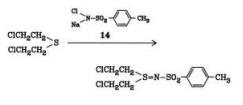
in benzene, chloroform, and ether. The compound reacts readily with mustard gas to yield
a harmless crystalline sulfimide; chloramine-T
derivatives are being studied as protective agents
against poison gas.
 | | References | [1] M. C. Agrawal, S. P. Mushran. "Mechanism of Oxidation of some Aliphatic Aldehydes by Chloramine-T." Zeitschrift für Naturforschung B 20 1 (1972): 401–404.
[2] B M Tashtoush. "Chloramine-T in radiolabeling techniques. IV. Penta-O-acetyl-N-chloro-N-methylglucamine as an oxidizing agent in radiolabelling techniques." Analytical biochemistry 288 1 (2001): 16–21.
[3] Petra R Quezada-Rodriguez. (2022). Effect of a prophylactic treatment with chloramine-T on gill histology and microbiome of Atlantic salmon (Salmo salar) under commercial conditions. Aquaculture, 546 1, 737319. https://doi.org/10.1016/j.aquaculture.2021.737319
|
| | Chloramine-T Preparation Products And Raw materials |
|