- Naphthoresorcinol
-
- $1.60
-
2026-08-25
- CAS:132-86-5
- Min. Order: 1kg
- Purity: 99%
- Supply Ability: 100kg
|
| | 1,3-Dihydroxynaphthalene Basic information |
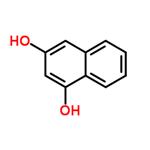
| Product Name: | 1,3-Dihydroxynaphthalene | | Synonyms: | 3-Hydroxybenzocyclohexadien-1-one;Naphthalenediol-(1,3);Naphthoresorcin;NAPHTHORESORCINE;NaphthoresorcinolGr;NaphthoresorcinolGr-(1,3-DihydroxyNaphthalene);1,3-Dihydroxynaphthalene, 99+%;1,3-Dioxynaphthalene | | CAS: | 132-86-5 | | MF: | C10H8O2 | | MW: | 160.17 | | EINECS: | 205-079-7 | | Product Categories: | Industrial/Fine Chemicals | | Mol File: | 132-86-5.mol | 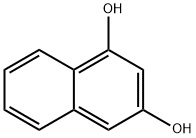 |
| | 1,3-Dihydroxynaphthalene Chemical Properties |
| Melting point | 123-125 °C(lit.) | | Boiling point | 246.06°C (rough estimate) | | density | 1.0924 (rough estimate) | | refractive index | 1.5418 (estimate) | | storage temp. | Keep in dark place,Inert atmosphere,Room temperature | | solubility | ethanol: soluble50mg/mL | | pka | 9.15±0.40(Predicted) | | form | crystalline | | color | white to tan | | Water Solubility | Soluble in ethanol (50 mg/ml), and water. | | λmax | 288 nm (298 nm (ethanol)) | | Sensitive | Light Sensitive | | Merck | 14,6396 | | BRN | 2044002 | | InChI | 1S/C10H8O2/c11-8-5-7-3-1-2-4-9(7)10(12)6-8/h1-6,11-12H | | InChIKey | XOOMNEFVDUTJPP-UHFFFAOYSA-N | | SMILES | Oc1cc(O)c2ccccc2c1 | | CAS DataBase Reference | 132-86-5(CAS DataBase Reference) | | EPA Substance Registry System | 1,3-Naphthalenediol (132-86-5) |
| Hazard Codes | Xi | | Risk Statements | 36/37/38-22 | | Safety Statements | 26-37/39 | | WGK Germany | 3 | | RTECS | QJ4725000 | | F | 8-9-23 | | TSCA | TSCA listed | | HS Code | 29029090 | | Storage Class | 11 - Combustible Solids | | Hazard Classifications | Muta. 2 | | Toxicity | mouse,LD50,intraperitoneal,200mg/kg (200mg/kg),National Technical Information Service. Vol. AD691-490, |
| | 1,3-Dihydroxynaphthalene Usage And Synthesis |
| Description | 1,3-Dihydroxynaphthalene (1,3-DHN) is a multifunctional chemical reagent. Similar to resorcinol, it can be phosphorylated at room temperature using phosphotriamide, though its rate of diphosphorylation is lower. In addition, the 1,3-DHN molecule exhibits fluorescent properties, with absorption spectra peaking at 290 nm and 330 nm, while the emission spectrum shows a peak at 380 nm and a shoulder peak at 425 nm. Non-ionic surfactants significantly enhance the fluorescence intensity of 1,3-DHN, whereas the addition of cationic or anionic additives diminishes its fluorescence intensity. | | Chemical Properties | orange-pink to brown crystalline powder. 1,3-Naphthalenediol [132-86-5], naphthoresorcinol, mp 124℃, is synthesized by hydrolysis of 1,3-naphthalenediamine with sulfuric acid; by heating 1-amino-3-hydroxy-naphthalene-4-sulfonic acid with acid; or by cyclization of ethyl phenylacetoacetate. It is used as an analytical reagent for sugars and glucuronic acid in urine. It is oxidized in alkaline solution to 2-hydroxy-1,4-naphthoquinone and reacts with ammonia at 140℃ to give 3-amino-1- naphthol and 1,3-naphthalenediamine. | | Uses | Reagent for sugars, oils, and for glucuronic acid in urine: Forsyth, Nature 161, 239 (1948); Heyns, Kelch, Z. Anal. Chem. 139, 339 (1953). | | Uses | 1,3-Naphthalenediol is a derivative of naphthalene (N345600) and may have antibacterial activity against oral bacteria.Dyes and metabolites. |
| | 1,3-Dihydroxynaphthalene Preparation Products And Raw materials |
|