






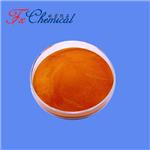

Product Details
| Product Name: Calcein disodium salt | CAS No.: 108750-13-6 |
| EC-No.: 999-999-2 | Min. Order: 1KG |
| Purity: 99% | Supply Ability: 200KG |
| Release date: 2025/12/02 |
What is Calcein Disodium Salt?
Calcein disodium salt is a synthetic, water-soluble fluorescent dye and chelating agent. It is the sodium salt of calcein (also known as fluorescein complexone), which is derived from fluorescein.
Its key properties are:
High Fluorescence: It emits a strong green-yellow fluorescence (around 515-520 nm) when excited by blue light (around 495 nm).
Metal Ion Sensitivity: Its fluorescence is quenched (significantly dimmed or turned off) upon binding to heavy metal ions like Co²⁺, Ni²⁺, Cu²⁺, and Fe³⁺.
Cell Permeability (in its AM form): The acetoxymethyl ester form (Calcein-AM) is non-fluorescent and cell-permeable. Once inside living cells, cellular esterases cleave the AM groups, trapping the highly fluorescent calcein inside. This is the basis of its most famous application.
Primary Applications and Uses
Calcein's applications are dominated by its fluorescent properties and its interaction with metal ions, making it indispensable in cell biology, physiology, and chemistry.
1. Cell Viability and Cytotoxicity Assays (Most Common Use)
This is the flagship application, enabled by the Calcein-AM ester form.
Mechanism: Live cells actively take up the non-fluorescent Calcein-AM. Intracellular esterases hydrolyze it into the fluorescent, cell-impermeant calcein disodium salt, causing live cells to glow bright green. Dead cells lack esterase activity and do not retain the dye.
Application: This provides a rapid, quantitative, and reliable method to:
Count the number of live cells in a sample.
Assess cell membrane integrity.
Screen for cytotoxic effects of drugs, chemicals, or environmental toxins.
It is often used in combination with a red fluorescent dead cell stain (like propidium iodide or ethidium homodimer-1) for a live/dead dual staining assay.
2. Cell Tracing and Migration Studies
Because the dye is well-retained in live cells, it is an excellent tool for tracking.
Cell Lineage Tracing: A population of cells can be loaded with Calcein-AM and then introduced into an organism or co-cultured with unlabeled cells. Their migration and proliferation can be tracked over time using fluorescence microscopy.
Wound Healing/Cell Migration Assays: A monolayer of cells is stained with Calcein-AM. A "wound" (scratch) is made in the monolayer. The migration of the fluorescent cells to close the wound can be monitored and quantified.
3. Fluorescent Metal Ion Indicator
Calcein's fluorescence is strongly quenched by heavy metal ions.
Metal Chelation/Detection: It can be used as a sensitive fluorescent probe to detect the presence of quenching metal ions in solution. The decrease in fluorescence intensity is proportional to the metal ion concentration.
Monitoring Metal Ion Flux: In physiology, it is used to study processes involving metal ions, such as zinc release in neurons or copper transport.
4. Bone Labeling in Biological Research
This is a specialized but important application in zoology and physiology.
Mechanism: Calcein binds strongly to calcium ions and incorporates into areas of active calcification.
Application: It is injected into living animals (e.g., fish, rodents) where it labels newly formed bone. At a later time, a second label (e.g., alizarin red) can be injected. The animal is then sacrificed, and the bone is examined under a fluorescent microscope. The distance between the two fluorescent bands allows researchers to precisely measure bone growth rates over a specific time period.
5. Fluorescent Tracer for Diffusion and Flow Studies
Its small size, high solubility, and strong fluorescence make it an ideal tracer.
Porosity and Permeability Studies: Used in geology and materials science to study fluid flow through porous media like rocks, concrete, or filters.
Microfluidics: Used to visualize and map fluid flow within microfluidic chips.
Company Profile Introduction
You may like

Recommended supplier
| Product name | Price | Suppliers | Update time | |
|---|---|---|---|---|
| $47.00/100mg |
VIP4Y
|
TargetMol Chemicals Inc.
|
2025-12-02 | |
| $47.00/100mg |
VIP6Y
|
TargetMol Chemicals Inc.
|
2025-12-02 | |
| $999.00/1kg |
VIP2Y
|
HEBEI SHENGSUAN CHEMICAL INDUSTRY CO.,LTD
|
2024-08-22 | |
| $1.00/1KG |
VIP8Y
|
Career Henan Chemical Co
|
2018-08-13 |

 China
China- Since: 2006-04-03
- Address: Room 2015, No.2 Building Kaixin Mansion