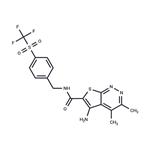
5-Amino-3,4-dimethyl-thieno[2,3-c]pyridazine-6-carboxylic acid 4-trifluoromethanesulfonyl-benzylamide
![5-Amino-3,4-dimethyl-thieno[2,3-c]pyridazine-6-carboxylic acid 4-trifluoromethanesulfonyl-benzylamide Structure](/CAS/20180529/GIF/1451993-15-9.gif)
|
- ₹0
- Product name: 5-Amino-3,4-dimethyl-thieno[2,3-c]pyridazine-6-carboxylic acid 4-trifluoromethanesulfonyl-benzylamide
- CAS: 1451993-15-9
- MF: C17H15F3N4O3S2
- MW: 444.45
- EINECS:-0
- MDL Number:
- Synonyms:5-Amino-3,4-dimethyl-thieno[2,3-c]pyridazine-6-carboxylic acid 4-trifluoromethanesulfonyl-benzylamide;VU0467154;VU0467154, VU-0467154, VU 0467154;Thieno[2,3-c]pyridazine-6-carboxamide, 5-amino-3,4-dimethyl-N-[[4-[(trifluoromethyl)sulfonyl]phenyl]methyl]-;VUO467154 - M4 Receptor Agonist;VU0467154,Muscarinic acetylcholine receptor,VU 0467154,VU-0467154,mAChR,inhibit,Inhibitor;5-Amino-3,4-dimethyl-N-(4-((trifluoromethyl)sulfonyl)benzyl)thieno[2,3-c]pyridazine-6-carboxamide;VU0467154, 10 mM in DMSO
| Manufacturer | Product number | Product description | Packaging | Price | Updated | Buy |
|---|
Properties
Density :1.514±0.06 g/cm3(Predicted)
storage temp. :Store at -20°C
solubility :DMSO: Soluble
form :A solid
pka :11.80±0.46(Predicted)
color :Light yellow to yellow
storage temp. :Store at -20°C
solubility :DMSO: Soluble
form :A solid
pka :11.80±0.46(Predicted)
color :Light yellow to yellow
Safety Information
| Symbol(GHS): |
  
|
||||||||||||||||||||||||||||||||||||||||||||||||||||||||||||||||||||||
|---|---|---|---|---|---|---|---|---|---|---|---|---|---|---|---|---|---|---|---|---|---|---|---|---|---|---|---|---|---|---|---|---|---|---|---|---|---|---|---|---|---|---|---|---|---|---|---|---|---|---|---|---|---|---|---|---|---|---|---|---|---|---|---|---|---|---|---|---|---|---|---|
| Signal word: | Danger | ||||||||||||||||||||||||||||||||||||||||||||||||||||||||||||||||||||||
| Hazard statements: |
|
||||||||||||||||||||||||||||||||||||||||||||||||||||||||||||||||||||||
| Precautionary statements: |
|
Description
VU0467154 is a positive allosteric modulator of the M4 muscarinic acetylcholine receptor that potentiates acetylcholine responses in CHO cells expressing M4 receptors (EC50s = 17.7, 630, and 1,000 nM for rat, human, and cynomolgus monkey receptors, respectively). It is selective for M4 over M1-3 and M5 receptors and a panel of receptors, transporters, and cation channels when used at a concentration of 10 μM. In vivo, VU0467154 (3-56.6 mg/kg, p.o.) reverses amphetamine-induced hyperlocomotion in rats. It reverses MK-801-induced hyperlocomotion, deficits in a pairwise visual discrimination task, and impairments in the acquisition of contextual fear conditioning in wild-type, but not M4 knockout, mice. VU0467154 (3-30 mg/kg) also increases freezing behavior in contextual and tone fear conditioning tests in wild-type mice when administered prior to the conditioning session. Chronic administration of VU0467154 (10 mg/kg once daily) reduces motor incoordination and prevents decreases in locomotion in the YAC128 transgenic mouse model of Huntington''s disease.More related product prices
VU 0364439 VU 0360223 VU 0357121 VU 0365114 VU 0360172 3-methylsulfanyl-7,8-dihydro-6H-cyclopenta[4,5]thieno[1,2-c]pyrimidin-1-amine 1246303-14-9 1160247-92-6 1161205-04-4 VU0483605 VU 591 hydrochloride 893990-34-6 VU-29 VU 0364770 409351-28-6 VU 0357017 hydrochloride 333415-38-6Related product price
- VU 0357121
₹14451.38 - 1160247-92-6
₹10229.63-41319.03 - 1161205-04-4
₹37530.28