


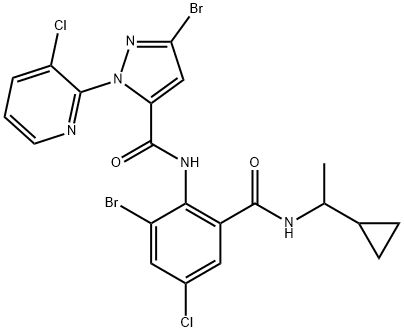
CYCLANILIPROLE synthesis
- Product Name:CYCLANILIPROLE
- CAS Number:1031756-98-5
- Molecular formula:C21H17Br2Cl2N5O2
- Molecular Weight:602.11
![Ethanamine, N-[(3,5-dichlorophenyl)methylene]-2,2-diethoxy-](/CAS/20210305/GIF/1000210-73-0.gif)
1000210-73-0
0 suppliers
inquiry

1033407-67-8
1 suppliers
inquiry
1031756-98-5
33 suppliers
$195.00/5mg
Yield:-
Reaction Conditions:
with potassium tert-butylate;sodium sulfate in dimethyl sulfoxide at 20; for 1 h;
Steps:
20
EXAMPLE 20 Preparation (3) of 3-bromo-N-(2-bromo-4-chloro-6-(1-cyclopropylethylcarbamoyl)phenyl)-1-(3-chloropyridin-2-yl)-1H-pyrazole-5-carboxamide 0.45 g of anhydrous sodium sulfate was added to a mixed solution comprising 0.23 g of 2-amino-3-bromo-5-chloro-N-(1-cyclopropylethyl)benzamide, 0.27 g of phenyl 3-bromo-1-(3-chloropyridin-2-yl)-1H-pyrazole-5-carboxylate and 5 ml of dimethyl sulfoxide at room temperature, and 0.16 g of potassium tert-butoxide was added, followed by reaction for one hour. Then, the reaction liquid was slowly added to water. The mixed liquid was subjected to extraction with ethyl acetate, and the organic layer was washed with a sodium chloride aqueous solution and dried over anhydrous sodium sulfate. The solvent was distilled off under reduced pressure, and the residue was purified by silica gel column chromatography (eluent: n-hexane/ethyl acetate = 8/2 to 4/6) to obtain 0.24 g of the desired product.
References:
ISHIHARA SANGYO KAISHA, LTD. EP2093223, 2009, A1 Location in patent:Page/Page column 37
1000210-73-0
0 suppliers
inquiry
1031756-98-5
33 suppliers
$195.00/5mg