


Inhibitor refers to substance that can hinder the chemical reactions, biological reactions (including immune response) and biological activity. In present time, commonly used inhibitors include immunosuppressants and inhibitors. 1. Immunosuppressive agents: immunosuppressants system refers to drug that can reduce the immune response. It can selectively suppress certain steps of the immune response and immune cells. Immune response refers to the body’s response to a variety of pathogenic substances. Some reactions are favorable to the body and can enhance the body's resistance to disease; some have adverse effects on the body and can cause tissue damage or disorders of physiological functions (allergy). Therefore, patients suffering from allergic reactions being harmful to the body should be subject to the treatment of immunosuppressant to affect the related immune processes and reduce the immune response of the body. For the treatment of various autoimmune diseases and weakening the tissue incompatibility, it has been developed of a variety of immunosuppressive agents, some of which have been widely used in clinical practice. Commonly used immunosuppressants include glucocorticoids (prednisone, prednisolone, etc.), alkylating agents (nitric oxide mustard, cyclophosphamide, thiotepa, busulfan, etc.), and antimetabolites (6- mercaptopurine, azathioprine, methotrexate, etc.). The mechanism of immunosuppressants, though not entirely clear, but is characterized by the following several aspects: ① most kinds of immunosuppressants can simultaneously inhibit cellular and humoral immunity and can be used for organ transplantation and autoimmune disease. ②Its inhibitory effect is strong for the primary immune response while the inhibitory effect against secondary response is weak. ③It can simultaneously act on normal and pathological immunity, therefore, can often lead to some complications. ④These drugs often have strong with serious adverse reactions. 2. Enzyme

Tazemetostat Hydrobromide:Synthesis and Introduction
Tazemetostat Hydrobromide is synthesised using 2- methyl-3-nitrobenzoic acid as a raw material by chemical reaction.
Jan 8,2024 Inhibitors
Synthesis of Surufatinib
Surufatinib is synthesised from dichloropyrimidine and hydroxyindole by substitution reaction. This process requires the participation of Surufatinib Amine.
Jan 5,2024 Inhibitors
How is Selumetinib Sulfate Synthesised?
Selumetinib Sulfate was prepared by a two-step chemical reaction by first synthesising Selumitinib Benzimidazole intermediates using 2,3,4-trifluorobenzoic acid as starting material.
Jan 5,2024 Inhibitors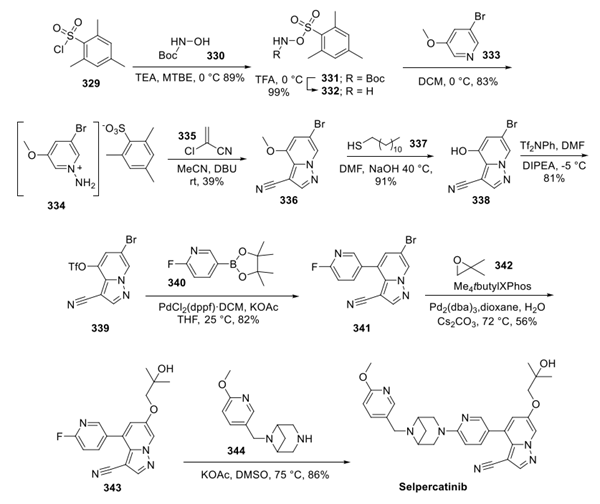
Selpercatinib: Synthesis and Description
Selpercatinib (LOXO-292) is synthesised using sulfonyl chloride as a raw material by chemical reaction.
Jan 5,2024 Inhibitors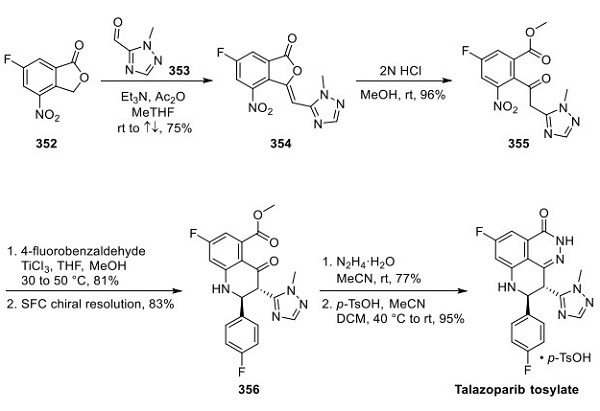
Talazoparib (BMN 673): a polymerase inhibitor
Talazoparib is a PARPi developed by Pfizer and approved in 2018 in USA and 2019 in EU for the treatment of germline BRCA-mutated, HER2-negative breast cancer.
Jan 3,2024 Inhibitors
An irreversible EGFR/HER2 dual tyrosine kinase inhibitor: Pyrotinib Maleate
Pyrotinib, an irreversible EGFR/HER2 dual tyrosine kinase inhibitor used for treating HER2-positive breast cancer, is primarily metabolized by cytochrome P450 (CYP)3A4 isozyme.
Jan 2,2024 Inhibitors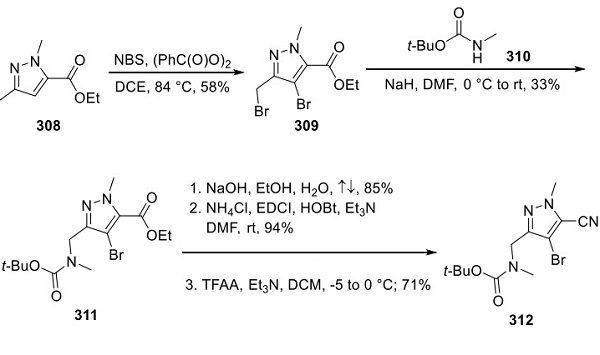
How to synthesize Lorlatinib?
Lorlatinib is an oral small molecule inhibitor of anaplastic lymphoma kinase (ALK) and C-ros oncogene 1 (ROS1) kinase developed by Pfizer for the treatment of ALK-positive non-small cell lung cancer.
Jan 2,2024 Inhibitors
Synthesis of Ripretinib
Ripretinib was synthesized by construction of a 1,6-naphtholide involving the junction of an α-aryl ester and appropriately functionalized 4-aminopyridine.
Jan 2,2024 Inhibitors
Pralsetinib: Synthesis and Introduction
Pralsetinib (BLU-667) is synthesised using bromopyridine as a raw material by chemical reaction.
Jan 2,2024 Inhibitors
How is Pemigatinib Synthesised?
Pemigatinib is synthesised using pyrrolopyridine as a raw material, firstly by synthesis of Pemigatinib Morpholine Intermediate and then by reduction, cyclisation and other reactions.
Jan 2,2024 Inhibitors