| Identification | More | [Name]
2,6-DIBROMO-4-FLUOROPHENOL | [CAS]
344-20-7 | [Synonyms]
2,6-DIBROMO-4-FLUOROPHENOL
2,6-Dibromo-4-2-fluorophenol
1-Bromo-3,4,5-trifluorobezene
2,6-Dibromo-4-fluorophenol 97%
2,6-Dibromo-4-fluorophenol97%
2,6-Dibromo-4-fluorophenol, 98+%
4-Fluoro-2,6-dibromophenol | [EINECS(EC#)]
206-451-1 | [Molecular Formula]
C6H3Br2FO | [MDL Number]
MFCD00002317 | [Molecular Weight]
269.89 | [MOL File]
344-20-7.mol |
| Questions And Answer | Back Directory | [Synthesis]
Currently, the main method for synthesizing 2,6-dibromo-4-fluorophenol is to use 4-fluorophenol as a raw material and obtain the target compound through a bromination reaction [1]. Alternatively, the target compound 2,6-dibromo-4-fluorophenol can be obtained by a two-step reaction of boronization and oxidation, starting from 3,5-dibromo-1-fluorobenzene. The synthesis reaction formula is shown in the figure below: 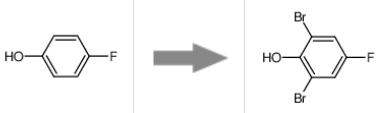
Figure 1 Synthesis reaction formula of 2,6-dibromo-4-fluorophenol Preparation of 2,6-dibromo-1-fluorophenylboronic acid: 2,2,6,6-tetramethylpiperidine (10.0 g, 70.8 mmol) and 160 mL of dry tetrahydrofuran were added to a 250 mL three-necked flask. Under N2 protection, the temperature was lowered to -78 °C in a low-temperature reactor, and n-butyllithium (21.2 mL, 53.0 mmol) was slowly added dropwise. After the addition was complete, the mixture was stirred for 30 min, and then 3,5-dibromo-1-fluorobenzene (8.3 g, 10.0 mmol) was slowly added dropwise. After the initial addition of 10.0 g (35.2 mmol), the mixture was stirred for 1 h, followed by slow addition of triisopropyl borate (10.0 g, 53.0 mmol). After the addition was complete, the mixture was stirred for another 2 h until the reaction was complete. The reaction solution was slowly poured into ice water and extracted with ethyl acetate (50 mL × 3). The pH of the aqueous phase was adjusted to 3–4 with 1 mol·L⁻¹ hydrochloric acid, and the precipitated solid was filtered, dried, soaked in 10 mL of n-hexane, stirred, filtered, and dried to obtain 5.8 g of 2,6-dibromo-1-fluorophenylboronic acid.
Preparation of 2,6-dibromo-4-fluorophenol: 40 g of water and potassium hydroxide (1.2 g, 21.4 mmol) were added to a 250 mL single-necked flask and completely dissolved. Then, 2,6-dibromo-1-fluorophenylboronic acid (3 g, 10.7 mmol) was added, followed by slow dropwise addition of a 30% aqueous solution of hydrogen peroxide (6.07 g, 53.5 mmol). After the addition was complete, stirring was continued for 10 min. Once the reaction was complete, the pH was adjusted to 5–6 with 1 mol·L⁻¹ hydrochloric acid. The mixture was extracted with ethyl acetate (80 mL × 2). The organic phases were combined, dried over anhydrous sodium sulfate, and evaporated to dryness to obtain a pale yellow crude solid. This crude solid was soaked in 5 mL of n-hexane, stirred, filtered, and dried to obtain 2.6 g of 2,6-dibromo-4-fluorophenol. | [Uses]
2,6-Dibromo-4-fluorophenol is an important intermediate in the preparation of α-amino acid derivatives and antispasmodic drugs. Halogenated phenols are important organic synthesis and pharmaceutical intermediates, widely used in the synthesis of pharmaceuticals, pesticides, plastic and rubber additives, disinfectants, preservatives, and other fine chemicals. Meta-halogenated phenols are raw materials for the synthesis of tramadol hydrochloride, a potent non-morphine analgesic; triarylmethanethiophene anti-tuberculosis drugs; and 4-arylpiperidine antipruritic drugs. 2,4-Dibromophenol (DBP) is an important organic chemical raw material, widely used as a reactive flame retardant in epoxy resins, phenolic resins, polyurethanes, and as an intermediate in the synthesis of other chemical raw materials. |
| Chemical Properties | Back Directory | [Appearance]
white to light yellow crystal powder | [Melting point ]
55-57°C | [Boiling point ]
219.5±35.0 °C(Predicted) | [density ]
2.168±0.06 g/cm3(Predicted) | [storage temp. ]
under inert gas (nitrogen or Argon) at 2-8°C | [solubility ]
soluble in Methanol | [form ]
powder to crystaline | [pka]
6.92±0.23(Predicted) | [color ]
White to Orange to Green | [BRN ]
1868033 | [InChI]
InChI=1S/C6H3Br2FO/c7-4-1-3(9)2-5(8)6(4)10/h1-2,10H | [InChIKey]
RRAZCUUOWIDAJS-UHFFFAOYSA-N | [SMILES]
C1(O)=C(Br)C=C(F)C=C1Br | [CAS DataBase Reference]
344-20-7(CAS DataBase Reference) |
| Hazard Information | Back Directory | [Description]
2,6-Dibromo-4-fluorophenol is a chemical compound used primarily as an intermediate in synthesising pharmaceuticals, agrochemicals, and speciality chemicals. Due to its unique properties, it is commonly employed in organic chemistry reactions as a halogenated building block. Safety precautions must be followed when handling this compound, as it may cause skin and eye irritation. It should be stored in a cool, well-ventilated area away from heat sources and incompatible substances. Proper personal protective equipment (PPE), such as gloves and goggles, should be worn during handling.
| [Chemical Properties]
white to light yellow crystal powder |
|
| Company Name: |
J & K SCIENTIFIC LTD.
|
| Telephone: |
18210857532 18210857532 |
| Website: |
https://www.jkchemical.com |
| Company Name: |
Alfa Aesar
|
| Telephone: |
400-6106006 |
| Website: |
http://chemicals.thermofisher.cn |
| Company Name: |
Energy Chemical
|
| Telephone: |
400-0056266 |
| Website: |
www.energy-chemical.com |
|