| Identification | Back Directory | [Name]
1-METHYL-1,2,3,6-TETRAHYDROPYRIDINE-4-BORONIC ACID PINACOL ESTER | [CAS]
454482-11-2 | [Synonyms]
1-Methyl-4-(4,4,5,5-tetraMe
6-TETRAHYDROPYRIDINE-4-BORONIC ACID PINACOL ESTER
-1,2,3,6-tetrahydropyridine-4-boronic acid pinacoL
Pinacol 1,2,3,6-tetrahydro-1-methyl-pyridine-4-boronate
1-Methyl-4-(tetraMethyl-1,3,2-dioxaborolan-2-yl)piperidine
1-METHYL-1,2,3,6-TETRAHYDROPYRIDINE-4-BORONIC ACID PICOL ESTER
1-METHYL-1,2,3,6-TETRAHYDROPYRIDINE-4-BORONIC ACID PINACOL ESTER
(1-METHYL-1,2,3,6-TETRAHYDROPYRIDIN-4-YL)BORONIC ACID PINACOL ESTER
1-Methyl-1,2,3,6-tetrahydropyridine-4-boronic acid pinacol ester 97%
1-methyl-4-(tetramethyl-1,3,2-dioxaborolan-2-yl)-1,2,3,6-tetrahydropyridine
4,4,5,5-tetramethyl-2-(1-methyl-3,5-dihydro-2H-pyrid-4-yl)-1,3,2-dioxaborolane
1-methyl-4-(4,4,5,5-tetramethyl-1,3,2-dioxaborolan-2-yl)-3,6-dihydro-2H-pyridine
4,4,5,5-Tetramethyl-2-[1-methyl-1,2,5,6-tetrahydropyridin-4-yl]-1,3,2-dioxaborolane
2-(1-Methyl-1,2,3,6-tetrahydropyridin-4-yl)-4,4,5,5-tetramethyl-1,3,2-dioxaborolane
1-Methyl-1,2,3,6-tetrahydro-4-(4,4,5,5-tetramethyl-1,3,2-dioxaborolan-2-yl)pyridine
1-Methyl-4-(4,4,5,5-tetraMethyl-1,3,2-dioxaborolan-2-yl)-1,2,3,6-tetrahydropyridine
1,2,3,6-tetrahydro-1-methyl-4-(4,4,5,5-tetramethyl-1,3,2-dioxaborolan-2-yl)-pyridine
Pyridine, 1,2,3,6-tetrahydro-1-Methyl-4-(4,4,5,5-tetraMethyl-1,3,2-dioxaborolan-2-yl)-
1-Methyl-4-(4,4,5,5-tetramethyl-1,3,2-dioxaborolan-2-yl)-methyl-1,2,3,6-tetrahydropyridine
3-hydroxy-2,3-dimethylbutan-2-yl hydrogen (1-methyl-1,2,3,6-tetrahydropyridin-4-yl)boronate
1-Methyl-1,2,3,6-tetrahydro-4-(4,4,5,5-tetramethyl-1,3,2-dioxaborolan-2-yl)pyridine, 2-(1-Methyl-1,2,3,6-tetrahydropyridin-4-yl)-4,4,5,5-tetramethyl-1,3,2-dioxaborolane | [Molecular Formula]
C12H24BNO3 | [MDL Number]
MFCD11506069 | [MOL File]
454482-11-2.mol | [Molecular Weight]
223.12 |
| Questions And Answer | Back Directory | [Synthesis]
Over the past few decades, coupling reactions have been widely used in the synthesis of novel alkyl or aromatic heterocyclic compounds. Among these transition metal-catalyzed coupling reactions, the Suzuki coupling reaction is favored due to its mild reaction conditions, applicability to a wide range of functional groups, relative stability in air, and relatively low toxicity. Therefore, chemists have shown great interest in the synthesis and activity studies of novel borate derivatives, especially nitrogen-containing heterocyclic borates, which can be used to establish combinatorial libraries in medicinal chemistry research. Using 1-methyl-4-[(trifluoromethanesulfonyl)oxy]-1,2,3,6-tetrahydropyridine as the starting material, 1-methyl-1,2,3,6-tetrahydropyridine-4-boronic acid pinacol ester was prepared by borate esterification. The reaction formula is shown in the figure below: 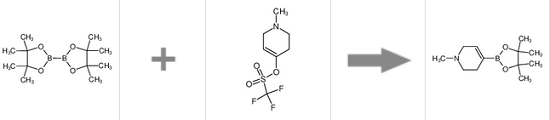
Figure 1 Reaction formula of 1-methyl-1,2,3,6-tetrahydropyridine-4-boronic acid pinacol ester In a 500 mL three-necked flask, add 1-methyl-4-[(trifluoromethanesulfonyl)oxy]-1,2,3,6-tetrahydropyridine and 150 mL of dry tetrahydrofuran. Stir well under argon protection. Slowly add 40 mL of n-butyllithium at below 5 °C. After the addition is complete, react at room temperature for 1 hour, then cool to -80 °C and add 15 mL of trimethyl borate. mL, after which the solution was added dropwise, stirred at -80℃ for 0.5 hours. The temperature was slowly raised to room temperature, and 150 mL of 15% ammonium chloride solution was added dropwise to neutralize the acid in the reaction solution. The mixture was then stirred at room temperature for 1 hour. The organic layer was separated, and the aqueous layer was extracted with ethyl acetate. The organic phases were combined and dried over anhydrous magnesium sulfate. The mixture was filtered, and the filtrate was evaporated to dryness under reduced pressure to obtain crude 1-methyl-1,2,3,6-tetrahydropyridine-4-boric acid, which was recrystallized from 5 times its volume of water. In a 250 mL three-necked flask, pure 1-methyl-1,2,3,6-tetrahydropyridine-4-boric acid, 100 mL of dry tetrahydrofuran, and 1.8 g (0.015 3 mol) of pinacol were added. After stirring to dissolve, molecular sieves were added, and the reaction was stirred at room temperature for 2 hours. The mixture was filtered, and the filtrate was evaporated to dryness. The solution was dissolved in 100 mL of n-hexane, the organic phase was washed with water, and dried over anhydrous magnesium sulfate. The solution was filtered, and the filtrate was evaporated to dryness to give 1-methyl-1,2,3,6-tetrahydropyridine-4-boronic acid pinacol ester. |
| Chemical Properties | Back Directory | [Melting point ]
72-76°C | [Boiling point ]
252.5±50.0 °C(Predicted) | [density ]
0.99±0.1 g/cm3(Predicted) | [storage temp. ]
2-8°C | [form ]
Crystalline Powder | [pka]
9.25±0.40(Predicted) | [color ]
White to off-white | [InChIKey]
SQMVRFXDBRYXFQ-UHFFFAOYSA-N |
| Hazard Information | Back Directory | [Uses]
1-Methyl-1,2,3,6-tetrahydropyridine-4-boronic acid pinacol ester can be used as a substrate in the study of para-alkenylation reactions of toluene using thianthrene S-oxide and palladium catalyst. |
|
| Company Name: |
J & K SCIENTIFIC LTD.
|
| Telephone: |
18210857532 18210857532 |
| Website: |
https://www.jkchemical.com |
| Company Name: |
Energy Chemical
|
| Telephone: |
400-0056266 |
| Website: |
www.energy-chemical.com |
| Company Name: |
Jia Xing Isenchem Co.,Ltd
|
| Telephone: |
0573-85285100 18627885956 |
| Website: |
https://www.chemicalbook.com/ShowSupplierProductsList14265/0_EN.htm |
| Company Name: |
Chem-Stone Co.,Ltd.
|
| Telephone: |
020-82185713,82185709 13418171485 |
| Website: |
www.chem-stone.com |
| Company Name: |
AllyChem Co., Ltd.
|
| Telephone: |
0411-62313318 13889470786 |
| Website: |
www.chemicalbook.com/showsupplierproductslist677/0_en.htm |
|