| Company Name: |
Ascent Scientific |
| Tel: |
4401179829988 |
| Email: |
customerservice@ascentscientific.co.uk |
|
| | Kainic acid 2-carboxy-3-carboxymethyl-4-isopropenylpyrrolidine Basic information |
| Product Name: | Kainic acid 2-carboxy-3-carboxymethyl-4-isopropenylpyrrolidine | | Synonyms: | 2-CARBOXY-3-CARBOXYMETHYL-4-ISOPROPENYLPYRROLIDINE;2-CARBOXYL-3-CARBOXYMETHYL-4-ISOPROPENYLPYRROLIDINE MONOHYDRATE;[2S-(2A,3BETA,4BETA)]-2-CAROXY-4-(1-METHYLETHENYL)-3-PYRROLIDINEACETIC ACID, MONOHYDRATE;(2S,3S,4S)-2-CARBOXY-4-ISOPROPENYL-3-PYRROLIDINEACETIC ACID;(-)-KAINIC ACID, MONOHYDRATE;KAINIC ACID MONOHYDRATE, ISOLATED FROM D;KAINIC ACID HYDRATE;Kainic acid monohydrate,2-Carboxy-3-carboxymethyl-4-isopropenylpyrrolidine | | CAS: | 58002-62-3 | | MF: | C10H15NO4.H2O | | MW: | 231.25 | | EINECS: | | | Product Categories: | Miscellaneous;Glutamate | | Mol File: | 58002-62-3.mol | 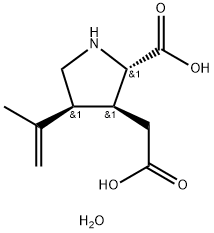 |
| | Kainic acid 2-carboxy-3-carboxymethyl-4-isopropenylpyrrolidine Chemical Properties |
| Melting point | 250-252°C | | RTECS | UX9665250 | | storage temp. | 2-8°C | | solubility | H2O: >10 mg/mL | | form | solid | | color | white | | biological source | Digenea simplex | | Water Solubility | H2O: soluble | | Sensitive | Light Sensitive | | InChI | InChI=1/C10H15NO4.H2O/c1-5(2)7-4-11-9(10(14)15)6(7)3-8(12)13;/h6-7,9,11H,1,3-4H2,2H3,(H,12,13)(H,14,15);1H2/t6-,7+,9-;/s3 | | InChIKey | FZNZRJRSYLQHLT-JMDCRQGXNA-N | | SMILES | C([C@@H]1[C@H](NC[C@@H]1C(=C)C)C(=O)O)C(=O)O.O |&1:1,2,5,r| |
| Safety Statements | 22-24/25 | | WGK Germany | 3 | | F | 10 | | TSCA | No | | Storage Class | 11 - Combustible Solids |
| | Kainic acid 2-carboxy-3-carboxymethyl-4-isopropenylpyrrolidine Usage And Synthesis |
| Description | (−)-(α)-Kainic acid is a cyclic analog of L-glutamate originally isolated from D. simplex that has neuroexcitatory activities. It binds to the homomeric kainate receptors GluK1, GluK2, GluK3, GluK4, and GluK5 (Kis = 75.9, 12.7, 32.8, 4.7, and 15 nM, respectively). (−)-(α)-Kainic acid (5 mM) induces calcium influx and membrane depolarization, as well as glutamate release, in rat brain synaptosomes. It induces chromatin condensation and nuclear membrane fragmentation, markers of apoptosis, in primary neonatal cerebellar granule neurons when used at a concentration of 100 μM. Intracerebroventricular administration of (−)-(α)-kainic acid induces convulsive behavior in rats (ED50 = 0.51 nmol/animal) and induces seizures in mice with a 50% convulsive dose (CD50) value of 0.39 nmol/animal. It has been commonly used to induce seizures in rodents. | | Uses | Kainic acid monohydrate has been used:
- As a convulsant to induce epileptogenesis and epilepsy in mice.
- To stimulate in vitro excitotoxic trauma in spiral ganglion neurons on inner hair cells.
- To induce seizures in rat model.
- To induce status epilepticus in adult male Wistar rats.
| | Uses | Kainic acid is used to study mechanisms of excitation-induced apoptosis and epilepsy. | | General Description | Kainic acid is an agonist for kainate-class ionotropic glutamate receptors. Kainate receptors directly gate ion channels and are generally excitatory. Excess stimulation by Kainic acid induces neurocytosis (apoptosis) and epileptic seizures. | | Biochem/physiol Actions | Kainic acid monohydrate is an agonist at the kainate class of ionotropic glutamate receptors, which induces seizures and neurodegeneration in vivo and is used to induce experimental epilepsy in rodents and study the mechanisms of excitation-induced neuronal apoptosis. | | in vivo | Kainic acid can be used to create epilepsy models and can be administered systemically, into the hippocampus, or amygdala, and is reproducible in various species. The systemic Kainic acid model closely mimics the manifestations of human temporal lobe epilepsy. When injected at a dose of 5 nM into the neostriatum, substantia nigra, or cerebellum, over half of the Kainic acid disappears from the injection site and brain within 0.5 hours, with radioactivity detected in other brain regions at concentrations lower than 7 pmol/mg[3][4][6].
Induction of epilepsy model[5] Background
Kainic acid, an analog of L-glutamate and an ionotropic KA receptor agonist, can damage hippocampal pyramidal neurons.
Specific Modeling Methods
Mice: C57BL/6J male 7 weeks old 22 g body weight
Administration: 10 μg in 5 μL i.c.v.
Note
(1) The right lateral brain ventricle is localized with a stereotactic instrument.
(2) After the operation, skin was sutured, and keep the mice under a warming place until they wake up.
(3) 48 hours after lateral ventricle injection, the mice are anaesthetized using Isoflurane and then sequentially intracardially perfused with saline and PFA (4%, 30 mL). Rapidly remove The mouse brain processed for paraffin embedding or frozen sections.
Modeling Indicators Electroencephalogram (EEG) recording: Had higher local maximal amplitude and reduced spike frequency compared to the control group.
Histology analysis: Showed Triangulated pyknotic nuclei and cytoplasmic shrinkage in the hippocampal neuron, and induced neuronal loss.
Correlated Product(s): / Opposite Product(s): Sitagliptin (HY-13749) | Animal Model: | 8 weeks, 200-250 g male adult Wistar rats[1] | | Dosage: | 5 mg/kg | | Administration: | I.p.; hourly at least 3 h until status epilepticus | | Result: | Induced seizures in rats. |
| | References | [1] NAREDLA KESAVA REDDY Srivari C. Total Synthesis of ()-α-Kainic acid via Chirality Transfer through Ireland–Claisen Rearrangement[J]. The Journal of Organic Chemistry, 2013, 78 7: 3355-3360. DOI: 10.1021/jo400001t
[2] EMANUELLE SAGOT. Chemo-Enzymatic Synthesis of a Series of 2,4-Syn-Functionalized (S)-Glutamate Analogues: New Insight into the StructureActivity Relation of Ionotropic Glutamate Receptor Subtypes 5, 6, and 7[J]. Journal of Medicinal Chemistry, 2008, 51 14: 4093-4103. DOI: 10.1021/jm800092x
[3] ANNA PASTUSZKO M. E David F Wilson. Effects of Kainic Acid in Rat Brain Synaptosomes: The Involvement of Calcium[J]. Journal of Neurochemistry, 1984, 43 3: 747-754. DOI: 10.1111/j.1471-4159.1984.tb12796.x
[4] N.A SIMONIAN . Kainic acid induces apoptosis in neurons[J]. Neuroscience, 1996, 75 4: Pages 1047-1055. DOI: 10.1016/0306-4522(96)00326-0
[5] CHRISTIAN CHIAMULERA. Domoic Acid Toxicity in Rats and Mice after Intracerebroventricular Administration: Comparison with Excitatory Amino Acid Agonists[J]. Basic & Clinical Pharmacology & Toxicology, 1992, 70 2: 115-120. DOI: 10.1111/j.1600-0773.1992.tb00439.x
[6] QUN WANG. Kainic acid-mediated excitotoxicity as a model for neurodegeneration.[J]. Molecular Neurobiology, 2005, 31 1-3: 3-16. DOI: 10.1385/mn:31:1-3:003
[7] HELENA DOMIN . Neuroprotective potential of mGluR5 antagonist MTEP: effects on kainate-induced excitotoxicity in the rat hippocampus[J]. Pharmacological Reports, 2010, 62 6: Pages 1051-1061. DOI: 10.1016/s1734-1140(10)70367-4 |
| | Kainic acid 2-carboxy-3-carboxymethyl-4-isopropenylpyrrolidine Preparation Products And Raw materials |
|