| Company Name: |
BOYAN PHARMA Gold |
| Tel: |
18566078841 18566078841 |
| Email: |
tanyan@boyanpharma.com |
arecoline manufacturers
- Arecoline
-

- $10.00
-
2026-10-11
- CAS:63-75-2
- Min. Order: 1ASSAYS
- Purity: 99%
- Supply Ability: 1 ton
- Arecoline
-

- $1.00
-
2026-08-07
- CAS:63-75-2
- Min. Order: 1KG
- Purity: 99%
- Supply Ability: 1KG 100KG 1MT
- Arecoline
-

- $92.00
-
2026-07-15
- CAS:63-75-2
- Purity: 98.00%
- Supply Ability: 10g
|
| | arecoline Basic information |
| Product Name: | arecoline | | Synonyms: | 1,2,5,6-Tetrahydro-1-methyl-3-pyridinecarboxylic acid methyl;methyl 1-methyl-3,6-dihydro-2H-pyridine-5-carboxylate;Methyl arecaidin;Methyl N-methyl-1,2,5,6-tetrahydronicotinate;1-Methyl-1,2,5,6-tertrahydro-pyridine-3-carboxylicacid methyl ester;NICOTINICACID,1,2,5,6-TETRAHYDRO-1-METHYL-,METHYLESTER;1,2,5,6-Tetrahydro-1-methyl-3-pyridinecarboxylic Acid Methyl Ester;1-Methyl-1,2,5,6-tetrahydro-pyridine-3-carboxylic Acid Methyl Ester | | CAS: | 63-75-2 | | MF: | C8H13NO2 | | MW: | 155.19 | | EINECS: | 200-565-5 | | Product Categories: | Heterocyclic Compounds;Intermediates & Fine Chemicals;Neurochemicals;Pharmaceuticals | | Mol File: | 63-75-2.mol | 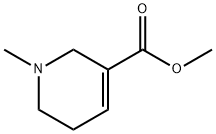 |
| | arecoline Chemical Properties |
| Melting point | <25℃ | | Boiling point | 209℃ | | density | 1.0504 g/cm3 (20 ºC) | | refractive index | 1.4860 (589.3 nm 20℃) | | storage temp. | Sealed in dry,Room Temperature | | solubility | Chloroform (Sparingly), Methanol (Slightly) | | form | Oil | | pka | 6.84(at 25℃) | | color | Oily liquid | | InChI | InChI=1S/C8H13NO2/c1-9-5-3-4-7(6-9)8(10)11-2/h4H,3,5-6H2,1-2H3 | | InChIKey | HJJPJSXJAXAIPN-UHFFFAOYSA-N | | SMILES | C1N(C)CCC=C1C(OC)=O | | LogP | 0.350 |
| Toxicity | LD50 in mice, dogs (mg/kg): 100, 5 s.c. (Burrows) |
| | arecoline Usage And Synthesis |
| Description | Areca catechu L. (Bin Lang), a palm plant native to Malaysia, is mainly distributed in tropical regions of Asia and the Americas. Arecoline is extracted from dry mature seeds of areca. The mature seeds of areca are 3–5 cm in diameter, with fibrous peel and a seed, namely, areca nut. The endosperm of areca nut is hard, with grayish-brown spots. Areca nut is harvested from August to November every year before the fruit is fully mature. The seeds are peeled, boiled, and cut into thin slices. The dried slices are brown or black, and it is an important medicine in traditional Chinese medicine. Areca nut is the raw materials of catechu. Areca nut was used as anthelmintics with arecoline as the main alkaloid in it. | | Chemical Properties | Oily Liquid | | Physical properties | Appearance: oily liquid. Solubility: mixed with water, ethanol, or ether in any ratio,
soluble in chloroform. Density: 1.059g/cm3
. Boiling point (760mmHg): 209°C.
Flash point: 81.1°C. Vapor pressure (25°C): 0.208mmHg. Arecoline can be synthesized to salts with organic acids. Arecoline hydrobromide, arecoline acetarsol,
and arecoline p-antimony carboxybenzoic acid are commonly used. | | History | Arecoline, an alkaloid extracted from Areca catechu L., is first reported by Jahns in
1888. Mujumdar found that there were at least six kinds of alkaloids in areca,
including arecoline, arecaidine, guavacoline, and guavacine. The content of arecoline in the fresh fruit of areca was 0.3–0.63% as determined with HPLC .
It has been found first that arecoline has the effect of antiparasite and is promoting the motility of the gastrointestinal smooth muscle. It activates the M and N
cholinergic receptors, excites the nervous system, promotes the body excitability,
and improves the ability of learning and memory . | | Uses | Arecoline is a cholinergic alkaloid from seeds of the betel nut palm Areca catechu. It is an agonist at both muscarinic and nicotinic acetylcholine receptors. It is used in the form of various salts as a ganglionic stimulant, a parasympathomimetic, and a vermifuge, especially in veterinary practice. It has been used as a euphoriant in the Pacific Islands. | | Uses | Arecoline has shown regulatory properties of controlling plasminogen activator inhibitor-1 expression in human buccal mucosa fibroblasts. | | Indications | This product has no source standard.
Tablets: anthelmintics, less used now. Eye drops: cholinergic drugs for glaucoma
treatment. | | Definition | ChEBI: Arecoline is a tetrahydropyridine that is 1,2,5,6-tetrahydropyridine with a methyl group at position 1, and a methoxycarbonyl group at position 3. An alkaloid found in the areca nut, it acts as an agonist of muscarinic acetylcholine. It has a role as a muscarinic agonist and a metabolite. It is a tetrahydropyridine, an enoate ester, a pyridine alkaloid and a methyl ester. | | Pharmacology | Paralysis was the main mechanism of the antiparasite effect of arecoline.
The effect of arecoline on cholinergic receptors is similar to that of pilocarpine.
It can agonize M-cholinergic receptors (M1, M2, M3, M4) and increase the
secretion of glands, especially the salivary. It can also agonize N-cholinergic
receptors and activate the muscles of skeletal, ganglia, carotid body, etc. The central
nervous system is also influenced by the cholinergic effect of arecoline. Intravenous
injection of small dosage of arecoline can cause wake-up reaction of the cortex in
cats, which is inhibited or blocked by atropine. Arecoline can cause salivation, vomiting, diuretic, lethargy, and convulsion when overdosed.
In addition, arecoline can enhance intestinal peristalsis, contract bronchus, lower
heart rate, dilate blood vessels, and decrease blood pressure. While in rabbit, it
induces coronary artery contraction.
Eye drops can reduce the pupil.
Pharmacokinetic parameters for arecoline after oral administration of arecoline
(3 mg/kg): Tmax, 120.07 min; Cmax, 60.61 ng/mL; t1/2, 69.32 min; AUC0 – t,
15116.86 min/ng/mL; AUC0-∞, 15771.37 min/ng/mL; plasma clearance, 0.19 L/
min/kg . | | Clinical Use | Arecoline is of historical interest, because its structure, like those of many other early medicinal agents, was determined and confirmed by a
19th-century German pharmacist, E. Jahns. Xanomeline may be viewed as a nonclassical bio-isostere of the ester moiety of arecoline. It is a
muscarinic M1/M4 agonist that is showing promise in clinical trials for the treatment of Alzheimer's disease. Although it is not tolerated at
orally effective doses, transdermal delivery systems are showing promise. | | Safety Profile | Poison by
subcutaneous and intraperitoneal routes.
Moderately toxic by ingestion. Questionable
carcinogen with experimental neoplastigenic
data. It mimics the action of acetylcholine, a
neurotransmitter, and is a parasympathetic
nervous system stimulant. Its action on the
central nervous system can cause tremors.
Human mutation data reported. It is easily
nitrosated to several nitrosamines. See also
ESTERS and NITROSAMINES. It is the
major alkaloid found in betel quid.
Combustible, can react with oxidzing
materials. When heated to decomposition it
emits hghly toxic fumes of NOx. |
| | arecoline Preparation Products And Raw materials |
| Raw materials | Arecoline hydrobromide-->3-(Methoxycarbonyl)-1-MethylpyridiniuM iodide-->4,4'-Dichlorodiphenyl disulfide-->Iodomethane-->Nicotinic acid | | Preparation Products | Pyridine, 3-(3-ethyl-1,2,4-oxadiazol-5-yl)-1,2,5,6-tetrahydro--->1,2,3,6-tetrahydro-5-(3-methyl-1,2,4-oxadiazol-5-yl)Pyridine |
|