


Prothioconazole Bioactivity and Multifunction
Aug 15,2026
Prothioconazole is a broad-spectrum systemic fungicide belonging to the triazole-thione class. Its mechanism of action involves inhibiting the biosynthesis of ergosterol in fungi, thereby disrupting the structure of the pathogen’s cell membrane. It possesses triple fungicidal activity—protective, curative, and eradicative.

Stereospecific Antifungal Activity of Chiral Fungicide Prothioconazole
Fusarium wilt of banana (FWB), caused by soil-borne fungus Fusarium oxysporum f. sp. cubense (Foc), led to the destruction of banana Gros Michel (Musa-AAA) and still poses as the greatest biotic challenge to the successor banana Cavendish. Four physiological races of Foc have been identified thus far based on the different banana cultivars they can invade. Among them, Foc tropical race 4 (TR4) is the most recently evolved and the most virulent strain. Like most of the triazole fungicides, Pro has an asymmetrically substituted carbon atom and thus consists of a pair of enantiomers with confirmed configurations as R-Pro and S-Pro. Prothioconazole is widely marketed and applied as the racemate. Significant stereoselective differences between Pro enantiomers were found in their environmental behaviors and toxicological effects. R-Pro is preferentially degraded in soils, and S-Pro is preferentially accumulated in earthworm (Eisenia foetida). Remarkable stereoselective endocrine-disrupting effects of Pro were found with the S-Pro, showing more potency than its R-enantiomers. However, relatively few cases considered the potential enantioselective fungicidal activities. There is speculation as to whether prothioconazole could also cause enantioselective fungicidal activities in TR4. A comprehensive understanding of the role of enantioselectivity of Pro in plant pathogen is very imperative for the application and regulation of this chiral compound. Scientists designed three bioassay experiments in vivo and in vitro to test the hypothesis that the prothioconazole enantiomers behave enantioselectively in their fungicidal effects against TR4. Accordingly, the underlying mechanism for the enantioselective effects were further investigated by evaluating the morphological changes and impairment in membrane integrity, measuring the oxidative stress responses and testing the interactions with CYP51.[1]
This study shows that both prothioconazole enantiomers could exhibit fungicidal activities against TR4 by modifying the mycelial morphology, damaging the integrity of cell membrane and inhibiting the activities of the major antioxidant enzymes. In addition, the bioactivity of Pro shows strong enantioselectivity, with R-Pro exerting more potent fungicidal activity than S-Pro. The enantioselective induction of CYP51 (enzyme activity, gene and protein expressions), to a certain extent, seems responsible for the cellular mechanisms of the enantioselective fungicidal activity. The affinity values and the structural information obtained from the SPR biosensor technique and molecular docking further elucidate the enantioselective interactions between Pro enantiomers and CYP51, which provides new insights into the molecular mechanism of the prothioconazole enantiomers against TR4. These results will not only provide the basis for more accurate assessment of the application of Pro chemicals, but also provide valuable clues for the discovery and rational design of novel fungicides as a strategy of Foc control. Furthermore, as a large number of fungicides work similarly by targeting CYP51, the enantioselective fungicidal activity of prothioconazole may be extended to other fungicides. Our results demonstrate the need to take the enantioselectivity into account for comprehensive risk assessments during fungal treatment for plant disease control.
Modification of the existing maximum residue levels for prothioconazole
Bayer CropScience Deutschland GmbH submitted an application to the competent national authority in Germany (evaluating Member State, EMS) to modify the existing maximum residue levels (MRLs) for the active substance prothioconazole in sugar beet roots and chicory roots. The EMS drafted an evaluation report in accordance with Article 8 of Regulation (EC) No 396/2005, which was submitted to the European Commission and forwarded to the European Food Safety Authority (EFSA) on 2 June 2022. To accommodate for the intended uses of prothioconazole, the EMS proposed to raise the existing MRLs from the limit of quantification (LOQ) to 0.03 mg/kg. EFSA assessed the application and the evaluation report as required by Article 10 of the MRL regulation. EFSA identified data gaps, which were requested from the EMS. On 7 March 2023, the EMS submitted a revised evaluation report, which replaced the previously submitted evaluation report. EFSA notes that for the present MRL application, since it was submitted before 1 September 2019, the submission of data on triazole derivative metabolites (TDMs) is in principle not required. However, where such information was provided, this was assessed. The metabolism of prothioconazole following foliar treatment was investigated in crops belonging to the groups of root crops, cereals and pulses/oilseeds.[2]
Validated analytical methods for enforcement of the proposed residue definition are available for all animal matrices at the LOQ of 0.01 mg/kg, except for milk where 0.004 mg/kg is achievable. The applicant provided the TDM data both for sugar beet root and tops. The residue levels of TDMs in sugar beet matrices are below the levels assessed by the peer review on the pesticide risk assessment for the TDMs in light of confirmatory data, except for the TAA levels in sugar beet tops. However, since TDM residue data are not available for all feed crops treated with prothioconazole and since the residue data available to the pesticide peer review on the TDM confirmatory data were affected by uncertainties related to storage stability and the number of residue trials, the livestock dietary burden to TDMs cannot be currently estimated. Moreover, the peer review on the TDM confirmatory data identified a data gap related to the lack of poultry and ruminant feeding studies with TLA. EFSA recommends that the livestock exposure to TDMs originating from the use of prothioconazole is further assessed in the framework of the renewal of the approval of active substance. For prothioconazole, no long‐term consumer intake concerns were identified for any of the diets included in the EFSA PRIMo, as the estimated maximum long‐term dietary intake accounted for 12% of the ADI (NL toddler diet). The short‐term exposure did not exceed the ARfD for any of the crops under consideration.
Electrochemical studies of prothioconazole as a novel corrosion inhibitor
Copper and copper alloys with their high-strength and high-conductivity, are widely used in the printed circuit board (PCB) manufacturing industry, as integrated circuit (IC) packaging materials, signal shielding devices, electrical pick-off contact supports and contact materials, joining Cu dissimilar joints using soldering and so on. The problem with BTA is the toxicity and poor solubility in water. Prothioconazole is a broad-spectrum organic fungicide that has been efficiently and widely used in disease prevention and control for cotton, beans, tomatoes, cereals and wheat crops. Propanthiazole has a better biological activity, no teratogenicity and is safe for humans and the environment. In addition, propanthiazole has an excellent water-solubility and biodegradability compared with benzotriazole derivatives. Fortunately, the processes for preparing propanthiazole has some advantages, such as less extensive raw materials, easily recycled reaction solvents, milder conditions, and a high product quality. Given the circumstances, using propanthiazole as an organic inhibitor reduces the labor intensity and pollution, and conserves water resources. To the best of our knowledge, prothioconazole as an anti-corrosion agent for copper in acidic solution has not been explored previously by scholars. Hence, in the present study, the inhibiting performance and anticorrosion mechanism of prothioconazole were investigated using traditional methods such as electrochemical experiments, weight loss tests, quantum chemical calculations and scanning electron microscopy (SEM) analysis. The electrochemical test results showed that prothioconazole was an excellent inhibitor, and the anticorrosion ability increased with the inhibitor concentration.[3]
References
[1]Yang X, Gong R, Chu Y, Liu S, Xiang D, Li C. Mechanistic Insights into Stereospecific Antifungal Activity of Chiral Fungicide Prothioconazole against Fusarium oxysporum F. sp. cubense. Int J Mol Sci. 2022 Feb 21;23(4):2352. doi: 10.3390/ijms23042352. PMID: 35216468; PMCID: PMC8875126.
[2]EFSA (European Food Safety Authority); Bellisai G, Bernasconi G, Cabrera LC, Castellan I, Del Aguila M, Ferreira L, Santonja GG, Greco L, Jarrah S, Leuschner R, Perez JM, Miron I, Nave S, Pedersen R, Reich H, Ruocco S, Santos M, Scarlato AP, Theobald A, Tiramani M, Verani A. Modification of the existing maximum residue levels for prothioconazole in sugar beet and chicory roots. EFSA J. 2023 Aug 10;21(8):e08198. doi: 10.2903/j.efsa.2023.8198. PMID: 37575618; PMCID: PMC10413182.
[3]Tao Z, Li Y, Peng YX, Su H, Han L, Liu G. Electrochemical studies of prothioconazole as a novel corrosion inhibitor for copper in acidic solutions. RSC Adv. 2020 Jun 5;10(36):21517-21529. doi: 10.1039/d0ra02919j. PMID: 35518749; PMCID: PMC9054380.
- Related articles
- Related Questions

(+)-Dipentene is a citrus-derived chiral monoterpene with reactive double bonds, commonly used in flavors, fragrances, green industrial solvents and resin raw materials.....
Aug 15,2026Chemical Reagents
N-Hydroxyphthalimide is a common crystalline organic oxidation catalyst widely used for selective oxidation of benzylic and allylic C–H bonds.....
Aug 15,2026API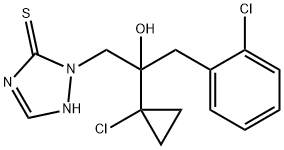
Prothioconazole
178928-70-6You may like
- prothioconazole
-
- 2026-07-14
- CAS:178928-70-6
- Min. Order: 100kg
- Purity: 98
- Supply Ability: 100
- Prothioconazole
-

- 2026-06-30
- CAS:178928-70-6
- Min. Order: 1kg
- Purity: 99%
- Supply Ability: 10000KGS
- PROTHIOCONAZOLE
-
- $100.00
- 2026-05-28
- CAS:178928-70-6
- Min. Order: 10KG
- Purity: 99%
- Supply Ability: 10000kg