


Research progress on hydrazoic acid
Sep 19,2026
Hydrazoic acid (molecular formula HN₃) is a colorless, highly volatile, highly hazardous liquid with a pungent odor. Its aqueous solution is weakly acidic and dissociates to form azide ions. It is chemically reactive and can easily undergo violent explosions when exposed to heat, impact, or electric sparks; It is highly toxic and can be absorbed through the respiratory tract or skin, causing damage to the nervous and cardiovascular systems. In laboratories, hydrazoic acid is primarily used in organic synthesis and the preparation of various azide derivatives.

Copper-Catalyzed Azide–Alkyne Cycloaddition of Hydrazoic Acid
Copper-catalyzed azide–alkyne cycloaddition (CuAAC), the prototypical example of “click” chemistry, has become one of the most widely used reactions and has been extended to various fields of science. As for the substrate scope, the reaction was extended to all types of starting alkyne reagents and almost all types of organic azide reagents, and the resulting 1,2,3-triazoles are found in a variety of applications. However, the CuAAC reaction of hydrogen azide (HN3, hydrazoic acid), leading to 4-substituted-1H-1,2,3-triazoles, has not yet been realized. 4-Substituted-1H-1,2,3-triazoles are also putative reaction products of cycloaddition between hydrogen azide (hydrazoic acid, HN3) and terminal alkynes. The thermal reaction of hydrazoic acid and phenylacetylene proceeds sluggishly at elevated temperatures.19 The CuAAC variant of this reaction is not readily performed, and methods based on transiently protected azides have been developed. To enable this reaction under the CuAAC reaction protocol and to avoid handling hazardous hydrazoic acid, N-protected organic azides, such as azidomethyl pivalate, azidomethyl morpholine-4-carboxylate, azidomethyl N,N-diethylcarbamate, trimethylsilyl azide, and α-azidoacetophenone, were demonstrated as viable substrates for the stepwise synthesis of 4-substituted-1H-1,2,3-triazoles via CuAAC, followed by a deprotection sequence. In the case of the trimethylsilyl azide reaction, TMS-N1-protected triazoles were not isolated, suggesting that hydrazoic acid may be involved in the reaction as a reactive species. Similarly, the reported reactions of sodium azide and terminal alkynes to NH-triazoles in the presence of a stoichiometric amount of copper, carried out under reflux of methanol for 2 days, and on water reaction employing Cu@g-C3N4, could also proceed via in situ formed hydrazoic acid.[1]
The reactions proceed with in situ formed hydrazoic acid that is present in solutions in low (<6%, w/w) concentrations. By employing tetradentate N-donor ligands, such as TBTA and (BimH)3, the reactions were realized at room temperature with 5 mol % copper catalyst loading, had high atom economy, and produced triazoles in good yields with little waste and by-products. The reactions could be carried out in environmentally friendly solvents and could afford 4-substituted-1,2,3-triazoles from the readily available alkynes and sodium azide, with almost complete incorporation of the starting materials into the final products. The method was demonstrated on a wide range of substrates, and the resulting NH-triazoles could be easily isolated. Noteworthily, 4-substituted-1H-1,2,3-triazoles, which were previously synthesized in a stepwise manner and required the preparation of starting reagents and/or an inert atmosphere and anhydrous solvents, are now accessible in one step from terminal alkynes under an ambient atmosphere. The developed method gives access to NH-triazole derivatives of peptides and potentially of other biomolecules. We have demonstrated the dual role of formic acid in the reported system, i.e., as an acid for the formation of hydrazoic acid from sodium azide and as a mild reducing agent for the regeneration of Cu(I) from Cu(II). It is noteworthy that hydrazoic acid was recently used for the large-scale synthesis of an early aryltetrazole intermediate in the synthesis of a drug candidate, giving the developed method the potential for scaling-up.
Molecular Structure of Hydrazoic Acid from 55 K to Close to the Melting Point
With 16 valence electrons the azide anion N3– belongs to the important group of linear triatomic molecules or ions such as CO2, N2O, CN2–, CNO–, OCN–, BN23–, NO2+, and BF2+, which have initialized a lot of theoretical calculations in the field of their chemical bonding. With respect to the explosive decomposition of azides, the detailed knowledge of the subtle differences in bonding is very important. For such research on azides, hydrazoic acid, HN3, as the simplest covalent azide is an ideal model molecule. It contains 97.7 wt % nitrogen. The earliest report on the preparation of HN3 found in literature was by Curtius in 1890. Fifty years later, a first result on the molecular geometry was obtained by infrared (IR) spectra by Eyster. These molecular data were refined by the use of electron diffraction, microwave spectra, and ab initio theoretical studies. However, all information derived by these studies up to 1980 refer to the atomic arrangement of hydrazoic acid in the gas phase, whereas important data on liquid and solid HN3 remained missing for several decades. The reasons for such a delay may be attributed to the very delicate handling of pure hydrazoic acid; as an endothermic compound, it is potentially explosive and, in addition, strongly toxic. The main goal of this work was to examine whether the weak vdW bonds between the layers are still effective at high temperatures. While the absence of vdW forces could cause the stacked-layer structure to collapse, parts of the single layers would still be present in the melt. For the purpose of this analysis, cooling experiments with polycrystalline hydrazoic acid in cycles between 55(5) and 190(5) K were carried out at the P02.1 beamline of PETRA III at DESY in Hamburg, Germany, with a wavelength of 0.2068 Å in a helium cryostat. At 190(5) K liquid HN3 was detected, since the observed diffractogram showed no reflections.[2]
Structural investigations at PETRA III at DESY on a polycrystalline sample of hydrazoic acid at temperatures between 55(5) and 190(5) K show that the layer structure of tetramers (HN3)4 stacked A, B, ..., A, B, which was recently determined by X-ray diffraction on a single crystal at 100(2) K, is stable from 55(5) to 180(5) K. This alternating two-layer stacking was compared to the structure of 2H-graphite which shows one of the strongest covalent bonds within the layers and weak vdW bonds between them. Thermal expansion of hydrazoic acid perpendicular to the layers with weak vdW bonds is three times larger than within the layers with N–H···N hydrogen bonds. Compared to the very strong covalent bond in the layers of 2H-graphite, thermal expansion parallel to the layers (αa = 5 × 10⁻⁷ K–1) in HN3 is 166 times higher (αa = 8.3 × 10⁻⁵ K–1). Close to the melting point splitting of reflections is observed in the diffractograms of hydrazoic acid, indexable with a second phase with the same structure but slightly increasing a and decreasing b lattice parameters. There are some indications that in the layer structure the nearly planar net of tetramers (HN3)4 is stressed at temperatures approaching the melting point since the anisotropic displacement parameter of the N atoms UN11 increases strongly.
References
[1]Gutmann, B., Obermayer, D., Roduit, JP. et al. Safe Generation and Synthetic Utilization of Hydrazoic Acid in a Continuous Flow Reactor. J Flow Chem 2, 8–19 (2012). https://doi.org/10.1556/jfchem.2012.00021
[2]Jankovič D, Virant M, Gazvoda M. Copper-Catalyzed Azide-Alkyne Cycloaddition of Hydrazoic Acid Formed In Situ from Sodium Azide Affords 4-Monosubstituted-1,2,3-Triazoles. J Org Chem. 2022 Mar 18;87(6):4018-4028. doi: 10.1021/acs.joc.1c02775. Epub 2022 Feb 11. Erratum in: J Org Chem. 2022 Jun 17;87(12):8277. doi: 10.1021/acs.joc.2c01150. PMID: 35148087; PMCID: PMC8938953.
- Related articles
- Related Questions
- Draw Lewis structures for hydrazoic acid (HN3) Jul 23,2026
HN3 (hydrazoic acid) has one hydrogen atom and three nitrogen atoms.H-N=N-N (One single bond between the first N and H and a triple bond between the first and second N. The second N has a single bond to the third N.)

Kaempferol is a widely studied natural flavonoid with antioxidant and anti-inflammatory properties.....
Sep 18,2026Natural Products
5,5-dimethyl-1-pyrroline N-oxide is a reagent conventionally applied in electron paramagnetic resonance detection of transient reactive-oxygen-species-derived free radicals.....
Sep 20,2026Chemical Materials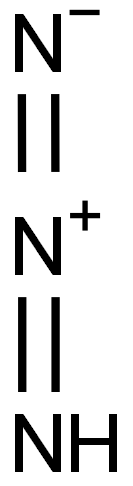
Hydrazoic acid
7782-79-8You may like