


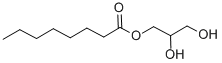
1-Octanoyl-rac-glycerol synthesis
- Product Name:1-Octanoyl-rac-glycerol
- CAS Number:19670-49-6
- Molecular formula:C11H22O4
- Molecular Weight:218.29
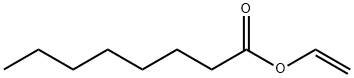
818-44-0
43 suppliers
$14.00/1mL
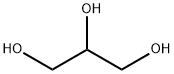
56-81-5
1843 suppliers
$5.00/25g
19670-49-6
48 suppliers
$36.50/100 mg

1429-66-9
37 suppliers
$34.00/5mg
Yield: 93%
Reaction Conditions:
lipase from Candida Antarctica type B, immobilized at 0;Product distribution / selectivity;Enzymatic reaction;
Steps:
7
DICAPRYLIN (1, 3-DCY) 1, 3DCy was purified by crystallization from n-hexane at-20°C several times. When high amount of MG was presented, the second crystallization in dry methanol has to be done to obtain 1,3-DCy in high purity (>98%). Highest yield of 1,3- DCy (93%) obtained from esterification between vinyl caprylate (CYVE) and glycerol at 0°C in a solvent-free condition catalyzed by CAL-B. The yield thus obtained was higher than the yield obtained (75%) in literature (see, e. g., J. Am. Oil Chem. Soc. , 1992,69 : 955- 960), see Figure 12. Figure 12 illustrates data of various esterification reactions in the synthesis of 1, 3-DCy. Method 1 is the esterification of glycerol and caprylic acid in a solvent-free condition at 0°C catalyzed by CAL-B. Method 2 is the esterification of glycerol and caprylic acid vinyl ester in a solvent-free condition at 0°C catalyzed by CAL-B. Method 3 see, e. g. , J. Am. Oil Chem. Soc. , 1992,69 : 955-960) is the esterification of glycerol immobilized on silica gel and caprylic acid vinyl ester in MTBE at room temperature catalyzed by Lipozyme RM IMTM (Novozymes, Denmark). DG = 1,3-dicaprylin, MG = 1-MONOCAPRYLIN. Esterification between caprylic acid (Cy) and glycerol gave moderate yield (55%) at lower reaction rates and high amount of MAG was produced during the reaction. The yield could be increased up to 65% by increasing the reaction temperature from 0°C to room temperature. CAL-B gave higher yield and less MAG and allowed faster reaction rate than Lipozyme RM IM" (Novozymes, Denmark) in esterification of glycerol and Cy or CYVE, both in organic solvent and a solvent-free condition. Studies on effect of ratio of glycerol: caprylic acid on esterification reaction showed that initial reaction rate decreased and the yield of 1, 3-DCy slightly increased with increasing ratio from 1: 2 to 1: 6, as illustrated in (Figure 13). Figure 13 summarizes data showing the effect of substrate ratio on esterification between glycerol and caprylic acid in n-hexane at 0°C catalyzed by CAL-B (DG = 1,3-dicaprylin, MG = 1- monocaprylin).
References:
DIVERSA CORPORATION WO2005/32496, 2005, A2 Location in patent:Page/Page column 224; 12/138
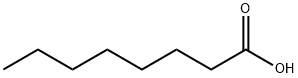
124-07-2
743 suppliers
$6.00/25g
56-81-5
1843 suppliers
$5.00/25g
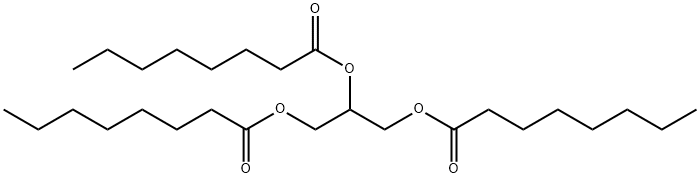
538-23-8
209 suppliers
$25.00/50mg
19670-49-6
48 suppliers
$36.50/100 mg
1429-66-9
37 suppliers
$34.00/5mg
124-07-2
743 suppliers
$6.00/25g
56-81-5
1843 suppliers
$5.00/25g
19670-49-6
48 suppliers
$36.50/100 mg
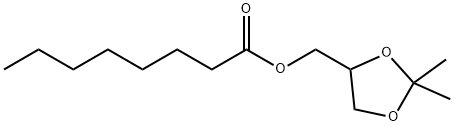
115228-29-0
9 suppliers
inquiry
19670-49-6
48 suppliers
$36.50/100 mg
124-07-2
743 suppliers
$6.00/25g
56-81-5
1843 suppliers
$5.00/25g
19670-49-6
48 suppliers
$36.50/100 mg
1429-66-9
37 suppliers
$34.00/5mg