| Identification | More | [Name]
Octachloronaphthalene | [CAS]
2234-13-1 | [Synonyms]
1,2,3,4,5,6,7,8-OCTACHLORONAPHTHALENE
HALOWAX 1051
OCTACHLORONAPHTHALENE
PCN-75
PERCHLORONAPHTHALENE
octachloro-naphthalen
Perna
OCTACHLORONAPHTHALENE, 20MG, NEAT
Octachloronaphthalene solution | [EINECS(EC#)]
218-778-7 | [Molecular Formula]
C10Cl8 | [MDL Number]
MFCD00145026 | [Molecular Weight]
403.73 | [MOL File]
2234-13-1.mol |
| Chemical Properties | Back Directory | [Appearance]
The chlorinated naphthalenes in which one or
more hydrogen atoms have been replaced by chlorine to
form wax-like substances, beginning with monochloronaphthalene and going on to the octachlor derivatives.
Their physical states vary from mobile liquids to waxysolids depending on the degree of chlorination; freezing/
melting points of the pure compounds range from 17C
for 1-chloronaphthalene to 198C for 1,2,3,4-
tetrachloronaphthalene.
1-Chloro-isomer: Hazard identification (based on
NFPA-704 M Rating System): Health 2, flammability 1,
reactivity 0.
2-Chloro-isomer: | [Melting point ]
185°C | [Boiling point ]
440°C | [density ]
2.00 | [vapor pressure ]
4.20 x 10⁻⁷ mmHg at 25.00 °C (Lei et al., 1999) | [refractive index ]
1.6000 (estimate) | [Fp ]
-18 °C | [storage temp. ]
APPROX 4°C
| [solubility ]
Soluble in benzene, chloroform, and ligroin (Weast, 1986) | [form ]
neat | [color ]
Waxy, light yellow solid with an aromatic odor | [Water Solubility ]
Insoluble | [BRN ]
1653604 | [Exposure limits]
NIOSH REL: TWA 0.1, STEL 0.3; OSHA PEL: TWA 0.1; ACGIH
TLV: TWA 0.1, STEL, 0,3 (adopted). | [InChIKey]
RTNLUFLDZOAXIC-UHFFFAOYSA-N | [CAS DataBase Reference]
2234-13-1(CAS DataBase Reference) | [NIST Chemistry Reference]
Naphthalene, octachloro-(2234-13-1) | [EPA Substance Registry System]
Octachloronaphthalene (2234-13-1) |
| Questions And Answer | Back Directory | [Synthesis]
Polychlorinated naphthalene was prepared from naphthalene and phosphorus pentachloride as starting materials via a substitution reaction (Williamson reaction). All reagents used in the experiment were commercially available. The synthesis experiment using phosphorus pentachloride as the chlorinating agent was carried out in a pressure-resistant stainless steel reactor lined with polytetrafluoroethylene (PTFE). Experimental procedure: Naphthalene and phosphorus pentachloride were weighed and added to the PTFE-lined reactor, which was then sealed in a pressure-resistant stainless steel reactor and reacted at 260°C for 15 hours. After the reaction, the PTFE-lined reactor was removed and poured into ice water to remove unreacted PCI5. The insoluble solid was collected, washed with a small amount of water, dissolved in a small amount of toluene, dried with anhydrous MgSO4, filtered, and then an equal volume of anhydrous ethanol was added. The mixture was heated to reflux, filtered while hot, and then cooled to crystallize, yielding perchloronaphthalene. Mass spectrometry characterization was performed (spectrum shown below), with an average yield of 85%. 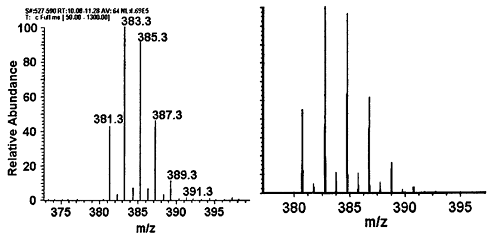
|
| Safety Data | Back Directory | [Hazard Codes ]
Xn,N,F | [Risk Statements ]
R22:Harmful if swallowed.
R67:Vapors may cause drowsiness and dizziness.
R65:Harmful: May cause lung damage if swallowed.
R50/53:Very Toxic to aquatic organisms, may cause long-term adverse effects in the aquatic environment .
R38:Irritating to the skin.
R11:Highly Flammable. | [Safety Statements ]
S36/39:Wear suitable protective clothing and eye/face protection .
S62:If swallowed, do not induce vomiting: seek medical advice immediately and show this container or label .
S61:Avoid release to the environment. Refer to special instructions safety data sheet .
S60:This material and/or its container must be disposed of as hazardous waste . | [OEB]
D | [OEL]
TWA: 0.1 mg/m3, STEL: 0.3 mg/m3 [skin] | [RIDADR ]
UN 1145 3/PG 2 | [WGK Germany ]
3 | [RTECS ]
QK0250000 | [TSCA ]
TSCA listed | [HS Code ]
2903998090 | [Safety Profile]
Poison by inhalation,
ingestion, and skin contact. When heated to
decomposition it emits highly toxic fumes of
Cl-. See also CHLORINATED
HYDROCARBONS, AROMATIC. | [Hazardous Substances Data]
2234-13-1(Hazardous Substances Data) | [Toxicity]
Heitmuller et al. (1981) reported a NOEC of 560 ppm. | [IDLA]
Unknown |
| Hazard Information | Back Directory | [General Description]
Pale yellow solid with an aromatic odor. | [Reactivity Profile]
Contact with strong oxidizing agents may cause fire and explosion . | [Air & Water Reactions]
Insoluble in water. | [Potential Exposure]
Industrial exposure from individual
chlorinated naphthalenes is rarely encountered; rather it
usually occurs from mixtures of two or more Chlorinated
naphthalenes. Due to their stability, thermoplasticity, and
nonflammability, these compounds enjoy wide industrial
application. These compounds are used in the production of
electric condensers; in the insulation of electric cables and
wires; as additives to extreme pressure lubricants; as supports for storage batteries; and as a coating in foundry use.
octachloro-: Used as a fireproof and waterproof additive
and lubricant additive. Pentachloro-: Used in electric wire
insulation and in additives to special lubricants. tetrachloro-: Used in electrical insulating materials and as an
additive in cutting oils. trichloro-: Used in lubricants and
in the manufacture of insulation for electrical wire.
Because of the possible potentiation of the toxicity of higher Chlorinated naphthalenes by ethanol and carbon tetrachloride, individuals who ingest enough alcohol to result in
liver dysfunction would be a special group at risk.
Individuals, e.g., analytical and synthetic chemists, mechanics and cleaners, who are routinely exposed to carbon tetrachloride or other hepatotoxic chemicals would also be at a
greater risk than a population without such exposure.
Individuals involved in the manufacture, utilization, or disposal of polychlorinated naphthalenes would be expected to
have higher levels of exposure than the general population. | [Fire Hazard]
Literature sources indicate that this chemical is nonflammable. | [First aid]
If this chemical gets into the eyes, remove any
contact lenses at once and irrigate immediately for at least
15 minutes, occasionally lifting upper and lower lids. Seek
medical attention immediately. If this chemical contacts the
skin, remove contaminated clothing and wash immediately
with soap and water. Seek medical attention immediately.
If this chemical has been inhaled, remove from exposure,
begin rescue breathing (using universal precautions, including resuscitation mask) if breathing has stopped and CPR if
heart action has stopped. Transfer promptly to a medical
facility. When this chemical has been swallowed, get medical attention. Give large quantities of water and induce
vomiting. Do not make an unconscious person vomit. | [Shipping]
UN3082 Environmentally hazardous substances,
liquid, n.o.s., Hazard class: 9; Labels: 9-Miscellaneous hazardous material, Technical Name Required. | [Incompatibilities]
All are incompatible with oxidizers
(chlorates, nitrates, peroxides, permanganates, perchlorates,
chlorine, bromine, fluorine, etc.); contact may cause fires
or explosions. Keep away from alkaline materials, strong
bases, strong acids, oxoacids, epoxides. Keep away from
heat. Penta- is also incompatible with acids, alkalis. | [Chemical Properties]
The chlorinated naphthalenes in which one or
more hydrogen atoms have been replaced by chlorine to
form wax-like substances, beginning with monochloronaphthalene and going on to the octachlor derivatives.
Their physical states vary from mobile liquids to waxysolids depending on the degree of chlorination; freezing/
melting points of the pure compounds range from 17C
for 1-chloronaphthalene to 198C for 1,2,3,4-
tetrachloronaphthalene.
1-Chloro-isomer: Hazard identification (based on
NFPA-704 M Rating System): Health 2, flammability 1,
reactivity 0.
2-Chloro-isomer: | [Waste Disposal]
High-temperature incineration
with flue gas scrubbing. Incineration, preferably after mixing with another combustible fuel. Care must be exercised
to assure complete combustion to prevent the formation of
phosgene. An acid scrubber is necessary to remove the halo
acids produced. | [Uses]
Chemical research; organic synthesis. According to HSDB (1005), U.S. has discontinued
manufacturing of chlorinated naphthalenes since 1977. Chlorinated naphthalenes were formerly
used as a wood preservative, additives in cutting oils, and as an additive in fireproofing and
waterproofing cable insulation. | [Uses]
In electric cable insulation; additive to
lubricants | [Uses]
Octachloronapthalene is a polychlorinated napththalene (PCN) produced via industrial thermal processes. It is a chemical pollutant present in the environment. | [Health Hazard]
The higher-chlorinated naphthalenes
may cause severe injury to the liver. | [Source]
Octachloronaphthalene was detected in various technical-grade PCB mixtures as
impurities or by-products. Concentrations were 0.098 μg/g in PCB-1016, 0.433 μg/g in PCB-
1232, 0.378 μg/g in PCB-1248, 3.23 μg/g in PCB-1254, 55.5 μg/g in PCB-1260, and 50.5 μg/g in
PCB-1262 (Yamashita et al., 2000). |
|
| Company Name: |
J & K SCIENTIFIC LTD.
|
| Telephone: |
18210857532 18210857532 |
| Website: |
https://www.jkchemical.com |
| Company Name: |
China Langchem Inc.
|
| Telephone: |
0086-21-58956006 |
| Website: |
www.chemicalbook.com/ShowSupplierProductsList19141/0_EN.htm |
|