




Borneol suppliers
Borneol
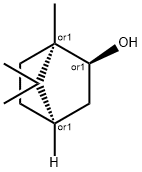
- CAS:
- 507-70-0
- MF:
- C10H18O
- MW:
- 154.25
Certification
- GMP
- HALAL
- KOSHER
Suppliers by country/region
Company Type
Properties
- Melting point:
- 206-209 °C
- Boiling point:
- 210 °C(lit.)
- alpha
- -0.5~+0.5゜(20℃/D)(c=5,C2H5OH)
- Density
- 1.011
- vapor density
- 5.31 (vs air)
- vapor pressure
- 33.5 mm Hg ( 25 °C)
- FEMA
- 2157 | BORNEOL
- refractive index
- 1.4831 (estimate)
- Flash point:
- 150 °F
- solubility
- DMSO:30.0(Max Conc. mg/mL);194.49(Max Conc. mM)
Ethanol:30.0(Max Conc. mg/mL);194.49(Max Conc. mM)
- form
- powder to crystal
- pka
- 15.36±0.60(Predicted)
- color
- White to Almost white
- Odor
- at 10.00 % in dipropylene glycol. pine woody camphor balsamic
- Odor Type
- balsamic
- Water Solubility
- insoluble
- Merck
- 14,1338
- JECFA Number
- 1385
- Henry's Law Constant
- 4.4×10⁻¹ mol/(m3Pa) at 25℃, Ebert et al. (2023)
- Stability:
- Stable. Highly flammable. Incompatible with strong oxidizing agents.
- Cosmetics Ingredients Functions
- PERFUMING
FRAGRANCE
- InChIKey
- DTGKSKDOIYIVQL-WEDXCCLWSA-N
- LogP
- 3.6 at 20℃
- CAS DataBase Reference
- 507-70-0(CAS DataBase Reference)
- NIST Chemistry Reference
- Borneol(507-70-0)
- EPA Substance Registry System
- Borneol (507-70-0)
Safety Information
- Symbol(GHS)


GHS02,GHS07,GHS08
- Signal word
- Warning
- Hazard statements
- H302-H371-H228
- Precautionary statements
- P501-P260-P270-P240-P210-P241-P264-P280-P370+P378-P308+P311-P301+P312+P330-P405
- Hazard Codes
- F,Xi,Xn
- Risk Statements
- 11-43-22
- Safety Statements
- 16-36/37
- RIDADR
- UN 1312
- WGK Germany
- 2
- RTECS
- DT5095000
- TSCA
- TSCA listed
- HazardClass
- 4.1
- PackingGroup
- III
- HS Code
- 29061990
- Hazardous Substances Data
- 507-70-0(Hazardous Substances Data)
- REACH Registrations
- Active
- Limited Quantities
- 5.0 Kg (11 lbs) (solid)
- Excepted Quantities
- Max Inner Pack (30g or 30ml) and Max Outer Pack (1Kg or 1L)
Use
Borneol is a bicyclic terpene alcohol. Borneol is an endo isomer; the corresponding exo isomer is isoborneol: Borneol occurs abundantly in nature as a single enantiomer or, less frequently, as the racemate. (1S,2R,4S)-(?)-Borneol occurs particularly in oils from Pinaceae species and in citronella oil. (1R,2S,4R)-(+)-Borneol is found, for example, in camphor oil (Ho-Sho oil), rosemary, lavender, and olibanum oils. Borneol is a colorless, crystalline solid. (+)-Borneol has a camphoraceous odor, with a slightly sharp, earthy, peppery note, which is less evident in (?)-borneol. Commercial borneol is often levorotatory ([α]20 D ?18 to ?28 in ethanol) and contains (?)-borneol and up to 40% isoborneol. Borneol is oxidized to camphor with chromic or nitric acid; dehydration with dilute acids yields camphene. Borneol is readily esterified with acids, but on an industrial scale, bornyl esters are prepared by other routes. For example, levorotatory borneol is synthesized industrially from levorotatory pinenes by Wagner–Meerwein rearrangement with dilute acid, followed by hydrolysis of the resulting esters. Borneol is used in the reconstitution of the essential oils in which it occurs naturally.
262 supplier list of "Borneol "

- Product Name:507-70-0
- Products Intro:Purity: 99% | Package: 25KG;5KG;1KG
- Company Type: Trader
- Country/Region: CHINA

- Product Name:Borneol
- Products Intro:Purity: 99.9% | Package: 1KG;5USD
- Company Type: Reagent
- Country/Region: CHINA

- Product Name:Borneol
- Products Intro:Purity: 0.99 | Package: 1kg,5kg,25kgs,200kgs;bulk
- Company Type: Trader
- Country/Region: CHINA
- Main Products: Octane booster,lubricant additve,specialty chemicals,ingredients

- Product Name:((1S)-endo)-(-)-borneol
- Company Type: Reagent
- Country/Region: CHINA
- Main Products: Gamma-butyrolactone

- Product Name:Borneol
- Products Intro:Purity: 0.99 | Package: 5KG;1KG
- Company Type: Trader
- Country/Region: CHINA
- Main Products: API(Active Pharmaceutical Ingredient),Lab Fine Chemical,Phytochemistry,Cosmetic Raw Materials
- Product Name:Borneol;(+)-Borneol
- Products Intro:Purity: 0.99 | Package: 25KG;5KG;1KG
- Company Type: Trader
- Country/Region: CHINA

- Product Name:Borneol
- Company Type: Trader
- Country/Region: CHINA
- Product Name:Formalin;Borneol
- Products Intro:Purity: 0.99 | Package: 25KG,200L
- Company Type: Trader
- Country/Region: CHINA
- Product Name:Borneol
- Products Intro:Package: 1g; 5g; 25g; 1kg; 5kg; 25kg
- Company Type: Trader
- Country/Region: CHINA
- Main Products: pharmaceuticals,intermediates,fine chemicals,screening compounds,building blocks