




Halothane suppliers
Halothane
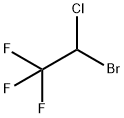
- CAS:
- 151-67-7
- MF:
- C2HBrClF3
- MW:
- 197.38
Suppliers by country/region
Company Type
Properties
- Melting point:
- -115.75°C
- Boiling point:
- 50.2 °C(lit.)
- Density
- 1.872 g/mL at 25 °C(lit.)
- vapor pressure
- 4.5 psi ( 20 °C)
- refractive index
- n
20/D 1.369(lit.)
- Flash point:
- 49-50°C
- storage temp.
- 2-8°C
- solubility
- Slightly soluble in water, miscible with anhydrous ethanol and with trichloroethylene.
- form
- Colorless liquid
- color
- Colorless to light yellow
- Odor
- Characteristic odor
- Water Solubility
- Soluble in water (8 mg/ml).
- Sensitive
- Light Sensitive
- Merck
- 14,4603
- BRN
- 1736947
- Henry's Law Constant
- 5.6×10⁻⁴ mol/(m3Pa) at 25℃, Fogg and Sangster (2003)
- Exposure limits
- TLV-TWA 50 ppm (~400 mg/m3) (ACGIH).
- InChI
- 1S/C2HBrClF3/c3-1(4)2(5,6)7/h1H
- InChIKey
- BCQZXOMGPXTTIC-UHFFFAOYSA-N
- SMILES
- FC(F)(F)C(Cl)Br
- CAS DataBase Reference
- 151-67-7(CAS DataBase Reference)
- EPA Substance Registry System
- Halothane (151-67-7)
Safety Information
- Symbol(GHS)


GHS05,GHS07,GHS08
- Signal word
- Danger
- Hazard statements
- H315-H318-H335-H360
- Precautionary statements
- P201-P280-P305+P351+P338+P310-P308+P313
- target organs
- Respiratory system
- PPE
- Eyeshields, Gloves
- Hazard Codes
- T,Xi,Xn
- Risk Statements
- 61-37/38-41-40-20
- Safety Statements
- 53-23-26-36/37-45-36
- RIDADR
- UN 3334
- OEL
- Ceiling: 2 ppm (16.2 mg/m3) [60-minute] [*Note: REL for exposure to waste anesthetic gas.]
- WGK Germany
- 3
- RTECS
- KH6550000
- F
- 8-19
- Hazard Note
- Irritant
- HS Code
- 2937990000
- Storage Class
- 6.1C - Combustible acute toxic Cat.3
toxic compounds or compounds which causing chronic effects
- Hazard Classifications
- Eye Dam. 1
Repr. 1B
Skin Irrit. 2
STOT SE 3
- Hazardous Substances Data
- 151-67-7(Hazardous Substances Data)
- Toxicity
- LD50 oral in rat: 5680mg/kg
Use
Halothane is a nonflammable, nonpungent, volatile, liquid,halogenated (F, Cl, and Br) ethane (bp=50°C), introducedin 1956. Halothane may increase heart rate, cause cardiacarrhythmias, increase cerebral blood flow, and increase intracranialpressure.It can undergo spontaneous oxidationwhen exposed to ultraviolet light to yield HCl, HBr, Cl ,Br- , and phosgene (COCl2). To prevent oxidation it ispackaged in amber bottles with a low concentration of thymol(0.01%) as a stabilizer. The drug has a high potency(MAC=0.75%), a blood:gas partition coefficient of 2.4,and high adipose solubility. Halothane undergoes both reductiveand oxidative processes with up to 20% of the doseundergoing metabolism .The trifluoroacetylchloride metabolite is electrophilic and can form covalentbonds with proteins leading to immune responses andhalothane hepatitis upon subsequent halothane exposure.Halothane hepatitis is rare with 1 case reported for every6,000 to 35,000 patients exposed.
90 supplier list of "Halothane"

- Product Name:2,2,2-Tribromoethanol
- Products Intro:Purity: 0.99 | Package: 5KG;1KG
- Company Type: Trader
- Country/Region: CHINA
- Main Products: Daily Chemicals

- Product Name:Halothane;Anestan;Narcotane
- Products Intro:Purity: 100.00% | Package: 100 mg;200 mg | CustNote: REAGENT;FOR LABORATORY USE ONLY
- Company Type: Trader
- Country/Region: UNITED STATES
- Main Products: Compound Libraries,Noval Small Molecucles,Nature Compounds,Inhibitory Antibodies,Life science Kits

- Product Name:Halothane
- Products Intro:Purity: 99% | Package: USP EP CP
- Company Type: Trader
- Country/Region: CHINA
- Main Products: Pharmceutical,Optical Brightening,dyes
- Product Name:2,2,2-Tribromoethanol
- Products Intro:Purity: 0.99 | Package: 5KG;1KG
- Company Type: Trader
- Country/Region: CHINA

- Product Name:2,2,2-Tribromoethanol
- Products Intro:Purity: 0.99 | Package: 5KG;1KG
- Company Type: Trader
- Country/Region: CHINA
- Main Products: N,N-Diethyl-3-methylbenzamide,β-Nicotinamide Mononucleotide NMN,2-Ethylhexanoic Acid,Sodium Cocoyl Isethionate,Glutathione powder Whitening
- Product Name:Formalin;Halothane
- Products Intro:Purity: 0.99 | Package: 25KG,200L
- Company Type: Trader
- Country/Region: CHINA

- Product Name:2-bromo-2-chloro-1,1,1-trifluoroethane
- Products Intro:Purity: 99.99% | Package: 25kg/drum
- Company Type: Trader
- Country/Region: CHINA
- Main Products: Benzaldehyde,Butyraldehyde,Benzene,resin,Acetic acid
- Product Name:1,1,1-Trifluoro-2-chloro-2-bromoethane
- Products Intro:Purity: 0.98 | Package: 1KG;5KG;10KG;25KG;100KG;200KG
- Company Type: Trader
- Country/Region: CHINA
- Main Products: fluoride pharmaceutical,fluoride intermediates

- Product Name:Halothane
- Products Intro:Purity: 98% | Package: 1g;USD
- Company Type: Trader
- Country/Region: CHINA
- Main Products: Fine chemicals,Photoresist,Pharmaceutical intermediates,nucleoside,polypeptide
- Product Name:Halothane
- Company Type: Trader
- Country/Region: GERMANY