- Dibutyl phosphate
-
- $1.00
-
2026-08-07
- CAS:107-66-4
- Min. Order: 1KG
- Purity: 99%
- Supply Ability: 200000KG
- Dibutyl phosphate
-

- $10.00
-
2026-03-20
- CAS:107-66-4
- Min. Order: 1kg
- Purity: 99.5%
- Supply Ability: 100
- Dibutyl Phosphate
-

-
2025-06-20
- CAS:107-66-4
- Min. Order: 1kg
- Purity: 99%
- Supply Ability: 20tons
|
| | Dibutyl phosphate Basic information |
| Product Name: | Dibutyl phosphate | | Synonyms: | dp4(couplingagent);phosphatededibutyle;DIBUTYL PHOSPHATE (DBP);Di-n-butyl phosphate, 97+%;Dibutyl Phosphate (Mono- and Di- Ester mixture);di-n-Butyl hydrogen phsophate;Dibutoxyphosphinic acid;O,O-Dibutyl phosphate | | CAS: | 107-66-4 | | MF: | C8H19O4P | | MW: | 210.21 | | EINECS: | 203-509-8 | | Product Categories: | bc0001 | | Mol File: | 107-66-4.mol | 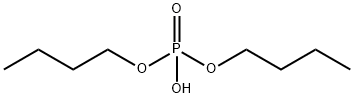 |
| | Dibutyl phosphate Chemical Properties |
| Melting point | -13 °C | | Boiling point | 250 °C | | density | 1.06 g/mL at 20 °C (lit.) | | vapor pressure | 0Pa at 20℃ | | refractive index | n20/D 1.428 | | Fp | 188 °C | | storage temp. | Store below +30°C. | | solubility | Chloroform (Soluble), Methanol (Slightly) | | form | Liquid | | pka | 1.53±0.50(Predicted) | | Specific Gravity | 1.1 | | color | Clear | | Water Solubility | insoluble | | BRN | 607224 | | Henry's Law Constant | 2.3×10³ mol/(m3Pa) at 25℃, HSDB (2015) | | Exposure limits | ACGIH:TLV-TWA 5 mg/m3 (0.6 ppm),Inhalable fraction and vapor
OSHA:PEL-TWA 1 ppm (5 mg/m3)
NIOSH:REL-TWA 1 ppm; REL-STEL 2 ppm | | InChI | 1S/C8H19O4P/c1-3-5-7-11-13(9,10)12-8-6-4-2/h3-8H2,1-2H3,(H,9,10) | | InChIKey | JYFHYPJRHGVZDY-UHFFFAOYSA-N | | SMILES | CCCCOP(O)(=O)OCCCC | | LogP | -0.9 at 25℃ | | CAS DataBase Reference | 107-66-4(CAS DataBase Reference) | | EPA Substance Registry System | Dibutyl phosphate (107-66-4) |
| Hazard Codes | Xi,C | | Risk Statements | 37/38-41-38-34-40 | | Safety Statements | 26-39-45-36/37/39-25 | | RIDADR | 3261 | | OEB | B | | OEL | TWA: 1 ppm (5 mg/m3), STEL: 2 ppm (10 mg/m3) | | WGK Germany | 1 | | RTECS | TB9605000 | | TSCA | TSCA listed | | HazardClass | 8 | | PackingGroup | III | | HS Code | 29199000 | | Storage Class | 8A - Combustible corrosive hazardous materials | | Hazard Classifications | Carc. 2
Eye Dam. 1
Skin Corr. 1B | | Hazardous Substances Data | 107-66-4(Hazardous Substances Data) | | IDLH | 30 ppm |
| | Dibutyl phosphate Usage And Synthesis |
| Description | Dibutyl phosphate is a pale amber to brown,odorless liquid. Molecular weight = 210.24; Specificgravity (H2O:1) = 1.06; Boiling point = (decomposes)135-138℃; Freezing/Melting point = 213℃; Vapor pressure-1 mmHg at 20℃; Flash point = 188℃ (oc);Autoignition temperature = 420℃. Hazard Identification(based on NFPA-704 M Rating System): Health 3,Flammability 2, Reactivity 0. Practically insoluble in water. | | Chemical Properties | Dibutyl phosphate is a pale amber to brown, odorless liquid. It is used as a catalyst for cross-linking in the paint industry and antistatics for the textile industry. It is stable in neutral, acidic or alkaline solution, and is classified as "not readily biodegradable" but inhererently biodegradable.The half-life time of 4.99 years is estimated for the degradation of dibutyl phosphate in air by the reaction with photochemically produced OH radicals. (MITI, Japan). | | Uses | Pale amber liquid | | Uses | Dibutyl phosphate is used as a plasticizer for polymer system and hydraulic fluid directly and used as a catalyst for cross-linking in paint industry. It is used as an antifoam agent in ore separation process and as an antistatic agent in the textile industry. It can be used as a precursor for antistatics, as a mould release agent in polyurethane applications and, as a non volatile acidic catalyst soluble in organic media. | | Definition | ChEBI: Dibutyl phosphate is a dialkyl phosphate. | | General Description | Pale-amber odorless liquid. Mp: -13°C, bp: 135-138°C. Density: 1.06 g cm-3. Moderately soluble in water (18 g / L at 20°C). | | Reactivity Profile | Dibutyl phosphate Is non-flammable, but combustible (flash point 188°C). Auto-ignition temperature is 420°C. Emits irritating or toxic fumes in a fire. Is a moderately strong acid obtained by the partial esterification of phosphoric acid. Reacts exothermically and vigorously with bases. Incompatible with strong oxidizing agents, alkali metals, heat, or plastic. Reacts with many metals liberating flammable/explosive hydrogen gas. | | Health Hazard | Dibutyl phosphate is an irritant
of the eyes and mucous membranes. | | Flammability and Explosibility | Non flammable | | Safety Profile | Moderately toxic by
ingestion. When heated to decomposition it
emits toxic fumes of POx. See also
PHOSPHATES. | | Potential Exposure | This material is used as a catalyst in
organic synthesis. | | First aid | If this chemical gets into the eyes, remove anycontact lenses at once and irrigate immediately for at least15 min, occasionally lifting upper and lower lids. Seek medical attention immediately. If this chemical contacts theDibutyl phosphate 901skin, remove contaminated clothing and wash immediatelywith soap and water. Seek medical attention immediately. Ifthis chemical has been inhaled, remove from exposure,begin rescue breathing (using universal precautions, including resuscitation mask) if breathing has stopped and CPR ifheart action has stopped. Transfer promptly to a medicalfacility. When this chemical has been swallowed, get medical attention. If victim is conscious, administer water ormilk. Do not induce vomiting. | | storage | Color Code—White: Corrosive or Contact Hazard;Store separately in a corrosion-resistant location. Prior toworking with this chemical you should be trained on its properhandling and storage. Dibutyl phosphate must be stored toavoid contact with strong oxidizers, such as chlorine, chlorinedioxide, and bromine, since violent reactions occur. | | Shipping | UN1760 Corrosive liquids, n.o.s., Hazard class: 8;
Labels: 8-Corrosive material, Technical Name Required.
UN3261 Corrosive solid, acidic, organic, n.o.s., Hazard
class: 8; Labels: 8-Corrosive material, Technical Name
Required. | | Incompatibilities | Dibutyl phosphate is a medium strong
acid. Incompatible with oxidizers (chlorates, nitrates, per-
oxides, permanganates, perchlorates, chlorine, bromine,
fluorine, etc.); contact may cause fires or explosions. Keep
away from alkaline materials, strong bases, strong acids,
oxoacids, and epoxides. Attacks many metals forming flammable and explosive hydrogen gas. Attacks some plas-
tics, rubber, and coatings. | | Toxics Screening Level | Two initial threshold screening levels (ITSLs) for dibutyl phosphate, included an JTSL of 86 μg/m3 based on an 8-hour averaging time, and an ITSL of 170 μg/m3 based on a 1-hour averaging time. |
| | Dibutyl phosphate Preparation Products And Raw materials |
|