- Cytosine
-

- $999.00
-
2026-10-14
- CAS:71-30-7
- Min. Order: 1kg
- Purity: 99%
- Supply Ability: 5000
- Cytosine
-

-
2026-10-14
- CAS:71-30-7
- Purity: 0.99
- Cytosine
-

-
2026-10-14
- CAS:71-30-7
- Min. Order: 1KG
- Purity: 99%
- Supply Ability: 500mt/year
|
| | Cytosine Chemical Properties |
| Melting point | >300 °C (lit.) | | Boiling point | 208.2°C (rough estimate) | | density | 0,48 g/cm3 | | refractive index | 1.5000 (estimate) | | storage temp. | 2-8°C | | solubility | Clear to very slightly hazy colorless to faint yellow solution at 50 mg/ml in 0.5 M HCL. | | form | Crystalline Powder | | pka | 4.60, 12.16(at 25℃) | | color | White to slightly yellow | | biological source | synthetic (organic) | | Water Solubility | soluble | | Specific Heat Capacity | Cp(crystal): 1.19 J/(g·K), at 25℃ | | Merck | 14,2795 | | BRN | 2637 | | Stability: | Stable. Incompatible with strong oxidizing agents. | | Cosmetics Ingredients Functions | SKIN CONDITIONING | | InChI | 1S/C4H5N3O/c5-3-1-2-6-4(8)7-3/h1-2H,(H3,5,6,7,8) | | InChIKey | OPTASPLRGRRNAP-UHFFFAOYSA-N | | SMILES | NC1=NC(=O)NC=C1 | | LogP | -1.962 (est) | | CAS DataBase Reference | 71-30-7(CAS DataBase Reference) | | NIST Chemistry Reference | 2(1H)-Pyrimidinone, 4-amino-(71-30-7) | | EPA Substance Registry System | 2(1H)-Pyrimidinone, 4-amino- (71-30-7) |
| Hazard Codes | Xi,Xn | | Risk Statements | 36/37/38-20/21/22 | | Safety Statements | 26-36-37/39 | | WGK Germany | 1 | | RTECS | UW7350150 | | Hazard Note | Irritant | | TSCA | TSCA listed | | HS Code | 29335910 | | Storage Class | 11 - Combustible Solids |
| | Cytosine Usage And Synthesis |
| Synthesis | 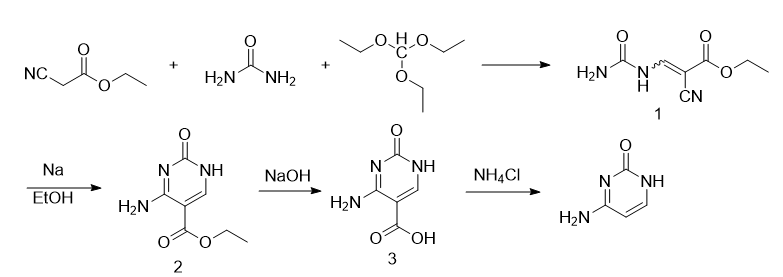
The specific synthesis method of intermediate 1 is as follows: In a 2500 mL round-bottom flask, add 180 g (3.0 mol) of urea, 370 g (2.5 mol) of triethyl orthoformate, and 226 g (2.0 mol) of ethyl cyanoacetate. Stir and reflux for 4 hours, constantly observing the reflux phenomenon to ensure uniform and stable reflux. After the reaction is stopped, cool and filter, collect the yellowish-white solid, wash with acetone, dry, and obtain intermediate 1, a yellowish-white powdery solid of 294.5 g, with a yield of 81%. The specific synthesis method of intermediate 2 is as follows: Add 1000 mL of anhydrous methanol to a 2500 mL round-bottom flask, then add 23 g (1 mol) of metallic sodium in portions. After the metallic sodium is completely dissolved, add 183 g (1 mol) of intermediate 1, followed by 5.6 g (0.1 mol) of nano-calcium oxide powder. Heat to 60 °C and reflux for 3 hours. Stop the reaction, cool, and collect the yellow solid by suction filtration. Dissolve the obtained solid in 500 mL of water, adding water while stirring until the yellow solid is completely dissolved. Acidify with dilute hydrochloric acid (prepared from concentrated hydrochloric acid and water in a volume ratio of 1:3) to a pH between 6 and 7. A precipitate forms; collect the white solid by suction filtration and wash with a small amount of acetone. Dry to obtain intermediate 2, a white powdery solid, 53 g, yield 29%. The specific synthesis method of intermediate 3 is as follows: 800 mL of 10% NaOH solution was prepared and added to a 2500 mL round-bottom flask. The solution was heated to 90°C, and 91.5 g (0.5 mol) of intermediate was added and stirred for 15 minutes. The solution was rapidly cooled to room temperature, and then acidified with hydrochloric acid to pH 5. A white precipitate was formed. The precipitate was filtered, washed with water, and dried to obtain 73.6 g of 5-carboxycytosine, a white powdery solid, with a yield of 95%. The decarboxylation synthesis of cytosine was performed as follows: 77.5 g (0.5 mol) of intermediate 3, 26.8 g (0.5 mol) of ammonium chloride, and 500 mL of N-methylpyrrolidone were added to a 1000 mL round-bottom flask. Nitrogen gas was introduced for protection, and the mixture was stirred until homogeneous. The mixture was then heated to 180 °C and maintained at this temperature for 8 hours. The mixture was then refluxed until few bubbles were removed. The reaction was stopped, and the mixture was cooled to room temperature. 150 mL of diethyl ether was added, and the precipitated solid was filtered. The white solid collected was the final product, cytosine. After drying, 49 g of a white crystalline solid was obtained, with a yield of 87.0%. | | Description | Cytosine is pyrimidine; along with adenine and guanine they account for the fi ve nucleic acid bases. Pyrimidines are heterocyclic single-ringed compounds based on the structure of pyrimidine. Cytosinelike adenine and guanine, form nucleosides and nucleotides in RNA and DNA. When the bases combine with ribose, a ribonucleoside forms; and when it attaches to deoxyribose, a deoxyribosenucleoside is formed. Names of the nucleoside are summarized in Table 29.1.these in turn combine with phosphoryl groups, in a process called phosphorylation, to form their respective nucleotides that form nucleic acids.the nucleotides can be tri, di, and mono phosphate nucleotides similar to the way in which adenine forms ATP, ADP, and AMP. | | Chemical Properties | White Solid | | History | Cytosine is first isolated by hydrolysis of calf thymus tissue by Albrecht
Kossel (1853–1927) and A. Neumann during 1893–1894. Thymine’s structure was published
in 1900 and confi rmed over the next several years when it was synthesized by several
investigators. In 1903, cytosine was synthesized by Henry Lord Wheeler (1867–1914) and
Treat B. Johnson, confirming its structure. Uracil was first isolated in 1900 from yeast
nucleic acid found in bovine thymus and herring sperm.the methylation of uracil produces
thymine; thymine is also called 5-methyluracil because methylation takes place at the fi fth
carbon in uracil to produce thymine. | | Uses | Widely distributed in nature; constituent of nucleic acids | | Uses | Cytosine is a nucleoside used for proteomics research. It is also used as an enzyme substrate or precursor of effector molecules such as cytosine sugars. | | Uses | Cytosine has been used:
- for the preparation of nucleobase solutions
- as a standard for high-performance liquid chromatography (HPLC)
- for the estimation of global methylation rate
- for nucleoside 5′-triphosphate (NTP) synthesis
- purification
| | Definition | ChEBI: An aminopyrimidine that is pyrimidin-2-one having the amino group located at position 4. | | Definition | cytosine: A pyrimidine derivative.It is one of the principal componentbases of nucleotides and the nucleicacids DNA and RNA. | | Definition | A nitrogenous
base found in DNA and RNA. Cytosine
has the pyrimidine ring structure. | | Biological Functions | Cytosine is one of the five nitrogenous bases that make up the genetic code in DNA and RNA. Nucleic acids are essential in heredity, cellular function, and biological reactions. Cytosine can also be methylated by adding a methyl (CH3) group at the C5 position and, in this modified form, plays a vital role in epigenetics. Moreover, cytosine can be transformed into other bases, such as uracil, further elevating the importance of this nitrogenous base in epigenetics. In its epigenetically modified form, cytosine associates with changes in the cellular and developmental process, neuron cell development, and human tumor development. Cytosine, in the form of cytidine triphosphate (CTP), may be used as an enzyme co-factor. Transferring a phosphate can convert adenosine diphosphate (ADP) to ATP. ATP is a high-energy molecule that is involved in a variety of cellular functions and essential biological reactions. | | General Description | Pharmaceutical secondary standards for application in quality control, provide pharma laboratories and manufacturers with a convenient and cost-effective alternative to the preparation of in-house working standards. | | Biochem/physiol Actions | Cytosine (C) is one of the four main bases found in DNA and RNA, along with adenine, guanine, and thymine (uracil in RNA). | | Purification Methods | Cytosine crystallises from H2O as the monohydrate which loses water on heating above 100o. Its solubility in H2O is 0.77%. UV: max 267nm (� 6,100) in H2O pH 8.8 and 275nm (� 10,400) in 0.1N HCl. [Hilbert & Johnson J Am Chem Soc 52 1152 1930, Hilbert et al. J Am Chem Soc 57 552 1935, Beistein 25 III/IV 3654.] | | Structure and conformation | Cytosine is a pyrimidine containing a single heterocyclic aromatic ring, a keto group at C2, and an amine group at C4. The molecule is planar in shape. Cytosine can form three hydrogen bonds with guanine. Due to these three hydrogen bonds, the cytosine-guanine base pair has an overall higher boiling point and greater bond strength than the adenine-thymine base pair. The high melting point makes the cytosine-guanine base-pair much more resistant to denaturation. The double strand of DNA breaks down into its single constituent strands due to high temperatures. |
| | Cytosine Preparation Products And Raw materials |
|