|
|
| | 2,3,6-Trichlorobenzoic acid Basic information |
| Product Name: | 2,3,6-Trichlorobenzoic acid | | Synonyms: | 4,4'-di(triphenylen-2-yl)biphenyl;2,3,6-TBA(R);BENZAC 1281;HC-1281;2,3,6-Tba(the herbicide);2,3,6-TCB;2,3,6-TCBA;2,3,6-Trichlorbenzoesaeure | | CAS: | 50-31-7 | | MF: | C7H3Cl3O2 | | MW: | 225.46 | | EINECS: | 200-026-4 | | Product Categories: | Aromatic acidAlphabetic;Herbicides;Pesticides&Metabolites;TP - TZ;MOF | | Mol File: | 50-31-7.mol | 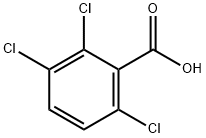 |
| | 2,3,6-Trichlorobenzoic acid Chemical Properties |
| Melting point | 126-127 °C(lit.) | | Boiling point | 324.5±37.0 °C(Predicted) | | density | 1.5599 (estimate) | | storage temp. | Sealed in dry,Room Temperature | | solubility | soluble in Methanol | | pka | 1.25±0.25(Predicted) | | color | White to Light yellow to Light orange | | Water Solubility | 7.70g/L(20 ºC) | | Henry's Law Constant | 4.7×10² mol/(m3Pa) at 25℃, Duchowicz et al. (2020) | | Stability: | Stable under recommended storage conditions., Stable Under Recommended Storage C | | CAS DataBase Reference | 50-31-7(CAS DataBase Reference) | | EPA Substance Registry System | 2,3,6-Trichlorobenzoic acid (50-31-7) |
| Hazard Codes | Xn,N | | Risk Statements | 22-51/53 | | Safety Statements | 61 | | RIDADR | UN 2811 6.1/PG 1 | | WGK Germany | 2 | | RTECS | DH7700000 | | TSCA | TSCA listed | | HS Code | 2916.39.7900 | | HazardClass | 9 | | Hazardous Substances Data | 50-31-7(Hazardous Substances Data) | | Toxicity | Acute oral LD50 for rats 1,500 mg/kg (Hartley and Kidd, 1987), 650 mg/kg
(RTECS, 1985). |
| | 2,3,6-Trichlorobenzoic acid Usage And Synthesis |
| Description | 2,3,6-TBA is a post-emergence herbicide. It is highly soluble in water and most organic solvents. It is considered volatile. Little has been reported on its environmental persistence or mobility. It is moderately toxic to mammals and a recognised irritant. Based on its chemical properties it would not expected to bioaccumulate. There are gaps in knowledge regarding its toxicity to biodiversity however data has shown that it is moderately toxic to bids, fish and honeybees. | | Chemical Properties | A solid. | | Uses | Systemic growth-regulator herbicide used for postemergence control of broad-leaved
perennial and annual weeds in cereals and grass seed crops. | | Uses | An all-purpose, non-selective, pre-emergent
and early post-emergent herbicide. | | Definition | A substituted benzoic acid that is a potent synthetic
auxin. | | Hazard | Poison; moderately toxic. | | Mechanism of action | Systemic, absorbed by leaves and roots with auxin type action | | Safety Profile | Poison by intraperitoneal route.Moderately toxic by ingestion and subcutaneous routes.When heated to decomposition it emits toxic fumes ofClí. Used as an herbicide. | | Synthesis | The general procedure for the synthesis of 2,3,6-trichlorobenzoic acid from 2,3,6-trichlorobenzene was as follows: 2,3,6-trichlorobenzene was added to 100 mL of water, followed by the addition of 0.4 g of tetrabutylammonium chloride as a phase-transfer catalyst, and 63 g of potassium permanganate. The reaction mixture was heated to 50 °C for 6 hours. Upon completion of the reaction, the pH of the filtrate was adjusted to 3 with 5% hydrochloric acid solution (mass percent, as HCl), at which time a large amount of white solid precipitated. The precipitate was collected by filtration, washed with a small amount of water and dried to give 43.3 g of 2,3,6-trichlorobenzoic acid with 95% purity and 96% yield by HPLC. | | Environmental Fate | Photolytic. Plimmer (1970) postulated that the irradiation of 2,3,6-trichlorobenzoic
acid in methanol will undergo dechlorination forming 2,3-, 2,6- and 3,6-dichlorobenzoic
acids. Further irradiation may yield 2- and 3-chlorobenzoic acids which may ultimately
form benzoic acid (Plimmer, 1970).
Chemical/Physical. Reacts with alkalies and amines forming water-soluble salts. | | References | [1] J. Appl. Chem. USSR (Engl. Transl.), 1980, vol. 53, # 12, p. 2076 - 2078
[2] Zhurnal Prikladnoi Khimii (Sankt-Peterburg, Russian Federation), 1980, vol. 53, # 12, p. 2737 - 2740
[3] Patent: CN105294419, 2016, A. Location in patent: Paragraph 0105; 0106
[4] Journal of the Chemical Society, 1951, p. 1208,1212
[5] Journal of the Chemical Society, 1902, vol. 81, p. 1335 | | Pesticide Type | Herbicide |
| | 2,3,6-Trichlorobenzoic acid Preparation Products And Raw materials |
|