|
|
| | Centanafadine HCl Basic information |
| Product Name: | Centanafadine HCl | | Synonyms: | Centanafadine HCl;Centanafadine hydrochloride (EB-1020 (hydrochloride));(1R,5S)-(+)-1-(naphthalen-2-yl)-3-azabicyclo[3.1.0]hexane hydrochloride;Centanafadine hydrochloride (Synonyms: EB-1020 (hydrochloride));Centafadine hydrochloride;EB-1020 hydrochloride;CTN SR;EB-1020 SR | | CAS: | 923981-14-0 | | MF: | C15H16ClN | | MW: | 245.75 | | EINECS: | | | Product Categories: | APIS | | Mol File: | 923981-14-0.mol | 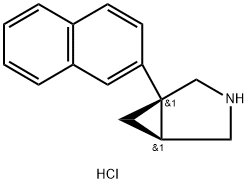 |
| | Centanafadine HCl Chemical Properties |
| storage temp. | Store at -20°C | | solubility | DMSO: 125 mg/mL (508.65 mM) | | form | Solid | | color | White to off-white |
| | Centanafadine HCl Usage And Synthesis |
| Uses | Centanafadine Hydrochloride is a serotonin-norepinephrine-dopamine reuptake inhibitor (SNDRI) used as a treatment for attention deficit hyperactivity disorder (ADHD) that is in phase II clinical trials. | | in vivo | In microdialysis studies, Centanafadine markedly increases NE, and DA concentrations levels in rat prefrontal cortex in vivo with peak increases of 375 and 300%, respectively with the greatest effects on NE, and also increases DA extracellular concentrations in the striatum to 400% of baseline concentrations. Behavioral studies demonstrate that Centanafadine dose-dependently decreases immobility in the mouse tail suspension test of depression to 13% of control levels, and do not stimulate locomotor activity in adult rats in the optimal dose range. Centanafadine dose-dependently inhibits locomotor hyperactivity in juvenile rats lesioned with the neurotoxin 6-hydroxydopamine (100 μg intracisternally) as neonates; a well-established animal model for attention-deficit hyperactivity disorder (ADHD)[1]. |
| | Centanafadine HCl Preparation Products And Raw materials |
|