| Company Name: |
BOC Sciences |
| Tel: |
1-631-485-4226; 16314854226 |
| Email: |
info@bocsci.com |
|
| | F-15599 Basic information |
| Product Name: | F-15599 | | Synonyms: | F-15599;F 15;F15;F-15;NLX 101;NLX101;NLX-101; NLX 101; NLX101; F-15;599; F 15;599; F15;599; F15599;NLX-101 F-15599 | | CAS: | 635323-95-4 | | MF: | C19H21ClF2N4O | | MW: | 394.85 | | EINECS: | | | Product Categories: | API | | Mol File: | 635323-95-4.mol | 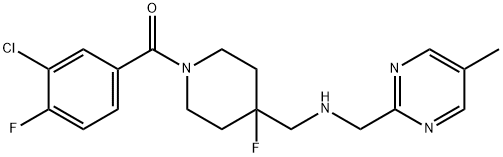 |
| | F-15599 Chemical Properties |
| Melting point | 195 °C | | Boiling point | 534.7±50.0 °C(Predicted) | | density | 1.33±0.1 g/cm3(Predicted) | | storage temp. | Store at -20°C | | solubility | DMSO:200.0(Max Conc. mg/mL);506.5(Max Conc. mM) | | form | Solid | | pka | 8.20±0.20(Predicted) | | color | White to off-white |
| | F-15599 Usage And Synthesis |
| Uses | F-15599 is a highly selective G-protein biased 5-HT1A receptor agonist, with Ki of 3.4 nM. | | in vivo | F15599 (0.06 or 0.12 mg/kg) significantly reduces l-DOPA-induced dyskinesia (LID), without affecting motor performance of rats. Rats treated with F15599 manifest less LID and mild 5-HT syndrome with the high dose of 30 μg/μL[1]. F15599 (0.0625, 0.125, 0.25, 0.5 and 1.0 mg/kg, i,p,) results in a significant and dose-dependent (MED=0.125 mg/kg) delay in the latency to attack, and a potent reduction (ID50=0.095 mg/kg) in the amount of aggressive behaviour directed towards the intruder rat. Starting from the 0.25 mg/kg dose, F15599 induces clear signs of the so-called serotonin syndrome characterized by flat body posture, head-waving, lower lip retraction and hindlimb abduction, leading to increased behavioural inactivity scores and social disengagement[2]. F15599 increases the discharge rate of pyramidal neurones in medial prefrontal cortex (mPFC) from 0.2 μg/kg i.v and reduces that of dorsal raphe 5-hydroxytryptaminergic neurones at doses >10-fold higher (minimal effective dose 8.2 μg/kg i.v.). F15599 increases dopamine output in mPFC (an effect dependent on the activation of postsynaptic 5-HT1A receptors) with an ED50 of 30 μg/kg i.p., whereas it reduces hippocampal 5-HT release (an effect dependent exclusively on 5-HT1A autoreceptor activation) with an ED50 of 240 μg/kg i.p[3]. | | IC 50 | 5-HT1A Receptor: 3.4 nM (Ki) | | References | [1] Meadows SM, et al. Characterizing the differential roles of striatal 5-HT1A auto- and hetero-receptors in the reduction of l-DOPA-induced dyskinesia. Exp Neurol. 2017 Jun;292:168-178. DOI:10.1016/j.expneurol.2017.03.013
[2] de Boer SF, et al. Anti-aggressive effects of the selective high-efficacy 'biased' 5-HTA receptor agonists F15599 and F13714 in male WTG rats. Psychopharmacology (Berl). 2016 Mar;233(6):937-47. DOI:10.1007/s00213-015-4173-x
[3] Lladó-Pelfort L, et al. Preferential in vivo action of F15599, a novel 5-HT(1A) receptor agonist, at postsynaptic 5-HT(1A) receptors. Br J Pharmacol. 2010 Aug;160(8):1929-40. DOI:10.1111/j.1476-5381.2010.00738.x |
| | F-15599 Preparation Products And Raw materials |
|