|
|
| | Abarelix (acetate) Basic information |
| Product Name: | Abarelix (acetate) | | Synonyms: | N-acetyl-3-(2-naphthalenyl)-D-alanyl-4-chloro-D-phenylalanyl-3-(3-pyridinyl)-D-alanyl-L-seryl-N-methyl-L-tyrosyl-D-asparaginyl-L-leucyl-N6-(1-methylethyl)-L-lysyl-L-prolyl-D-alaninamide, acetate salt | | CAS: | 785804-17-3 | | MF: | C74H99ClN14O16 | | MW: | 1476.14 | | EINECS: | | | Product Categories: | | | Mol File: | 785804-17-3.mol | 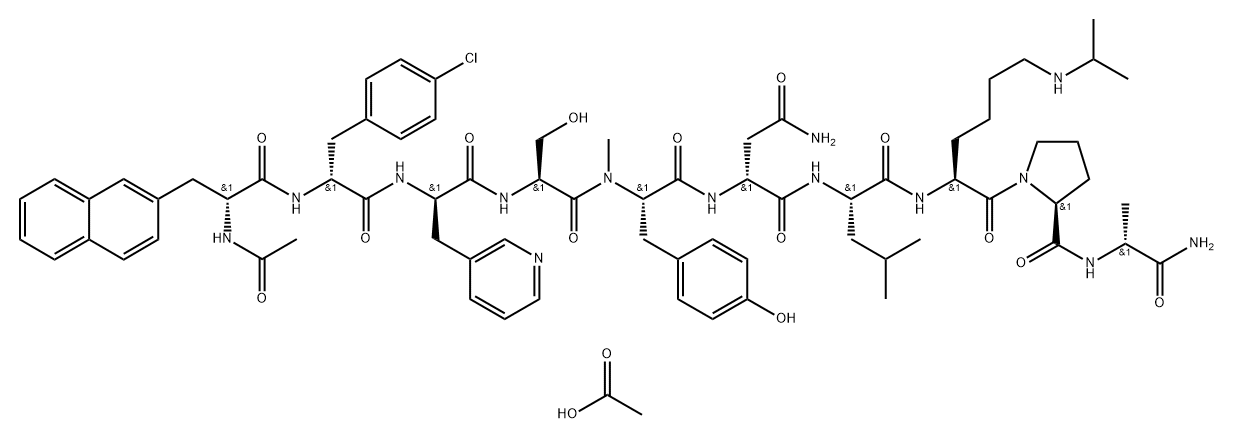 |
| | Abarelix (acetate) Chemical Properties |
| storage temp. | Store at -20°C | | solubility | DMF: 30 mg/ml; DMSO: 30 mg/ml; Ethanol: 30 mg/ml; PBS (pH 7.2): 5 mg/ml | | form | A crystalline solid | | color | white to beige |
| WGK Germany | WGK 3 | | Storage Class | 11 - Combustible Solids | | Hazard Classifications | Repr. 2 |
| | Abarelix (acetate) Usage And Synthesis |
| Description | Abarelix acetate is a synthetic third generation gonadotropin-releasing hormone receptor (GnRHR) antagonist. It increases histamine release from rat peritoneal mast cells in vitro and from a human skin model ex vivo. In vivo, abarelix decreases plasma luteinizing hormone (LH) levels six hours post-treatment in castrated rats, with levels returning to baseline within 24 hours.3 Abarelix (2 mg/kg) also transiently decreases plasma testosterone levels in intact rats, with levels returning to baseline within seven days post-treatment. Formulations containing abarelix have previously been used in the treatment of advanced prostate cancer. |
| | Abarelix (acetate) Preparation Products And Raw materials |
|