|
|
| | BUTROXYDIM Basic information |
| Product Name: | BUTROXYDIM | | Synonyms: | butroxydim (bsi, pa e-iso);FALCON;BUTROXYDIM;5-(3-butyryl-2,4,6-trimethylphenyl)-2-[1-(ethoxyimino)propyl]-3-hydroxycyclohex-2-en-1-one;Butroxydim [iso];2-[1-(Ethoxyimino)propyl]-3-hydroxy-5-[2,4,6-trimethyl-3-(1-oxobutyl)phenyl]-2-cyclohexen-1-one;Fenoxydim;Butroxydim, 10 μg /μL in cyclohexane | | CAS: | 138164-12-2 | | MF: | C24H33NO4 | | MW: | 399.52 | | EINECS: | 414-790-3 | | Product Categories: | | | Mol File: | 138164-12-2.mol | 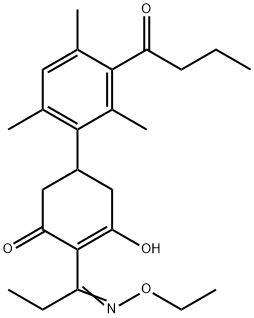 |
| | BUTROXYDIM Chemical Properties |
| Melting point | 80.8℃ | | Boiling point | 535.9±60.0 °C(Predicted) | | density | 1.11±0.1 g/cm3(Predicted) | | storage temp. | 0-6°C | | pka | 4.18±0.25(Predicted) | | Henry's Law Constant | 1.7×10⁴ mol/(m3Pa) at 25℃, MacBean (2012) |
| | BUTROXYDIM Usage And Synthesis |
| Description | Butroxydim is an obsolete herbicide. It has a low aqueous solubility, is relatively volatile and, based on its chemical properties, is non-mobile and would not be expected to leach to groundwater. It is generally non-persistent in soil systems but may persist in aquatic systems under certain conditions. It is not generally susceptible to hydrolysis. It has a moderate mammalian toxicity and has a high potential to bioaccumulate. It is moderately toxic to most aquatic species, birds and earthworms but relatively non-toxic to honeybees. | | Production Methods | The production of butroxydim involves synthesising a cyclohexane-1,3-dione core, which serves as the backbone for its herbicidal activity. The process begins with constructing the substituted aromatic ring, typically a 3-butanoyl-2,4,6-trimethylphenyl group, through Friedel–Crafts acylation and methylation reactions. This aromatic moiety is then coupled to the cyclohexanedione ring via condensation, forming a stable enone intermediate. Next, the key oxime ether side chain is introduced by reacting the enone with ethoxyamine, yielding the biologically active ketoxime structure. | | Definition | ChEBI: Butroxydim is a butanone. | | Mechanism of action | Selective and systemic. Absorbed by leaves and translocated. Acetyl CoA carboxylase inhibitor (ACCase) - distrupts fatty acid biosynthesis and lipid formation. | | Pesticide Type | Herbicide |
| | BUTROXYDIM Preparation Products And Raw materials |
|