


Application of 2-(Perfluorohexyl)ethyl methacrylate
Dec 16,2025
2-(Perfluorohexyl)ethyl methacrylate, a colorless transparent liquid under ambient conditions, is insoluble in water but miscible with most organic solvents. As a common polymer monomer and crucial intermediate for producing surface protective agents, 2-(Perfluorohexyl)ethyl methacrylate finds applications in textiles, coatings, and the preparation of fluorinated surfactants.

Figure1: Picture of 2-(Perfluorohexyl)ethyl methacrylate
General Introduction
2-(Perfluorohexyl)ethyl methacrylate (C6Rf) was employed as a key comonomer with divinylbenzene (DVB) in an autoclave-based solvothermal copolymerization to produce fluorous porous poly(methacrylate-divinylbenzene) (FPMD) materials, which demonstrate significant potential for adsorption applications due to their tunable porosity, functional group flexibility, and chemical stability. Through comprehensive characterization via nitrogen adsorption-desorption, FTIR, SEM, TGA, and XPS, it was established that 2-(Perfluorohexyl)ethyl methacrylate effectively forms porous networks with DVB, where the porosity is highly dependent on both the C6Rf/DVB molar ratio and the solvent type—in ethyl acetate at a 1:1 molar ratio, porosity diminishes or vanishes, whereas the use of hydrofluoroether (HFE-7300) at the same ratio yields a well-defined porous structure, likely due to enhanced stretching of the fluorocarbon chains during polymerization. When HFE-7200, a lower-boiling fluorous solvent, was substituted, the pore structure transformed into a characteristic bottle-shaped mesoporous morphology, and optimized FPMD exhibited pure solvent absorption capacities of 4.7, 6.2, and 7.8 mL/g for toluene, isopropanol, and HFE-7200, respectively, with the highest absorption for HFE-7200 confirming the fluorophilicity of the synthesized fluorinated porous material. 2-(Perfluorohexyl)ethyl methacrylate was copolymerized with divinylbenzene (DVB) via free radical initiation in a straightforward solvothermal system to generate porous fluorous polymeric materials, where the molar ratio of the monomers and the solvent type significantly influenced the pore structure and absorption characteristics of the resulting fluorous porous poly(methacrylate-divinylbenzene) (FPMD). When ethyl acetate served as the solvent, increasing the 2-(Perfluorohexyl)ethyl methacrylate-to-DVB molar ratio to 1 resulted in reduced or eliminated porosity; however, employing hydrofluoroether solvents (HFE-7300 or HFE-7200) at the same monomer ratio yielded materials with restored porosity and specific surface areas exceeding 120 m²/g. Absorption evaluations demonstrated a capacity of 7.4 mL/g for HFE-7200, substantially higher than for toluene or isopropanol, confirming the fluorophilicity of the FPMD, which maintained its absorption capacity over multiple cycles following solvent removal at elevated temperatures. [1]
Application
Fabrication of copolymer emulsion
2-(Perfluorohexyl)ethyl methacrylate was employed as a principal monomer alongside stearyl methacrylate, with N-methylolacrylamide (NMA) as a post-crosslinking monomer and methyl methacrylate/2-ethylhexyl acrylate as auxiliary comonomers, to prepare short-chain fluoroacrylate copolymer emulsions via miniemulsion polymerization. At an optimized NMA mass fraction of 2.44%, the resulting copolymer film exhibited a surface energy as low as 9.7 mN/m. When applied to cotton fabric waterproof finishing under optimized conditions (30 s immersion, 2 g/L finishing concentration, 180°C curing for 3 min), the fabric treated with the copolymer based on 2-(Perfluorohexyl)ethyl methacrylate demonstrated a water contact angle of 143.3° and a water repellency rating of 90 points, maintaining a high contact angle of 136.7° after 20 laundering cycles, which confirmed the durable wash resistance imparted by the fluoroacrylate copolymer emulsion. [2]
Polymerization
The research team synthesized amphiphilic diblock copolymers comprising 2-(Perfluorohexyl)ethyl methacrylate and 2-hydroxyethyl methacrylate for the first time via a two-stage reversible addition-fragmentation chain-transfer polymerization and applied them as coatings on cotton fabric. Their study revealed that the fabric coatings derived from these diblock copolymers exhibited notable hydrophobic and oleophobic properties, with some samples achieving superhydrophobicity; it was further demonstrated that 2-(Perfluorohexyl)ethyl methacrylate plays a crucial role, as the contact angles could be effectively controlled by adjusting the ratio of the polymethacrylate block lengths.
Construction of superhydrophobic coatings
The synthesis involved reacting 2-(Perfluorohexyl)ethyl methacrylate with trimethoxyhydrosilane to produce a fluorinated silane coupling agent. This agent was then mechanically blended with organic polysilazane (OPSZ) to yield a fluorinated OPSZ coating material. Finally, 2-(Perfluorohexyl)ethyl methacrylate-derived hybrid material was doped with micro-nano SiO₂ particles, and a durable superhydrophobic coating was fabricated via a spraying method universally applicable to various substrates. [3]
参考文献
[1] Tang H, Gou Y, Yan Z, et al. Copolymerization of 2-(perfluorohexyl) ethyl methacrylate with divinylbenzene to fluorous porous polymeric materials as fluorophilic absorbents[J]. Microporous and Mesoporous Materials, 2020, 305: 110398.
[2] Zhang, Y., & Tang, M. (2014). A core-shell short-chain fluoroacrylate emulsion and its preparation method (Chinese Patent No. CN 201410398398).
[3] K. E. Chekurov, Omniphobic Coatings Based on Amphiphilic Diblock Copolymers of 2-(Perfluorohexyl)ethyl Methacrylate and 2-Hydroxyethyl Methacrylate, Dokl Chem, 2021, 496, 18–23.
- Related articles
- Related Qustion

Triethyl phosphonoacetate is utilized in intramolecular Heck-type cyclization and isomerization reactions within Horner-Wadsworth-Emmons reactions.....
Dec 16,2025API
Capstone 62-AL’s chemical traits, toxicity evidence, and expanding roles in fluorinated polyurethane materials are summarized in this review.....
Dec 16,2025Organic Chemistry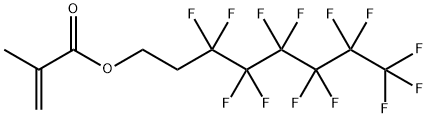
2-(Perfluorohexyl)ethyl methacrylate
2144-53-8You may like
2-(Perfluorohexyl)ethyl methacrylate manufacturers
- 2-(Perfluorohexyl)ethyl methacrylate
-

- $0.00 / 1KG
- 2025-12-16
- CAS:2144-53-8
- Min. Order: 1KG
- Purity: 98%min
- Supply Ability: 30tons/month
- 2-(Perfluorohexyl)ethyl methacrylate
-

- $1.00 / 25KG
- 2025-12-11
- CAS:2144-53-8
- Min. Order: 1KG
- Purity: 99%
- Supply Ability: 10 mt
- 2-(Perfluorohexyl)ethyl methacrylate
-
- $100.00 / 1KG
- 2025-09-25
- CAS:2144-53-8
- Min. Order: 1KG
- Purity: 99%
- Supply Ability: g-kg-tons, free sample is available