


Clinical Research, Applications and Impact of Eplerenone
Dec 24,2025
Eplerenone is a derivative of spironolactone that is more selective for the MR than spironolactone. The presence of the 9,11-epoxy group reduces the progestagenic and anti-androgenic action of eplerenone compared with spironolactone, but maintains the aldosterone-blocking properties. Eplerenone is indicated for the treatment of hypertension. It can be used alone or in combination with other antihypertensive agents. The principal risk of eplerenone is hyperkalaemia, and it is contraindicated in patients with serum potassium levels > 5.5 meq/l. Eplerenone is an aldosterone antagonist with an excellent safety profile. It is used to treat heart failure. [1]

Figure1: Picture of Eplerenone
Introduction
Eplerenone is an aldosterone receptor blocker that is chemically derived from spironolactone. In Canada, it is indicated for use as adjunctive therapy to reduce mortality for heart failure patients with New York Heart Association (NYHA) class II systolic chronic heart failure and left ventricular systolic dysfunction. It is also used as adjunctive therapy for patients with heart failure following myocardial infarction. Additionally, it is indicated for the treatment of mild and moderate essential hypertension for patients who cannot be treated adequately with other agents. It is important to determine the clinical impact of all antihypertensive medications, including aldosterone antagonists, to support their continued use in essential hypertension. No previous systematic reviews have evaluated the effect of eplerenone on cardiovascular morbidity, mortality, and magnitude of blood pressure lowering in patients with hypertension. [2]
![]() Clinical Research
Clinical Research
Eplerenone has been evaluated alone and in combination with other antihypertensive agents, including ACE inhibitors, AT1 -receptor antagonists, calcium-channel blockers, β-adrenoceptor antagonists (beta blockers) and hydrochlorothiazide, in clinical studies of 3,091 hypertensive patients. In two placebo-controlled 8–12-week studies involving 751 patients with baseline diastolic blood pressure of 95–114 mm Hg, patients treated with eplerenone showed decreases of 6–13 mm Hg in systolic blood pressure and 3–7 mm Hg in diastolic blood pressure. Blood-pressure lowering was apparent within two weeks of starting therapy, with maximal antihypertensive effects being achieved within four weeks. The overall incidence of adverse events reported with eplerenone was similar to that reported with placebo. [1]
Applications
Treatment of Patients with Glomerulonephritis
Eplerenone is effective in reducing proteinuria in patients with a higher degree of baseline proteinuria. Moreover, patients who received eplerenone maintained stable kidney function after 12 months, Eplerenone has exhibited an antiproteinuric effect in experimental nephrotic syndrome , and additionally, it reduces albuminuria effectively in non-diabetic CKD patients after 8 weeks of administration at a dose of 25–50 mg once daily as an add-on treatment to ACEi or ARBs . Higher doses of eplerenone up to 100 mg/day have also shown a significant effect on albuminuria, up to almost 50%, in patients with diabetic nephropathy . Treatment for longer periods, up to 1 year, has also shown benefit in albuminuria in patients with hypertension and CKD. Administration of eplerenone as an add-on treatment to ACEi or ARBs in patients with chronic glomerulonephritis can be beneficial in proteinuria reduction in those with baseline values of more than 1000 mg/24 h with a favorable safety profile.[3]
Substrate probe
Eplerenone forms two major hydroxylated metabolites via CYP3A4 and CYP3A5. The 6β-hydroxy metabolite exhibits a strong preferential metabolism via CYP3A4 while the 21-hydroxy metabolite exhibits a more modest preferential metabolism via CYP3A5. This duality in metabolite production may allow probing enzyme activity of CYP3A4 alone via the 6 beta-hydroxy metabolite and the combination of CYP3A4/5 through the 21-hydroxy metabolite. Eplerenone is unlikely to interact with other CYP3A4 substrates due to a high IC50 (> 300μM). Additionally, hepatic blood flow will not be the rate-limiting factor for eplerenone as it is with some individuals taking midazolam. These attributes make eplerenone an excellent substrate probe for future clinical study of CYP3A4 and CYP3A4/5 activity. [4]
Impact of Eplerenone
Eplerenone is e marketed as a novel therapy, despite the availability of the non-selective aldosterone antagonist spironolactone, which is currently classed and marketed as a diuretic. eplerenone, with both the ability to lower blood pressure through its diuretic actions, and its positive actions on vascular endothelial function. might fulfil these criteria. However, owing to a failure to demonstrate improved efficacy in comparison with currently marketed agents and the potential for side-effects (hyperkalaemia), the use of eplerenone may be focused on certain target patient groups; for example, the drug may be beneficial for the treatment of salt-sensitive hypertensive patients, who have low levels of plasma renin and therefore increased cardiovascular risk.Eplerenone has also been shown to have a superior antihypertensive effect in comparison with losartan in black patients, a group whose blood pressure is often inadequately controlled by existing RAAS inhibitors. [1]
Refenence
[1] Ruth Brown, Eplerenone, Nature Reviews Drug Discovery ,2003,2,177-178
[2] Tam T S C, et al. Eplerenone for hypertension[J]. Cochrane Database of Systematic Reviews, 2017, 2.
[3] Marios Papasotiriou, A Prospective Study of Eplerenone in the Treatment of Patients with Glomerulonephritis, Biomedicines 2023, 11(12), 3340
[4] Joseph McGraw,The Relative Role of CYP3A4 and CYP3A5 in Eplerenone Metabolism, Toxicology Letters, 2019, 315, 9-13.
- Related articles
- Related Qustion
- Pharmacology and Side Effects of Eplerenone Aug 15, 2019
Eplerenone is the second oral aldosterone antagonist available for the treatment of essential hypertension and heart failure. Treatment has been associated with reductions in blood pressure and improved survival (15% reduction in total mortality) for patients with heart failure who are in stable condition after a myocardial infarction.

Potassium citrate monohydrate is primarily prepared by neutralizing citric acid with potassium hydroxide followed by crystallization.....
Dec 24,2025API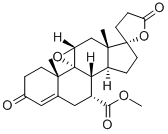
Eplerenone
107724-20-9You may like
- Eplerenone
-

- $0.00 / 10g
- 2025-12-24
- CAS:107724-20-9
- Min. Order: 10g
- Purity: 97.0-102.0%
- Supply Ability: 50kg/month
- Eplerenone
-

- $5.00/ KG
- 2025-12-24
- CAS:107724-20-9
- Min. Order: 1KG
- Purity: 99% hplc
- Supply Ability: 500TONS
- Eplerenone
-

- $0.00 / 1kg
- 2025-12-23
- CAS:107724-20-9
- Min. Order: 1kg
- Purity: 0.99
- Supply Ability: 1000kg