


Dehydration kinetics and application of Potassium citrate monohydrate
Dec 24,2025
Potassium citrate monohydrate is a type of citrate salt, which appears as a white crystalline solid under ambient conditions. In the food industry, potassium citrate monohydrate can be used as a buffer, chelating agent, stabilizer, antioxidant, emulsifier, and flavor enhancer, and is applicable in dairy products, jellies, jams, meat products, canned hydrogel desserts, cheese emulsification, and citrus preservation.

Figure1: Picture of Potassium citrate monohydrate
Synthesis
Potassium citrate monohydrate is primarily prepared by neutralizing citric acid with potassium hydroxide followed by crystallization. While traditional processes may face issues with chlorate residues, improved methods enhance purity by controlling chlorate content in raw materials and introducing hydrogen peroxide decomposition technology. According to international pharmacopoeia standards (Ph. Eur., BP, FCC), potassium citrate monohydrate must have a purity of at least 99% and exhibits biological activities such as HIF inhibition and lipid metabolism regulation.
Dehydration kinetics
The dehydration kinetic of potassium citrate monohydrate has been investigated by TG-DTG. The kinetic parameters of activation energy and pre-exponential factor were calculated using the methods of FWO and KAS. The results show that the kinetic parameters calculated by two methods were consistent. Meanwhile, the most probable kinetic function was acquires by means of the Malek method. The thermodynamic functions of the dehydration process are then calculated according to the transition theory, which indicate that the dehydration process of potassium citrate monohydrate is endothermic and non-spontaneous. The dehydration process of potassium citrate monohydrate was analyzed by thermogravimetry, with the TG-DTG curves displayed in the results. The data indicate a single DTG peak at 214.6 °C, suggesting that the dehydration of potassium citrate monohydrate likely follows a single‑step mechanism. The TG results further show a mass loss of approximately 5.78%, which corresponds to the loss of about one mole of water per mole of the compound. [1]
Application
Potassium citrate monohydrate is the tri-potassium salt hydrate of citric acid, widely used in the food industry as an acidity regulator (E332), in the pharmaceutical field for treating hypokalemia and inhibiting kidney stone formation, and also applied in agricultural fertilizers and paper manufacturing. Research indicates that potassium citrate monohydrate is effective in inhibiting ATP-citrate lyase and reducing kidney stone formation. In vitro studies have demonstrated its HIF inhibitory activity and mitochondrial protective function, while in vivo experiments show it can lower the levels of renal injury biomarkers. Additionally, it is used in the preparation of tri-potassium citrate buffer and Otto I separation buffer for biological protocols, and can further improve the release profile of diltiazem hydrochloride in melt-extruded matrix tablets. [2]
Reference material
Sodium tartrate dihydrate, lactose monohydrate, potassium citrate monohydrate, and calcium oxalate monohydrate are commonly used as primary standards for methods determining water content. Based on thermogravimetry/differential thermal analysis (TG/DTA) and dynamic vapor sorption data, this study identifies the type of hydration water (channel, lattice, or ion-associated) for each standard. The results show that sodium tartrate dihydrate is a mixed hydrate containing 1 mole of channel water and 1 mole of lattice water. Lactose monohydrate and calcium oxalate monohydrate both contain lattice water, while potassium citrate monohydrate exhibits ion-associated hydration. Furthermore, the researchers discuss how the type of hydrate, thermal properties, and hygroscopicity may affect the suitability of each compound as a standard. The TG/DTA profile of potassium citrate monohydrate shows a single mass loss and a single endotherm corresponding to its dehydration process. The observed mass loss of 5.4% is in good agreement with the theoretical value of 5.55% for a monohydrate. Water loss occurs well above 100°C, which is consistent with the characteristics of an ion‑associated hydrate. No mass loss or evidence of water loss is detected below 150°C. After dehydration, the TG curve remains flat until the onset of degradative mass loss around 250°C. The clear separation between the temperature required for dehydration and the onset of degradation allows for the selective removal of water of hydration by heating, making it feasible for moisture content determination.[2]
Reference
[1] Wangy, Xiaofang, et al. "Non-isothermal Dehydration Kinetics of Potassium Citrate Monohydrate." IOP Conference Series: Materials Science and Engineering. 2019, 490. 2.
[2] Nancy Redman-Furey, An evaluation of primary water standards by TG/DTA and vapor sorption analysis, J. Therm. Anal. Calorim. 2010 102:633–639.
- Related articles
- Related Qustion

Eplerenone is indicated for the treatment of hypertension. It can be used alone or in combination with other antihypertensive agents.....
Dec 24,2025API
As a cross-linking agent and antistatic agent, N,N,N',N'-Tetrakis(2-hydroxypropyl)ethylenediamine is widely used in synthetic rubber and polyurethane products.....
Dec 24,2025API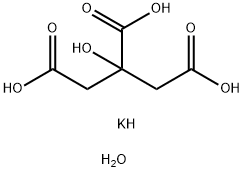
Potassium citrate monohydrate
6100-05-6You may like
Potassium citrate monohydrate manufacturers
- Potassium citrate monohydrate
-
- $0.00 / 1KG
- 2025-12-24
- CAS:6100-05-6
- Min. Order: 1KG
- Purity: 98%min
- Supply Ability: 30tons/month
- Potassium Citrate FCC
-

- $900.00/ ton
- 2025-12-08
- CAS:6100-05-6
- Min. Order: 3ton
- Purity: 99%
- Supply Ability: 500 tons
- potassium citrate
-

- $1200.00 / 1ton
- 2025-11-04
- CAS:6100-05-6
- Min. Order: 1ton
- Purity: 99%
- Supply Ability: 1000T/M