| Identification | More | [Name]
Agmatine sulfate | [CAS]
2482-00-0 | [Synonyms]
RGAMINE
ARGAMINE SULFATE
AGMATINE SULFATE
AGMATINE SULPHATE
AGARICUSBLAZTIP.E
Agmatine sulfate,99%
Agmatine sulfate,70%
Agmatine sulfate,85+%
agmatine sulfate salt
AGMATINESULFATE,POWDER
AGMATINE SULFATE SALT(P)
4-GUANIDINOBUTANE SULFATE
guanidinobutane sulfate salt
4-GUANIDINO-BUTYLAMINE SULFATE
(4-AMINOBUTYL)GUANIDINE SULFATE
1-AMINO-4-GUANIDOBUTANE SULFATE
AGMATINE SULFATE PRACTICAL GRADE
N-(4-AMINOBUTYL)GUANIDINE SULFATE
1-AMINO-4-GUANIDINOBUTANE SULFATE
1-(4-aMinobutyl)guanidine sulfate
(4-aminobutyl)guanidinium sulphate
(4-Aminobutyl)guanidinium sulfate.
4-GUANIDINO-BUTYLAMINE SULFATE SALT
4-Guanidinobutylamine sulphate salt
1-AMINO-4-GUANIDINOBUTANE SULFATE SALT
N-(4-Aminobutyl)guanidine sulfate salt
AGMATINE SULFATE((4-AMINOBUTYL)GUANIDINE)
ArgaMine · sulfate, 4-Guanidino-butylaMine · sulfate
1-Amino-4-guanidinobutane sulfate salt, 4-Guanidinobutylamine sulfate salt, N-(4-Aminobutyl)guanidine sulfate salt | [EINECS(EC#)]
219-617-3 | [Molecular Formula]
C5H16N4O4S | [MDL Number]
MFCD00013109 | [Molecular Weight]
228.27 | [MOL File]
2482-00-0.mol |
| Questions And Answer | Back Directory | [Synthesis]
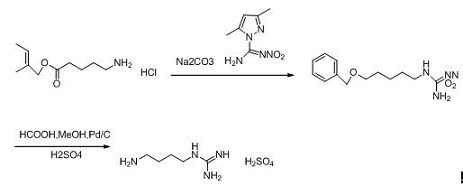
Route 1: Using 1,4-butanediamine as a starting material, it is first protected with a monoamine group, then nitrified with 1-nitroguanidinyl-3,5-dimethylpyrazole to nitrify the other amine group. Following reduction, deprotection, and salt formation, Agmatine sulfate is finally obtained. See the figure below:
Route 2: First, diethyl adipate reacts with hydrazine hydrate to obtain adipate dihydrazide, which then reacts with sodium nitrite to obtain a diazonium salt. Heating removes nitrogen to generate 1,4-diisocyanate butane, which is hydrolyzed to obtain the key intermediate 1,4-butanediamine. This intermediate then reacts with S-methylisothiourea sulfate to obtain Agmatine sulfate. The specific reaction process is as follows: 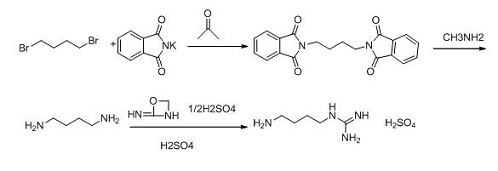
Route 4: Using 1,4-butanediamine as a starting material and S-methylisothiourea sulfate as a guanidinizing agent, the reaction is shown below:
Route 5: Using 1,4-butanediamine as a starting material and cyanamide aqueous solution as a guanidinizing agent, guanidinobutylamine is obtained through an addition reaction, followed by salt formation with sulfuric acid, yielding:
Route 5: Using 1,4-butanediamine as a starting material and cyanamide aqueous solution as a guanidinizing agent, guanidinobutylamine is obtained through an addition reaction, followed by salt formation with sulfuric acid, yielding:
Route 5: Using 1,4-butanediamine as a starting material and cyanamide aqueous solution as a guanidinizing agent, guanidinobutylamine is obtained through an addition reaction, followed by salt formation with sulfuric acid, yielding: Route 6: A method for synthesizing Agmatine sulfate, comprising the following steps: 1,4-Butanediamine and O-methylisourea sulfate undergo a condensation reaction in a reaction solvent at -20 to 100°C. The reaction is monitored by TLC until the endpoint is reached. The reaction solution is filtered, and an alcoholic solution of sulfuric acid is added dropwise to the filtrate to adjust the pH to below 7.0. The filtrate is concentrated to dryness, and the residue is recrystallized to obtain Agmatine sulfate. The reaction solvent is water or a C1-C3 alcohol. The molar ratio of 1,4-butanediamine to O-methylisourea sulfate is 1:1 to 1:2.0. The volumetric amount of the reaction solvent, based on the mass of O-methylisourea sulfate, is 4-20 ml/g. This invention is simple and safe to operate, has a high reaction yield, low production cost, and virtually no emissions of waste, demonstrating significant practical value and socio-economic benefits. The specific reaction process is as follows:
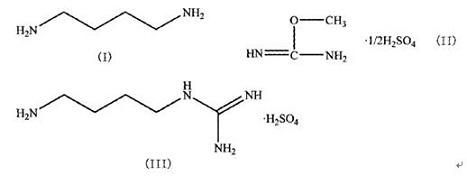
Route 7: A biotransformation method for Agmatine sulfate, comprising: using L-arginine as a substrate and arginine decarboxylase as a biotransformation catalyst, performing a decarboxylation reaction to generate crude guanidinobutylamine product, and acidifying the crude guanidinobutylamine product with dilute sulfuric acid to obtain crude Agmatine sulfate. The method has a simple process flow, requires no special equipment, and is suitable for industrial production. Compared with purely chemical methods, this method has milder reaction conditions, is easier to operate, has lower costs, less pollution, and can complete enzymatic catalytic reactions that are difficult to perform in chemical reactions. | [General Uses]
Neuroprotective, CNS studies, Autism and depression research
Description: Agmatine Sulfate is a polyamine derived from L-arginine decarboxylation and is a known putative endogenous neurotransmitter at imidazoline receptors. Agmatine sulfate displaces clonidine at α2-adrenergic and at imidazoline receptors and was recently shown to exert some neuroprotective effects. It blocks NMDA-receptor associated cation channels. Acts as a competitive inhibitor of nitric oxide synthase (NOS). It functions as neurotransmitter since it is stored in synaptic vesicles and is related from axon terminals by depolarization(1). Protects autistic behavior in rats and reverses depressive like behavior in mice. |
| Chemical Properties | Back Directory | [Melting point ]
234-238 °C(lit.)
| [RTECS ]
ME8413000 | [storage temp. ]
−20°C
| [solubility ]
H2O: 50 mg/mL
| [form ]
powder
| [color ]
white to off-white
| [Water Solubility ]
Soluble in water, nearly insoluble in alcohol | [Merck ]
188 | [BRN ]
3918807 | [InChI]
InChI=1S/C5H14N4.H2O4S/c6-3-1-2-4-9-5(7)8;1-5(2,3)4/h1-4,6H2,(H4,7,8,9);(H2,1,2,3,4) | [InChIKey]
PTAYFGHRDOMJGC-UHFFFAOYSA-N | [SMILES]
C(CCCN)NC(N)=N.S(O)(O)(=O)=O | [CAS DataBase Reference]
2482-00-0(CAS DataBase Reference) |
| Questions and Answers (Q&A) | Back Directory | [Description]
Agmatine sulfate is the sulfate of the Agmatine. Agmatine is an aninoguanidine that is naturally derived from the arginine. It can exert modulatory effect on many molecular targets such as neurotransmitter systems, opioid analgesia, ion channels, and nitric oxide (NO) synthesis and polyamine metabolism. It has been also found that it can reverse the pain induced from inflammation, neuropathy, and spinal cord injury. Those effects make it a potential candidate for multiple pharmacological applications in the future.
| [References]
Fairbanks, C. A., et al. "Agmatine reverses pain induced by inflammation, neuropathy, and spinal cord injury." Proceedings of the National Academy of Sciences of the United States of America97.19(2000):10584.
Kolesnikov, Yuri, S. Jain, and G. W. Pasternak. "Modulation of opioid analgesia by agmatine." European Journal of Pharmacology296.1(1996):17-22.
Su, R. B., J. Li, and B. Y. Qin. "A biphasic opioid function modulator: agmatine. "Acta Pharmacologica Sinica24.7(2003):631.
Galea, Elena, et al. "Inhibition of mammalian nitric oxide synthases by agmatine, an endogenous polyamine formed by decarboxylation of arginine." Biochemical Journal 316 ( Pt 1).1(1996):247.
https://en.wikipedia.org/wiki/Agmatine
|
| Hazard Information | Back Directory | [Chemical Properties]
White to off-white powder | [Uses]
Agmatine is an intermediate in the biosynthesis of the polyamines putrescine and spermine. Agmatine binds with high affinity to α2-adrenergic receptors and imidazoline binding sites and produces blockade of the NMDA-receptor associated cation channels. Agmatine is a competitive inhibitor of nitric oxide synthase activity owing to mimicry of the natural NOS substrate arginine. | [Uses]
Agmatine Sulfate is a a polyamine derived from L-arginine (A769500) decarboxylation and is a known putative endogenous neurotransmitter at imidazoline receptors. Agmatine sulfate displaces clonidine a
t α2-adrenergic and at imidazoline receptors and was recently shown to exert some neuroprotective effects. | [Biological Functions]
Agmatine sulfate is the sulfate preparation of Agmatine. Agmatine binds with high affinity to α2-adrenergic receptors and imidazoline binding sites and produces blockade of the NMDA-receptor associated cation channels. Research found that Agmatine is stored in synaptic vesicles, is specifically degraded by agmatinase, and is released from axon terminals by depolarization all suggest that Agmatine has endogenous function as a neurotransmitter[1]. | [Biological Activity]
Arginine metabolite that is synthesized within bovine brain and exhibits clonidine-displacing substance (CDS) activity. Putative endogenous ligand for the imidazoline binding site. | [Biochem/physiol Actions]
Putative endogenous neurotransmitter at imidazoline receptors; displaces clonidine at α2-adrenergic and at imidazoline receptors; blocks NMDA-activated ion channels in hippocampal neurons. | [Purification Methods]
Crystallise the salt from aqueous MeOH. The free base has m 101.5-103o, the gold chloride hydrochloride crystallises from H2O with m 223o(dec), and the picrate has m 236-238o. [Odo J Chem Soc Jpn 67 132 1946, Beilstein 4 I 420, 4 II 703, 4 III 575, 4 IV 1291.] |
|
| Company Name: |
Jingjingpharm Gold
|
| Telephone: |
15103327112 13831108726 |
| Website: |
https://www.jjpharm.cn |
| Company Name: |
J & K SCIENTIFIC LTD.
|
| Telephone: |
18210857532 18210857532 |
| Website: |
https://www.jkchemical.com |
| Company Name: |
Alfa Aesar
|
| Telephone: |
400-6106006 |
| Website: |
http://chemicals.thermofisher.cn |
| Company Name: |
Energy Chemical
|
| Telephone: |
400-0056266 |
| Website: |
www.energy-chemical.com |
| Company Name: |
Jia Xing Isenchem Co.,Ltd
|
| Telephone: |
0573-85285100 18627885956 |
| Website: |
https://www.chemicalbook.com/ShowSupplierProductsList14265/0_EN.htm |
|