| Identification | More | [Name]
ALPHA-METHYL-L-P-TYROSINE | [CAS]
672-87-7 | [Synonyms]
ALPHA-METHYL-L-P-TYROSINE
ALPHA-METHYL-L-TYR
ALPHA-METHYL-L-TYROSINE
ALPHA-METHYLTYROSINE
A-METHYL-L-P-TYROSINE
AMPT
H-(ME)TYR-OH
L-2-METHYL-3-[4-HYDROXYPHENYL]-ALANINE
METYROSINE
(S)-2-AMINO-2-METHYL-3-(4'-HYDROXYPHENYL)PROPANOIC ACID
Metirosine
2-Methyl-L-Tyrosine
α-Methyl-L-tyrosine
L-ALPHA-METHYLTYROSINE, 98%
AMPT,Metyrosine,
-Methyl-L-Tyr
A-METHYL-L-TYR
A-METHYL-L-TYROSINE
L-2-Me-Tyr-OH
ALPHA-METHYL-L-P-TRYOSINE | [EINECS(EC#)]
211-599-5 | [Molecular Formula]
C10H13NO3 | [MDL Number]
MFCD00064201 | [Molecular Weight]
195.22 | [MOL File]
672-87-7.mol |
| Chemical Properties | Back Directory | [Appearance]
White Solid | [Melting point ]
320-340°C dec. | [Boiling point ]
383.7±32.0 °C(Predicted) | [density ]
1.283±0.06 g/cm3(Predicted) | [storage temp. ]
−20°C
| [solubility ]
Aqueous Acid (Slightly) | [form ]
Powder | [pka]
pKa 2.7 (Uncertain);10.1 (Uncertain) | [color ]
White to pale yellow | [Optical Rotation]
-3.60°(C=0.01g/ml 1N HCL) | [Usage]
A tyrosine hydroxylase inhibitor. An antihypertensive in pheochromocytoma | [Merck ]
13,6183 | [BRN ]
2368400 | [InChI]
InChI=1/C10H13NO3/c1-10(11,9(13)14)6-7-2-4-8(12)5-3-7/h2-5,12H,6,11H2,1H3,(H,13,14)/t10-/s3 | [InChIKey]
NHTGHBARYWONDQ-JTQLQIEISA-N | [SMILES]
C(C1C=CC(O)=CC=1)[C@@](N)(C)C(=O)O |&1:8,r| | [CAS DataBase Reference]
672-87-7(CAS DataBase Reference) |
| Safety Data | Back Directory | [Risk Statements ]
22-38-40-48/20/22 | [Safety Statements ]
S22:Do not breathe dust .
S24/25:Avoid contact with skin and eyes . | [WGK Germany ]
3
| [TSCA ]
No | [HS Code ]
2922504500 | [Storage Class]
11 - Combustible Solids |
| Hazard Information | Back Directory | [Chemical Properties]
White Solid | [Originator]
Demser,MSD,US,1979 | [Uses]
α-Methyl-L-tyrosine is used to determine whether Fe2/ methamphetamine (METH) -induced cell death is dependent on cytosolic dopamine and iron mediated oxidative stress. | [Uses]
A tyrosine hydroxylase inhibitor. An antihypertensive in pheochromocytoma | [Definition]
ChEBI: An L-tyrosine derivative that consists of L-tyrosine bering an additional methyl substituent at position 2. An inhibitor of the enzyme tyrosine 3-monooxygenase, and consequently of the synthesis of catecholamines. It is us
d to control the symptoms of excessive sympathetic stimulation in patients with pheochromocytoma. | [Manufacturing Process]
50 g of α-methyl-N-dichloroacetyl-p-nitrophenylalanine was dissolved in 500
ml methanol, 300 mg of platinum oxide were added and the mixture reduced
at 41 pounds of pressure; within an hour 14.5 pounds were used up (theory
12.4 pounds). After filtration of the catalyst, the red clear filtrate was
concentrated in vacuo and the residual syrup flushed several times with ether.
The crystalline residue thus obtained, after air drying, weighed 45.3 g
(99.5%), MP unsharp at about 104°C to 108°C with decomposition. After two
precipitations with ether from an alcoholic solution, the somewhat hygroscopic
amine was dried over sulfuric acid for analysis.
10 g of the amine prepared above was dissolved in 5 ml of 50% sulfuric acid
at room temperature; the viscous solution was then cooled in ice and a
solution of sodium nitrite (2.4 g) in 10 ml water gradually added with
agitation. A flocculent precipitate formed. After all the nitrite had been added,
the mixture was aged in ice for an hour, after which it was allowed to warm
up to room temperature. Nitrogen came off and the precipitate changed to a
sticky oil. After heating on the steam bath until evolution of nitrogen ceased,
the oil was extracted with ethyl acetate. After removal of the solvent in vacuo,
9.4 g of colored solid residue was obtained, which was refluxed with 150 ml
hydrochloric acid (1:1) for 17 hours. The resulting dark solution; after Norite
treatment and extraction with ethyl acetate, was concentrated in vacuo to
dryness and the tan colored residue (7.4 g) sweetened with ethanol.
Dissolution of the residue in minimum amount of ethanol and neutralization
with diethylamine of the clarified solution, precipitated the α-methyl tyrosine,
which was filtered, washed with ethanol (until free of chlorides) and ether. The
crude amino acid melted at 309°C with decomposition. For further purification,
it was dissolved in 250 ml of a saturated sulfur dioxide-water solution, and the
solution, after Noriting, concentrated to about 80 ml, the tan colored solid
filtered washed with ethanol and ether. Obtained 1.5 g of α-methyl tyrosine,
MP 320°C dec. | [Brand name]
Demser (Merck). | [Therapeutic Function]
Tyrosine hydroxylase inhibitor | [General Description]
Metyrosine (α-Methyl-L-tyrosine, Demser). Althoughinhibition of any of the three enzymes involved in CA biosynthesisshould decrease CAs, inhibitors of the first andthe rate-limiting enzyme TH would be the most effective.As such, metyrosine is a much more effective competitiveinhibitor of E and NE production than agents that inhibitany of the other enzymes involved in CA biosynthesis. Itis often possible to “fool” the enzymes into accepting astructurally similar and unnatural substrate such as metyrosine.Metyrosine differs structurally from tyrosine onlyin the presence of an α-methyl group . It is oneexample of a CA-biosynthesis inhibitor in clinical use.Although metyrosine is used as a racemic mixture, it is the (-)isomer that possesses the inhibitory activity.Metyrosine, which is given orally in dosages ranging from 1 to 4 g/day, is used principally for the preoperative managementof pheochromocytoma, chromaffin cell tumorsthat produce large amounts of NE and E. Although theseadrenal medullary tumors are often benign, patients frequentlysuffer hypertensive episodes. Metyrosine reducesthe frequency and severity of these episodes by significantlylowering CA production (35%–80%). The drug ispolar (log P=0.73) and excreted mainly unchanged in theurine. Because of its limited solubility in water caused byintramolecular bonding of the zwitterions, crystalluria is apotential serious side effect. It can be minimized by maintaininga daily urine volume of more than 2 L. Inhibitors ofCA synthesis have limited clinical utility because suchagents nonspecifically inhibit the formation of all CAs andresult in many side effects. Sedation is the most commonside effect of this drug.
A similar example is the use of α-methyl-m-tyrosine inthe treatment of shock. It differs structurally from metyrosineonly in the presence of m-OH instead of p-OH inmetyrosine. This unnatural amino acid is accepted by the enzymesof the biosynthetic pathway and converted tometaraminol (an α-agonist). | [Biochem/physiol Actions]
α-Methyl-L-tyrosine (L-AMPT) acts as a competitive inhibitor of tyrosine hydroxylase and inhibits the conversion of tyrosine to L-DOPA and eventually lowers dopamine synthesis in cytosol. AMPT at low concentrations can be used as a potent therapeutic for refractory dystonia or dyskinesia. It also helps in decreasing catecholamine concentration in pheochromocytoma patients. | [Synthesis]
Metyrosine, (?)|á-methyltyrosine (12.3.11), is synthesized in a few different
ways, the simplest of which is the synthesis from 4-methoxybenzylacetone, which is
reacted with potassium cyanide in the presence of ammonium carbonate to give the hydan�toin (12.3.9). Treating this with hydrogen iodide removes the methyl-protecting group on
the phenyl hydroxyl group and the product (12.3.10) is hydrolyzed by barium hydroxide
into a racemic mixture of |á-methyl-D,L-tyrosine, from which the desired L-isomer is iso�lated (12.3.11) [83¨C86].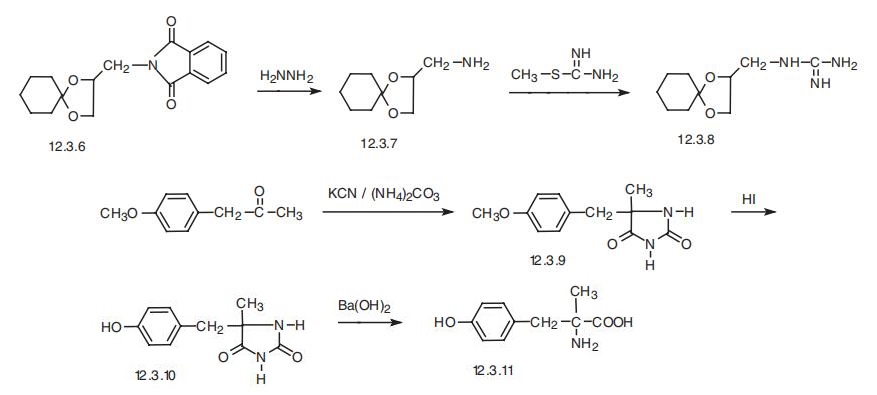
| [storage]
Store at -20°C |
|
| Company Name: |
J & K SCIENTIFIC LTD.
|
| Telephone: |
18210857532 18210857532 |
| Website: |
https://www.jkchemical.com |
| Company Name: |
Energy Chemical
|
| Telephone: |
400-0056266 |
| Website: |
www.energy-chemical.com |
|