- Rutaecarpine
-
-
2026-09-30
- CAS:84-26-4
- Min. Order: 1KG
- Purity: 98%min HPLC
- Supply Ability: 100kg
- Rutaecarpine
-

- $33.00
-
2026-07-27
- CAS:84-26-4
- Purity: 99.20%
- Supply Ability: 10g
- Rutaecarpine
-
-
2025-08-22
- CAS:84-26-4
- Min. Order: 1kg
- Purity: 99%
- Supply Ability: 20 tons
|
| Product Name: | Rutaecarpine | | Synonyms: | :3,4]pyrido[2,1-b]quinazolin-5(7H)-one;Indolo(2',3':3,4)pyrido(2,1-b)quinazolin-5(7H)-one, 8,13-dihydro- (9CI);Rutecarpine (8CI);7,8-dihydroindolo[2',3':3,4]pyrido[2,1-b]quinazolin-5(13H)-one;RHETINE;8,13-DIHYDRO-INDOLO[2'3':3,4]PYRIDO[2,1-B]QUINAZOLIN-5(7H)-ONE;RUTECARPINE 95+;Rutaecarpine std. | | CAS: | 84-26-4 | | MF: | C18H13N3O | | MW: | 287.32 | | EINECS: | 635-907-6 | | Product Categories: | chemical reagent;pharmaceutical intermediate;Indoles and derivatives;phytochemical;reference standards from Chinese medicinal herbs (TCM).;standardized herbal extract;Inhibitors | | Mol File: | 84-26-4.mol | 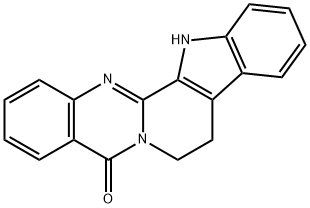 |
| | Rutaecarpine Chemical Properties |
| Melting point | 259.5-260° | | Boiling point | 429.62°C (rough estimate) | | density | 1.2030 (rough estimate) | | refractive index | 1.5855 (estimate) | | storage temp. | Sealed in dry,2-8°C | | solubility | DMSO: 18 mg/mL clear yellow solution, soluble | | form | solid | | pka | 15.79±0.20(Predicted) | | color | white | | Merck | 14,8298 | | InChI | InChI=1S/C18H13N3O/c22-18-13-6-2-4-8-15(13)20-17-16-12(9-10-21(17)18)11-5-1-3-7-14(11)19-16/h1-8,19H,9-10H2 | | InChIKey | ACVGWSKVRYFWRP-UHFFFAOYSA-N | | SMILES | N1C2=C(C=CC=C2)C(=O)N2CCC3C4=C(NC=3C=12)C=CC=C4 | | CAS DataBase Reference | 84-26-4(CAS DataBase Reference) |
| Hazard Codes | T | | Risk Statements | 25-36/37/38 | | Safety Statements | 45-36-26 | | RIDADR | UN 2811 6.1/PG 3 | | WGK Germany | 3 | | RTECS | NM3454000 | | HS Code | 29339900 | | Storage Class | 11 - Combustible Solids | | Hazard Classifications | Acute Tox. 4 Oral |
| | Rutaecarpine Usage And Synthesis |
| Synthesis | Currently, there are the following methods for synthesizing Rut:
Method 1: This method uses readily available raw materials, has mild reaction conditions, short reaction time, and high yield. By changing the type of lactam, a series of derivatives can be obtained. The crude product can be recrystallized from ethanol to obtain the pure product. Using this method, the yield of Rut reaches 92%. 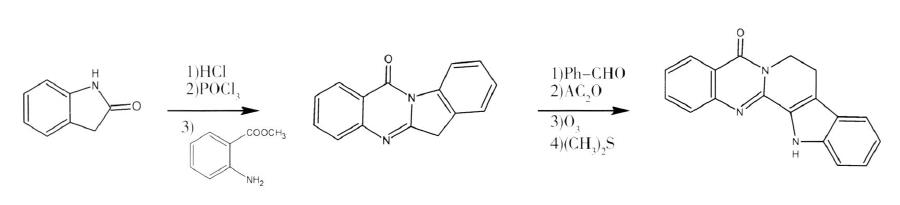 Figure: Synthetic route Figure: Synthetic route
Method 2: Using indocyanine anhydride as a raw material, Rut is obtained through 7 steps. The reaction time is long and there are many steps. The target product reported in the literature is only Rut, without other derivatives, and the yield is 30%.
Method 3: Using indocyanine anhydride as a raw material, Rut is obtained through 4 steps. The conditions are mild and the reaction time is short. In the literature, the target product can be synthesized by substituting on the benzene ring to obtain derivatives, but the yield is low. Fourthly, using o-aminobenzamide and glutaric anhydride as raw materials, a 6-step reaction was conducted, yielding Rut at a rate of 34.6%. The conditions were mild, but the reaction time was relatively long. | | Description | This alkaloid occurs with Evodiamine (q.v.) in the Chinese drug 'Wou-chou-yu'
which is the dried fruit of Evodia rutaecarpa Benth. It crystallizes from boiling
EtOH as colourless, or pale yellow, needles and is optically inactive. The acetyl
derivative has m.p. 184-6°C and the benzoyl compound, m.p. 194°C. The
alkaloid gives a yellow colour with concentrated H2S04 and is decomposed by
KOH in boiling amyl alcohol yielding anthranilic acid and 3-{3-aminoethylindole-
2-O!carboxylic acid, CllH120 2N2, silky crystals, m.p. 257°C.
Pharmacologically, the alkaloid causes increased arterial pressure on injection. | | Chemical Properties | Solid | | Uses | Rutaecarpine is an indole alkaloid contained in the fruit of Evodiae fruits. It been shown to ameliorate bodyweight gain through orexigenic neuropeptides NPY and AgRP. It also playes a role in the treatment of high blood pressure | | Definition | ChEBI: Rutecarpine is a member of beta-carbolines. | | in vivo | Rutaecarpine showed in vivo anti-inflammatory activity on rat l-carrageenan induced paw edema by intraperitoneal administration[1]. Rutaecarpine significantly decreases the number of antibody-forming cells and causes weight decrease in spleen in a dose-dependent manner. In addition, rutaecarpine administered mice exhibit reduced splenic cellularity, decreased numbers of total T cells, CD4+ cells, CD8+ cells, and B cells in spleen. IL-2, interferon and IL-10 mRNA expressions are suppressed significantly by rutaecarpine treatment. The number of CD4+IL-2+ cells is reduced significantly following administration of mice with rutaecarpine[3]. | | IC 50 | COX-2: 0.28 μM (IC50, in BMMC); COX-1: 8.7 μM (IC50, in BMMC) | | References | Asahina, Kashiwagi., J. Pharm. Chim., 14,54 (1916)
Asahina, Mayeda.,J. Pharm. Soc., Japan, No. 416 (1916)
Asahina, Fujita., ibid, 863 (1921)
Kermack, Perkin, Robinson.,J. Chem. Soc., 119,1615 (1921)
Asahina, Manske, Robinson., ibid, 1708 (1927)
Asahina, Irie, Ohta., J. Pharm. Soc., Japan, 48, 51 (1928)
Ohta., ibid, 60, 109 (1940)
Schopf, Steuer., Annalen, 558, 124 (1947)
Biosynthesis:
Yamazaki, Ikuta., Tetrahedron Lett., 3221 (1966)
Yamazakietal., ibid, 3317 (1967)
Pharmacology:
Raymond-Hamet., Cornpt. rend., 220, 749 (1945) |
| | Rutaecarpine Preparation Products And Raw materials |
|