- FENHEXAMID
-
- $1.10
-
2026-08-20
- CAS:126833-17-8
- Min. Order: 1g
- Purity: 99.00%
- Supply Ability: 100 Tons min
- Fenhexamid
-

- $128.00
-
2026-07-15
- CAS:126833-17-8
- Purity: 99.56%
- Supply Ability: 10g
- Fenhexamid
-

-
2026-07-14
- CAS:126833-17-8
- Min. Order: 100KG
- Purity: 98
- Supply Ability: 200TONS
|
| | Fenhexamid Basic information |
| Product Name: | Fenhexamid | | Synonyms: | Cyclohexanecarboxamide, N-(2,3-dichloro-4-hydroxyphenyl)-1-methyl-;FENHEXAMID STANDARD;fenhexamid N-(2,3-dichlor-4-hydroxyphenyl)-1-methylcyclohexancarboxamid;Fenhexamid 250mg [126833-17-8];KBR 2738;Teldor;Fenhexamid 0.1;-1-methylcyclohexanecarboxamide | | CAS: | 126833-17-8 | | MF: | C14H17Cl2NO2 | | MW: | 302.2 | | EINECS: | 422-530-5 | | Product Categories: | Agro-Products;Amines;Aromatics | | Mol File: | 126833-17-8.mol | 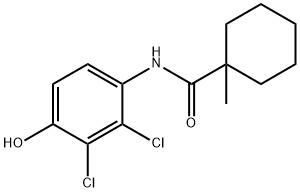 |
| | Fenhexamid Chemical Properties |
| Melting point | 141° | | Boiling point | 320°C(lit.) | | density | 1.338±0.06 g/cm3(Predicted) | | Fp | 150 °C | | storage temp. | 0-6°C | | solubility | DMF: 5 mg/ml,DMSO: 3 mg/ml,Ethanol: slightly soluble | | pka | 7.73±0.36(Predicted) | | form | Solid | | color | White to Light yellow | | Merck | 14,3974 | | BRN | 8996658 | | Henry's Law Constant | 2.0×10⁵ mol/(m3Pa) at 25℃, MacBean (2012) | | Major Application | agriculture
environmental | | InChI | InChI=1S/C14H17Cl2NO2/c1-14(7-3-2-4-8-14)13(19)17-9-5-6-10(18)12(16)11(9)15/h5-6,18H,2-4,7-8H2,1H3,(H,17,19) | | InChIKey | VDLGAVXLJYLFDH-UHFFFAOYSA-N | | SMILES | C1(C)(C(NC2=CC=C(O)C(Cl)=C2Cl)=O)CCCCC1 | | LogP | 4.020 (est) | | EPA Substance Registry System | Fenhexamid (126833-17-8) |
| Hazard Codes | N | | Risk Statements | 51/53 | | Safety Statements | 61 | | RIDADR | UN 3077 9/PG 3 | | WGK Germany | 2 | | RTECS | GU7879550 | | HS Code | 2924.29.4700 | | HazardClass | 9 | | PackingGroup | III | | Storage Class | 11 - Combustible Solids | | Hazard Classifications | Aquatic Chronic 2 | | Hazardous Substances Data | 126833-17-8(Hazardous Substances Data) | | Toxicity | LD50 in rats (mg/kg): >5000 orally; >5000 dermally (24 hr); LC50 (4hr) in rats (mg/m3): >5057 by inhalation. (Rosslenbroich). |
| | Fenhexamid Usage And Synthesis |
| Description | Fenhexamid is a foliar fungicide. It has a moderate aqueous solubility, a low risk of leaching to groundwater and is relatively volatile. It is not persistent in soil or aquatic systems. It has a low mammalian toxicity and these is a slight concern regarding its potential to bioaccumulate. No serious human health risks have been identified. It is moderately toxic to birds, most aquatic organisms and earthworms. The risk to honeybees is low. | | Uses | Hydroxyanilide fungicide. | | Definition | ChEBI: Fenhexamid is an aromatic amide resulting from the formal condensation of the carboxy group of 1-methylcyclohexanecarboxylic acid with the amino group of 4-amino-2,3-dichlorophenol. It has a role as an EC 1.14.13.72 (methylsterol monooxygenase) inhibitor, a sterol biosynthesis inhibitor and an antifungal agrochemical. It is a dichlorobenzene, a monocarboxylic acid amide, a member of phenols, an aromatic amide and an anilide fungicide. | | Production Methods | Fenhexamid is commercially produced through a multi-step chemical synthesis that begins with the reaction of 2,3-dichloro-4-hydroxyaniline and 1-methylcyclohexanoyl chloride in ethyl acetate. The mixture is heated to around 78 DegC for a reflux reaction, during which triethylamine is added dropwise to neutralize the hydrochloric acid formed. This step facilitates the formation of the key amide bond in fenhexamid’s structure. After maintaining reflux for approximately two hours, the reaction mixture is cooled and filtered to isolate the product. | | Hazard | Low toxicity by ingestion, inhalation, and
skin contact. | | Agricultural Uses | Fungicide: Fungicide; for control of Botrytis cinerea and related
diseases on Rubus, Ribes, bushberries, caneberries,
grapes, pistachios, strawberries, ornamentals and other
crops. Control of Monilinia diseases of almonds and stone
fruit. On grapes and grapevines for suppression of powdery
mildew and to control bunch rot[83]. | | Trade name | KBR-2738 | | Toxicity evaluation | Low toxicity, high safety: Acute oral LD₅₀ (rats): males > 5000 mg/kg; acute dermal LD₅₀ (rats, 24 hours): > 5000 mg/kg; acute inhalation LC₅₀ (4 hours, rats): > 5057 mg/kg air. Non-irritating to rabbit skin and eyes; no teratogenic or carcinogenic effects. | | Mode of action | Fenhexamid is a systemic, protective amide fungicide developed by Bayer in 1989. Its mode of action involves inhibiting sterol biosynthesis—specifically by targeting 3-ketoreductase—to prevent C4 demethylation, which halts fungal conidiophore and hyphal growth. This unique mechanism provides excellent activity against resistant strains. Furthermore, it can be formulated with various active ingredients, such as tebuconazole, fenarimol, carbendazim, flupyrazole, pyraclostrobin, and imazalil. | | References | [1] Xu, Xinxin et al. “A strategy for the free-formulation application of hydrophobic pesticides: achieving efficient and multifunctional utilization to promote green and sustainable agriculture.” Pest Management Science 81 7 (2025): 4016–4026.https://doi.org/10.1002/ps.8776 | | Pesticide Type | Fungicide |
| | Fenhexamid Preparation Products And Raw materials |
|