


Methyl 3-amino-4-methylbenzoate: Synthesis and Crystal Structure
Dec 15,2025
Methyl 3-amino-4-methylbenzoate serves as a key intermediate in the synthesis of telmisartan, an angiotensin II receptor antagonist indicated for the treatment of obesity associated with metabolic syndrome. This compound is synthesised catalysed by sulphuric acid from 3-methyl-4-aminobenzoic acid and methanol. The substituents on the benzene ring are coplanar within the molecule, forming a five-membered ring via intramolecular hydrogen bonding. In the crystal structure, molecules stack along the crystal axes in a chain-like arrangement via intermolecular hydrogen bonds.
Synthesis of Methyl 3-amino-4-methylbenzoate
Telmisartan (Telmisartan/Micardis telmisartan) is a selective ATⅠ receptor inhibitor developed by Boehringer Ingelheim and Glaxo Wellcome. The synthesis of this drug requires Methyl 3-amino-4-methylbenzoate as a raw material. It was first listed in the United States in March 1999 and was approved in Germany in the same month. Listed in the UK in February 2000. Micardis HCT, a compound preparation with the diuretic hydrochlorothiazide, was launched in the United States in December 2001, and the product patent expired in January 2014. The preparation method of telmisartan: Methyl 3-amino-4-methylbenzoate with butyryl chloride to obtain 3, and then In water acetic acid, intramolecular condensation and ring-closing reaction occurs, and then the key intermediate 4-methyl-2-propylbenzimidazole-6-carboxylic acid methyl ester 7 is obtained through hydrolysis. N-methyl o-phenylenediamine and 7 are condensed in polyphosphoric acid (PPA) at 150°C to obtain 8, and under the action of potassium tert-butoxide, it will react with 4-bromomethylbiphenyl-2-carboxylate tert-butyl ester The reaction is separated by silica gel column chromatography to obtain 9, and finally the tert-butyl group is removed with trifluoroacetic acid to obtain Telmisartan.[1]
Preparation of Methyl 3-amino-4-methylbenzoate by Electroreduction: parate electrolyzer, using proton exchange membranes. Add magnetic stirrer, 0.39g 3-methyl-4-nitrobenzoic acid methyl ester and 30mL methanol to the cathode (brass) electrolyzer, stir to dissolve, then add 26mL deionized water and 4mL hydrochloric acid; anode (platinum mesh electrode) electrolysis Add 60mL deionized water and 1.25mL sulfuric acid to the tank; use a saturated calomel electrode as the reference electrode for the cathode, control the current 0.8A, and stir for 3.5h at 25°C; add potassium hydroxide solution to the catholyte to adjust to weak alkali It was extracted with dichloromethane and spin-dried to obtain 0.32 g of Methyl 3-amino-4-methylbenzoate (yellow solid) with a melting point of 115-116°C and a yield of 97.0%. 1H NMR (400MHz, DMSO-D6) δ: 7.55~7.52 (m, 2H, C6H32, 6-H), 6.60 (d, J=8.4Hz, 1H, C6H35-H), 5.73 (s, 2H, NH2) , 3.73 (s, 3H, OCH3), 2.07 (s, 3H, CH3).
Crystal Structure of Methyl 3-Amino-4-methylbenzoate
Methyl 3-amino-4-methylbenzoate was prepared from 3-methyl-4-aminobenzoic acid (38 g, 250 mmol) in methanol (101 ml, 250 mmol). After the solid has melted, concentrated sulfuric acid (16 ml, 300 mmol) was dropped from the dropping funnel at 363 K, the latter was treated with a mixture of ice and water. The product was filtered by suction. Crystals of (I) suitable for X-ray diffraction were obtained by slow evaporation of an ethanol solution.[2]
Methyl 3-methyl-4-aminobenzoate is important as an intermedicine to prepare telmisartan, an angiotensin II receptor blocker, on the development of obesity and related metabolic disorders in diet-induced obese mice (Ries et al., 1993). Telmisartan can be used as a therapeutic tool for metabolic syndrome, including visceral obesity (Engeli et al., 2000; Kintscher et al., 2004; Goossens et al., 2003; Kurtz et al., 2004). As part of our studies in this area, we report herein the synthesis and crystal structure of Methyl 3-amino-4-methylbenzoate. In the molecule of Methyl 3-amino-4-methylbenzoate, C9H11NO2, the methyl C and amino N atoms bonded to the benzene ring lie in the ring plane. Intramolecular C—H⋯O hydrogen bonding results in the formation of a five-membered planar ring, which is oriented at a dihedral angle of 2.73 (3)° with respect to the benzene ring, so they are nearly coplanar. In the crystal structure, intermolecular N—H⋯O hydrogen bonds link the molecules into chains elongated along the c axis and stacked along the b axis.
References
[1] HUNAN UNIVERSITY - CN111041516, 2021, B
[2] Li X, Yuan LS, Wang D, Liu S, Yao C. Methyl 4-amino-3-methyl-benzoate. Acta Crystallogr Sect E Struct Rep Online. 2008 Apr 23;64(Pt 5):o886. doi: 10.1107/S1600536808006223. PMID: 21202370; PMCID: PMC2961297.
- Related articles
- Related Qustion
Fluorescein 5(6)-isothiocyanate serves as a versatile fluorescent dye with broad applications, being extensively employed for labeling antibodies.....
Dec 15,2025API
γ-Valerolactone is a valuable chemical intermediate that can be obtained by catalytic reduction of levulinic acid or alkyl levulinates.....
Dec 15,2025Organic Synthesis Intermediate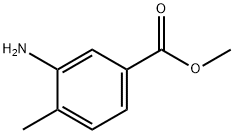
Methyl 3-amino-4-methylbenzoate
18595-18-1You may like
Methyl 3-amino-4-methylbenzoate manufacturers
- Methyl 3-amino-4-methylbenzoate
-
- $106.05 / 25Kg/Drum
- 2025-12-16
- CAS:18595-18-1
- Min. Order: 25Kg/Drum
- Purity: 99.00%HPLC
- Supply Ability: 8tons/month
- Methyl 3-amino-4-methylbenzoate
-

- $0.00 / 25Kg/Drum
- 2025-12-16
- CAS:18595-18-1
- Min. Order: 1KG
- Purity: 98%min
- Supply Ability: 10 tons
- Methyl 3-amino-4-methylbenzoate
-
- $0.00 / 25KG
- 2025-12-01
- CAS:18595-18-1
- Min. Order: 1KG
- Purity: 98.0%
- Supply Ability: 10000KGS