| Identification | More | [Name]
Tropicamide | [CAS]
1508-75-4 | [Synonyms]
MYDRIATICUM
N-ETHYL-2-PHENYL-N-[4-PYRIDYLMETHYL]HYDRACRYLAMIDE
n-ethyl-3-hydroxy-2-phenyl-n-(pyridin-4-ylmethyl)propanamide
N-ETHYL-3-HYDROXY-2-PHENYL-N-PYRIDIN-4-YLMETHYL-PROPIONAMIDE
N-ETHYL-3-HYDROXY-2-PHENYL-N-(PYRIDINYLMETHYL)PROPANAMIDE
N-ETHYL-ALPHA-(HYDROXYMETHYL)-N-(4-PYRIDINYLMETHYL)BENZENEACETAMIDE
N-ETHYL-N-(4-PYRIDYLMETHYL)TROPAMIDE
TROPICAMIDE
Benzeneacetamide, N-ethyl-alpha-(hydroxymethyl)-N-(4-pyridinylmethyl)-
bistropamide
component of Paremyd
epitromina
Mydriacyl
mydriat
mydrin
mydrum
n-ethyl-2-phenyl-n-(4-pyridylmethyl)-hydracrylamid
N-Ethyl-3-hydroxy-2-phenyl-N-(4-pyridinylmethyl)propanamide
n-ethyl-alpha-(hydroxymethyl)-n-(4-pyridinylmethyl)-benzeneacetamid
ro1-7683 | [EINECS(EC#)]
216-140-2 | [Molecular Formula]
C17H20N2O2 | [MDL Number]
MFCD00058580 | [Molecular Weight]
284.35 | [MOL File]
1508-75-4.mol |
| Chemical Properties | Back Directory | [Appearance]
Crystalline Solid | [Melting point ]
98 °C | [Boiling point ]
492.8±45.0 °C(Predicted) | [density ]
1.161±0.06 g/cm3(Predicted) | [storage temp. ]
2-8°C
| [solubility ]
45% (w/v) aq 2-hydroxypropyl-β-cyclodextrin: 4.3 mg/mL
| [form ]
solid
| [pka]
pKa 5.3 (Uncertain) | [color ]
white
| [Water Solubility ]
0.2g/L(25 ºC) | [Usage]
Ophthalmic anticholinergic. Mydriatic | [λmax]
254nm(HCl aq.)(lit.) | [Merck ]
9780 | [Major Application]
pharmaceutical (small molecule) | [InChI]
InChI=1S/C17H20N2O2/c1-2-19(12-14-8-10-18-11-9-14)17(21)16(13-20)15-6-4-3-5-7-15/h3-11,16,20H,2,12-13H2,1H3 | [InChIKey]
BGDKAVGWHJFAGW-UHFFFAOYSA-N | [SMILES]
C(CO)(C(=O)N(CC)CC1=CC=NC=C1)C1C=CC=CC=1 | [CAS DataBase Reference]
1508-75-4(CAS DataBase Reference) | [NIST Chemistry Reference]
Tropicamide(1508-75-4) |
| Safety Data | Back Directory | [Symbol(GHS) ]

GHS07 | [Signal word ]
Warning | [Hazard statements ]
H302+H312+H332-H315-H317-H319-H335 | [Precautionary statements ]
P261-P280-P301+P312-P302+P352+P312-P304+P340+P312-P305+P351+P338 | [Hazard Codes ]
Xn,Xi | [Risk Statements ]
R20/21/22:Harmful by inhalation, in contact with skin and if swallowed .
R36/37/38:Irritating to eyes, respiratory system and skin .
R42/43:May cause sensitization by inhalation and skin contact .
R41:Risk of serious damage to eyes.
R37/38:Irritating to respiratory system and skin .
R22:Harmful if swallowed. | [Safety Statements ]
S22:Do not breathe dust .
S26:In case of contact with eyes, rinse immediately with plenty of water and seek medical advice .
S36:Wear suitable protective clothing .
S36/37/39:Wear suitable protective clothing, gloves and eye/face protection . | [WGK Germany ]
3
| [RTECS ]
CY1487860
| [HS Code ]
29333990 | [Storage Class]
11 - Combustible Solids | [Hazard Classifications]
Acute Tox. 4 Dermal
Acute Tox. 4 Inhalation
Acute Tox. 4 Oral
Eye Irrit. 2
Skin Irrit. 2
Skin Sens. 1
STOT SE 3 |
| Hazard Information | Back Directory | [Chemical Properties]
Crystalline Solid | [Originator]
Mydriacyl,Alcon,US,1959 | [Definition]
ChEBI: Tropicamide is a member of acetamides. | [Manufacturing Process]
A solution of 82 parts by weight of γ-chloromethyl-pyridine-hydrochloride in 60
parts of water is added dropwise, at 0° to 5°C, to 250 parts by weight of a
50% aqueous ethyl amine solution. The mixture is stirred for 1 hour at 60°C,
whereupon it is cooled down and separated in the cold with solid potassium
hydroxide. The oil formed is separated off, dried over potassium hydroxide
and distilled. The ethyl-(γ-picolyl)-amine formed boils over at 103° to 104°C
under a pressure of 13 mm Hg. Its dihydrochloride melts at 198° to 200°C.
To a mixture of 48.7 parts by weight of ethyl-(γ-picolyl)-amine and 36 parts
by weight of dry pyridine in 220 parts by weight of dry chloroform is slowly
added, while stirring and cooling with ice water, crude acetyltropic acid
chloride prepared from 60 parts by weight of tropic acid. To complete the
reaction, the mixture is stirred for one additional hour at 23°C. Thereupon the
chloroform solution is diluted with 200 parts by weight of ether and agitated
with 3 N hydrochloric acid. The weakly Congo acid solution is heated for 1
hour in a steam bath, the acetyl group of the reaction product being thereby
split off, and the mixture is filtered over charcoal.
Upon adding concentrated ammonia in excess, the condensation product
separates and is taken up in chloroform. The chloroform solution is dried and
distilled, the tropic acid N-ethyl-N-(γ-picolyl)-amide being thereby obtained in
the form of a thick oil, which crystallizes after prolonged time and which then
melts at 96° to 97°C. | [Brand name]
Mydriacyl (Alcon); Tropicacyl (Akorn). | [Therapeutic Function]
Anticholinergic (ophthalmic) | [General Description]
Tropicamide, N-ethyl-2-phenyl-N-(4-pyridylmethyl)hydracrylamide (Mydriacyl), is aneffective anticholinergic for ophthalmic use when mydriasisis produced by relaxation of the sphincter muscle ofthe iris, allowing adrenergic innervation of the radial muscleto dilate the pupil. Its maximum effect is achieved inabout 20 to 25 minutes and lasts for about 20 minutes,with complete recovery in about 6 hours. Its action ismore rapid in onset and wears off more rapidly thanthat of most other mydriatics. To achieve mydriasis, either0.5% or 1.0% concentration may be used, althoughcycloplegia is achieved only with the stronger solution.Its uses are much the same as those described above formydriatics in general, but opinions differ on whether thedrug is as effective as homatropine, for example, inachieving cycloplegia. For mydriatic use, however, in examinationof the fundus and treatment of acute iritis,iridocyclitis, and keratitis, it is quite adequate; and becauseof its shorter duration of action, it is less prone toinitiate a rise in intraocular pressure than the more potent,longer-lasting drugs. As with other mydriatics, however,pupil dilation can lead to increased intraocular pressure.In common with other mydriatics, it is contraindicated inpatients with glaucoma, either known or suspected, andshould not be used in the presence of a shallow anteriorchamber. Thus far, no allergic reactions or ocular damagehas been observed with this drug. The ability to clone thevarious muscarinic receptor subtypes has allowed the observationthat tropicamide has modest selectivity for theM4 receptor. | [Biological Activity]
M 4 selective muscarinic receptor antagonist. | [Biochem/physiol Actions]
M4 muscarinic acetylcholine receptor antagonist. | [Synthesis]
Tropicamide, N-(4-piridinylmethyl)-N-ethyl-|?-hydroxy-|á-phenylpropi�onamide (14.1.41), is synthesized by reacting O-acetyltropyl chloride with ethyl
(4-piridinylmethyl)amine and the subsequent acidic hydrolysis of the acetyl group in the
resulting amide (14.1.40) [31].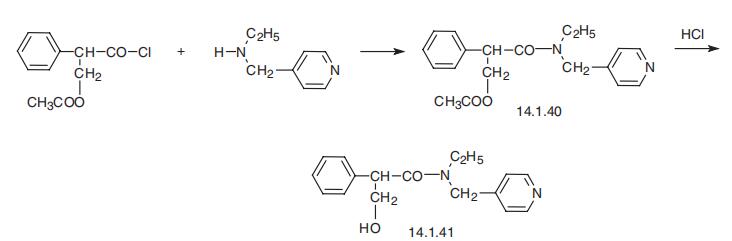
| [Veterinary Drugs and Treatments]
Tropicamide, like atropine, causes mydriasis and cycloplegia, but
has more mydriatic than cycloplegic activity. Tropicamide has a
more rapid onset (maximum mydriasis in 15 – 30 minutes) of action
and a shorter duration of action (pupil returns to normal in
6 – 12 hours in most animals) than does atropine, thereby making
it more useful for funduscopic examinations. In dogs, intraocular
pressure is apparently not affected by tropicamide. Tropicamide is
also indicated following cataract removal to prevent synechiae formation
that is associated with post-cataract atropine administration.
As the half-life of tropicamide is shorter than that of atropine,
this allows iris contraction preventing synechial adhesions. | [storage]
Store at RT |
| Questions And Answer | Back Directory | [Ophthalmic drugs]
Tropicamide is an anticholinergic agent. At room temperature, it is a white crystalline powder and is odorless. It is slightly soluble in water and easily soluble in ethanol, dilute hydrochloric acid, sulfuric acid and chloroform. It can block the excitement of iris sphincter and ciliary muscle induced by acetylcholine. Its 0.5% solution can cause mydriasis while its 1% solution can cause ciliary muscle paralysis and mydriasis. Clinically it is mainly used for the treatment of eye drops mydriasis and paralysis.
Tropicamide is the synthetic derivative of tropic acid. It has a relative low dissociation constant with good intraocular permeability and strong tissue diffusion capability which may be the underlying mechanism for its quick onset but short maintaining time. After the drop of the 0.5% or 1% solution of this product, the instillation dilation and paralysis adjustment can reach peak within 20-30 minutes. Then the effect gradually decreases with adjusting paralysis (residual) for 2 to 6 hours and mydriasis (residual) for about 7 hours. Tropicamide is similar drug as atropine which can cause a dramatic increase on the angle closure glaucoma intraocular pressure as well as possibly stimulate undiagnosed angle-closure glaucoma.
The potency of ciliary muscle paralysis adjustment of tropicamide eye drops is closely related with the doses used, its 0.25%, 0.5%, 0.75% and 1% four concentrations can all adjust paralysis. After instillation, the maximum degree of residual adjustment is 0.25%: diopter: 3.17; 1% diopter: 3.17. The residue adjustment degree can be maintained in cases of the refraction being 2.0 or less, 0.75% and 1% solutions can maintain for 40 minutes while 0.5% can only maintain about 15 minutes. After a drop of 1% solution, have the second drop after 5 to 25 minutes and by doing this, we can get more satisfactory ciliary muscle paralysis effect for about 20 to 30 minutes. After 2 to 6 hours, you can read books and newspapers with the adjustment function being able to recover to the level before drop within 6 hours.
The above information is edited by the Chemicalbook of Dai Xiongfeng.
| [Uses]
It can be used as an anti-cholinergic drugs or mydriatic drug.
It is a kind of M4 muscarinic acetylcholine receptor antagonist.
|
|
| Company Name: |
J & K SCIENTIFIC LTD.
|
| Telephone: |
18210857532 18210857532 |
| Website: |
https://www.jkchemical.com |
| Company Name: |
Energy Chemical
|
| Telephone: |
400-0056266 18918157536; |
| Website: |
http://www.energy-chemical.com |
| Company Name: |
Adamas Reagent, Ltd.
|
| Telephone: |
4006009262 13023226327 |
| Website: |
http://www.tansoole.com |
| Company Name: |
Maya High Purity Chemicals
|
| Telephone: |
+86 (573) 82222445 (0)18006601000 452520369 |
| Website: |
www.chemicalbook.com/ShowSupplierProductsList15221/0_EN.htm |
|