| Identification | Back Directory | [Name]
Acetylacetonatobis(2-phenylpyridine)iridium | [CAS]
337526-85-9 | [Synonyms]
(ppy)2Ir(acac)
Ir(ppy)2(acac)
Acetylacetonatobis(2
fac-tris(2-(2-pyridinyl)phenyl)iridium
Acetylacetonatobis(2-phenylpyridine)iridium
Bis(2-phenylpyridine)(acetylacetonate)iridium
Bis(2-phenylpyridine)(Acetylacetonato)iridium(III)
Bis(2-phenylpyridine) (acetylacetonate) iridium(III)
Bis(2-phenylpyridine-C2,N')(acetylacetonato)IridiuM (III)
Bis[2-(2-pyridinyl-N)phenyl-C](acetylacetonato)iridiuM(III)
IridiuM(III) bis(2-phenylpyridinato-N,C2') (acetylacetonate)
Ir(ppy)2(acac) , Acetylacetonatobis(2-phenylpyridine)iridiuM
Bis(2-phenylpyridine)(acetylacetonate)iridiuM(III)/ Ir(ppy)2(acac)
Bis[2-(2-pyridinyl-N)phenyl-C](2,4-pentanedionato-O2,O4)iridium(III)
Iridium,(2,4-pentanedionato-κO,κO')bis[2-(2-pyridinyl-κN)phenyl-κC]-,
Bis(2-phenylpyridine-C2,N′ )(acetylacetonato)iridium(III) Ir(ppy)2(acac) | [EINECS(EC#)]
1312995-182-4 | [Molecular Formula]
C27H23IrN2O2 | [MDL Number]
MFCD12022553 | [MOL File]
337526-85-9.mol | [Molecular Weight]
599.711 |
| Questions And Answer | Back Directory | [Synthesis]
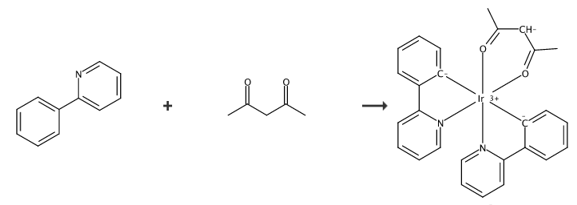
Step 1: Synthesis of the chloro-bridged dimer The [{Ir(COD)Cl}2] dimer (2.00 g, 2.98 mmol) was suspended in 9 mL of 2-ethoxyethanol in a 50 mL flask. Argon gas was passed through three times, the ligand (11.95 mmol, 4 equivalents) was added, and the mixture was rinsed with 1 mL of 2-ethoxyethanol. The mixture was refilled with argon gas three times, the flask was sealed and heated at 130°C for 3 hours. The solution darkened to a deep orange color, and a yellow precipitate appeared within half an hour. After 3 hours, the solution was concentrated under reduced pressure, 20 mL of methanol was added, the precipitate was filtered, washed with methanol and dried to obtain the chlorinated iridium dimer [{Ir(ppy)(2-Cl)2], an orange solid (2.94 g, 2.74 mmol, yield = 92%). Step 2: Synthesis of Acetylacetonatobis(2-phenylpyridine)iridium. Acetylacetone (4 equivalents) and tetrabutylammonium hydroxide (3 equivalents) were dissolved in dichloromethane/methanol (volume ratio 10/1). This solution was added to the corresponding dimer in the dichloromethane solution. The solution was slowly refluxed overnight under argon (approximately 40°C). After cooling to room temperature, the solution was evaporated to dryness to obtain a yellow viscous oil. Methanol and deionized water were added to precipitate the oil. The suspension was placed in a refrigerator for 2 hours, filtered, and washed with water. The solid was adsorbed onto silica and deposited on the top of a silica gel column, eluted with dichloromethane. Finally, the major fraction was dissolved in a small amount of dichloromethane and slowly precipitated with hexane. The suspension was filtered, washed with hexane, and dried to obtain an orange solid, Acetylacetonatobis(2-phenylpyridine)iridium (946 mg, 89% yield). | [Applications]
Like Ir(ppy)3, bis[2-(2-pyridinyl-N)phenyl-C](acetylacetonato)iridium(III), or Ir(ppy)2(acac), is one of the most studied OLED materials due to its high quantum yields. When doped into 3,5-Diphenyl-4-(1-naphthyl)-1H-1,2,4-triazole (TAZ), very high external quantum efficiencies of (19.06 ± 1.0%) and luminous power efficiencies of 60±5 lm/W were achieved. This was attributed to the nearly 100% internal phosphorescence efficiency of Ir(ppy)2(acac), coupled with balanced hole and electron injection, and triplet exciton confinement within the light-emitting layer.
Ir(ppy)2(acac) demonstrated higher external quantum efficiency when compared with Ir(ppy)3. It was suggested that Ir(ppy)2(acac) molecules preferentially align so that their transition dipole moment is parallel to the substrate, whereas the orientation of Ir(ppy)3 molecules is nearly isotropic.
|
| Chemical Properties | Back Directory | [Melting point ]
349-356°C | [form ]
powder | [color ]
Light yellow to Yellow to Orange | [λmax]
261 nm in dichloromethane | [InChI]
InChI=1S/2C11H8N.C5H8O2.Ir/c2*1-2-6-10(7-3-1)11-8-4-5-9-12-11;1-4(6)3-5(2)7;/h2*1-6,8-9H;3,6H,1-2H3;/q;;;+1/p-1/b;;4-3-; | [InChIKey]
QISLNNOQKUEVTI-DVACKJPTSA-M | [SMILES]
C1=CC=C([Ir](C2C=CC=CC=2C2N=CC=CC=2)O/C(/C)=C\C(C)=O)C(C2N=CC=CC=2)=C1 | [Absorption]
λmax?259 in THF | [Description]
Like?Ir(ppy)3, bis[2-(2-pyridinyl-N)phenyl-C](acetylacetonato)iridium(III), or?Ir(ppy)2(acac), is one of the most studied OLED materials due to its high quantum yields. When doped into 3,5-Diphenyl-4-(1-naphthyl)-1H-1,2,4-triazole (TAZ), very high external quantum efficiencies of (19.06 ± 1.0%) and luminous power efficiencies of 60±5 lm/W were achieved. This was attributed to the nearly 100% internal phosphorescence efficiency of Ir(ppy)2(acac), coupled with balanced hole and electron injection, and triplet exciton confinement within the light-emitting layer. | [Odor]
Yellow powder/crystals |
| Safety Data | Back Directory | [Hazard Codes ]
Xi | [Risk Statements ]
36/37/38 | [Safety Statements ]
26 | [WGK Germany ]
3 | [HS Code ]
2843.90.0000 | [Storage Class]
11 - Combustible Solids | [Hazard Classifications]
Eye Irrit. 2
Skin Irrit. 2
STOT SE 3 |
| Hazard Information | Back Directory | [Uses]
(ppy)2Ir(acac) used in green phosphorescent OLED devices as dopant/emitter achieved high brightness of 130800 cd m_2 at a current density of 1550 mA cm_2 (13 V), and high quantum efficiency (15~16%). |
|
| Company Name: |
Energy Chemical
|
| Telephone: |
400-0056266 |
| Website: |
www.energy-chemical.com |
| Company Name: |
T&W GROUP
|
| Telephone: |
021-61551611 13296011611 |
| Website: |
www.trustwe.com/ |
|