| Identification | Back Directory | [Name]
3-Hydroxytyramine | [CAS]
51-61-6 | [Synonyms]
opamine
Dopamine
4-(2-Aminoethyl)
Dopamine Control
3-Hydroxytyramine
3,4-Dihydroxyphenethylamine
Noradrenaline EP Impurity C
3-Hydroxytyramine USP/EP/BP
Norepinephrine EP Impurity C
β-Hydroxytyramine (Dopamine)
4-(2-Aminotehyl)pyrocatechol
2-(3,4-Dihydroxyphenyl)ethylamine
3-Hydroxytyramine hydrobromide,99%
1,2-Benzenediol, 4-(2-aminoethyl)-
Dobutamine Impurity 1 (Dobutamine EP Impurity A) | [EINECS(EC#)]
200-110-0 | [Molecular Formula]
C8H11NO2 | [MDL Number]
MFCD00130258 | [MOL File]
51-61-6.mol | [Molecular Weight]
153.18 |
| Chemical Properties | Back Directory | [Melting point ]
218-220 ºC | [Boiling point ]
276.1°C (rough estimate) | [density ]
1.1577 (rough estimate) | [refractive index ]
1.4770 (estimate) | [storage temp. ]
Hygroscopic, -20°C Freezer, Under inert atmosphere | [solubility ]
Aqueous Acid (Slightly), DMSO (Slightly, Heated), Methanol (Slightly) | [form ]
Solid | [pka]
8.9(at 25℃) | [color ]
Light Brown to Brown | [Stability:]
Hygroscopic | [NIST Chemistry Reference]
Dopamine(51-61-6) | [EPA Substance Registry System]
1,2-Benzenediol, 4-(2-aminoethyl)-(51-61-6) |
| Hazard Information | Back Directory | [Description]
Dopamine, abbreviated DA, is a biosynthetic compound and neurotransmitter produced in
the body from the amino acid tyrosine by several pathways. It is synthesized in the adrenal
gland where it is a precursor to other hormones (see Epinephrine) and in several portions of
the brain, principally the substantia nigra and hypothalamus. | [Originator]
Dopmin,Orion Corporation,Finland | [History]
Dopamine is stored in vesicles
in the brain’s presynaptic nerve terminals. It is closely associated with its immediate precursor,
l-Dopa (levodopa). Casmir Funk (1884–1967) first synthesized Dopa in racemic form in 1911 and considered Dopa a vitamin. In 1913, Marcus Guggenheim, a biochemist from
Hoff man-LaRoche, isolated l-Dopa from seedlings of Vicia faba, the Windsor bean plant
native to northern Africa and southwest Asia. Guggenheim used beans from the garden of
Felix Hoff man (1868–1946), the discoverer of aspirin. Guggenheim ingested a 2.5-gram dose
of l-Dopa, resulting in nausea and vomiting; he also administered small dosages to animals
and did not observe any signifi cant effects. This led him to believe that l-Dopa was biologically
inactive. Studies commencing in 1927 reported that Dopa played a role in glucose
metabolism and aff ected arterial blood pressure. Interest in dopamine accelerated in 1938
when the German physician and pharmacologist Peter Holtz (1902–1970) and co-workers
discovered the enzyme l-Dopa decarboxylase and that it converted l-Dopa into dopamine in
humans and animals. Research over the next two decades focused on l-Dopa’s role as a precursor
to other catecholamine hormones, its vascular effects, and its role in brain chemistry. | [Uses]
Adrenergic. | [Uses]
Dopamine(3-Hydroxytyramine) is used as a drug to treat several conditions. It can be injected as a solution ofdopamine hydrochloride, such as in the drug Intropin. It is used as a stimulant to the heartmuscle to treat heart conditions; it also constricts the blood vessels, increasing systolic bloodpressure and improving blood flow through the body. Dopamine is used in renal medicationsto improve kidney function and urination. Dopamine dilates blood vessels in the kidneys,increasing the blood supply and promoting the fl ushing of wastes from the body. Dopamineis used to treat psychological disorders such as schizophrenia and paranoia.
| [Definition]
dopamine: A catecholamine thatis a precursor in the synthesis of noradrenalineand adrenaline. It alsofunctions as a neurotransmitter inthe brain. | [Manufacturing Process]
To 5 g of 3,4-dimethoxyphenylethyl amine HCl was added 20 ml of
concentrated HCl. The mixture was heated at 150°C for 2 hours. Then it wascooled to ambient temperature and decolored with a charcoal, filtered and
deluted with ethanol. The resulting crystals was isolated and re-crystallized
from acetone. The melting point of 3,4-dihydroxyphenylethylamine
hydrochloride is 174°-175°C. The free base may be prepared from this
product by adding of equivalent of NaOH or any other alkali. | [Brand name]
Intropin (Mayne). | [Therapeutic Function]
Cardiotonic | [Biological Functions]
Quantitatively, dopamine is the most important of the
biogenic amine neurotransmitters in the CNS.The three
major distinct dopaminergic systems in the mammalian
brain are categorized according to the lengths of the
neurons. There is a system comprising ultrashort neurons
within amacrine cells of the retina and periglomerular
cells in the olfactory bulb. Of the several
intermediate-length dopaminergic neuronal systems, the
best studied are neurons in the tuberobasal ventral hypothalamus
that innervate the median eminence and the
intermediate lobe of the pituitary. These neurons are
important in the regulation of various hypothalamohypophysial
functions, including prolactin release from the
anterior pituitary.The best-categorized of the dopamine
neuronal systems are the long projections from nuclei in
the substantia nigra and ventral tegmental areas to the
limbic cortex; other limbic structures, including the
amygdaloid complex and piriform cortex; and the neostriatum
(primarily the caudate and putamen). In
Parkinson’s disease, the primary biochemical feature is a
marked reduction in the concentration of dopamine in
this long projection system.
Several classes of drugs, notably the antipsychotics,
discussed in Chapter 34, interfere with dopaminergic
transmission. In general, dopamine appears to be an inhibitory
neurotransmitter. Five dopamine receptors
have been identified; the most important and best studied
are the D1- and D2-receptor groups.The D1-receptor,
which increases cyclic adenosine monophosphate
(cAMP) by activation of adenylyl cyclase, is located primarily
in the region of the putamen, nucleus accumbens,
and in the olfactory tubercle. The D2-receptor decreases
cAMP, blocks certain calcium channels, and
opens certain potassium channels. | [General Description]
Dopamine (Intropin) acts primarily on 1-and 1-adrenergic receptors, increasing systemic vascularresistance and exerting a positive inotropic effect on theheart. It must be administered by an intravenous route, becauseoral administration results in rapid metabolism byMAO and/or catechol-O-methyltransferase (COMT). | [Mechanism of action]
Dopamine is found in every sympathetic neuron and ganglion in the CNS. As a drug, and
in addition to stimulation of dopaminergic receptors, dopamine indirectly stimulates both
α- and β-adrenoreceptors. Dopamine also causes a release of endogenous norepinephrine.
The mechanism of action is based on the excitatory effect on β-adrenoreceptors (in low and
moderate doses), as well as on α-adrenoreceptors (in large doses). It has a positive inotropic
effect on the heart, increases blood supply, selectively widens renal and mesenteric blood
vessels, does not elevate blood pressure, and slightly increases the frequency of heartbeats. | [Clinical Use]
Although not strictly an adrenergic drug, dopamine is a catecholamine with properties related to the cardiovascular activities of the other agents in this chapter.
Dopamine acts on specific dopamine receptors to dilate renal vessels, increasing renal blood flow.
Dopamine also stimulates cardiac β1-receptors through both direct and indirect mechanisms. It is used to correct hemodynamic imbalances induced by conditions such
as shock, myocardial infarction, trauma, or congestive heart failure. As a catechol and primary amine, dopamine is rapidly metabolized by COMT and MAO and, similar
to dobutamine, has a short duration of action with no oral activity. It is administered as an intravenous infusion. | [Synthesis]
As a medicinal agent, dopamine, 2-(3,4-dihydroxyphenyl)-ethylamine
(11.3.1), is synthesized by demethylation of 2-(3,4-dimethoxyphenyl)ethylamine (19.4.3)
using hydrogen bromide [49¨C51].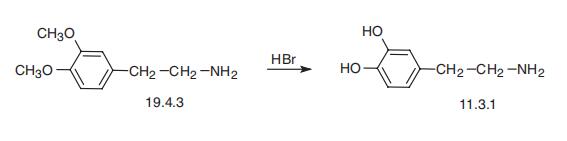
| [Environmental Fate]
Dopamine quinones may irreversibly alter protein function through the
formation of 5-cysteinyl-catechols on the proteins. The
formation of dopamine quinone-alpha-synuclein consequently
increases cytotoxic protofibrils and the covalent modification of
tyrosine hydroxylase by dopamine quinones. The melaninsynthetic
enzyme tyrosinase in the brain may rapidly oxidize
excess amounts of cytosolic dopamine and prevent slowly
progressive cell damage by auto-oxidation of dopamine, thus
maintaining dopamine levels. | [Toxicity evaluation]
High concentrations
of dopamine present inside of a cell than there are
vesicles to store it in, oxidative stress can occur and cause damage
or death to the cell. It is thought that dopamine overload causes
biochemical damage to cellular mitochondria, that provide the
cell with all of the energy it requires to function, resulting in
death of the cell. Catecholamines produced circulatory changes
that reversed propofol anesthesia in animal models. |
|
| Company Name: |
Adamas Reagent, Ltd.
|
| Telephone: |
4006009262 13023226327 |
| Website: |
http://www.tansoole.com |
|