|
|
| | Biphenyl-4,4'-dicarboxylic acid Basic information | | Synthesis |
| Product Name: | Biphenyl-4,4'-dicarboxylic acid | | Synonyms: | 4,4'-DICARBOXYDIPHENYL;4,4'-DIBENZOIC ACID;4,4'-BISBENZOIC ACID;4,4'-DIPHENIC ACID;4,4'-DIPHENYLDICARBOXYLIC ACID;DIPHENYL-4,4'-DICARBOXYLIC ACID;4,4'-Dicarboxybiphenyl;BIPHENYL-4,4-DICAROXYLIC ACID / 4,4-DIPHENIT ACID | | CAS: | 787-70-2 | | MF: | C14H10O4 | | MW: | 242.23 | | EINECS: | 212-328-3 | | Product Categories: | Biphenyl series;Carboxylic Acid Monomers;Biphenyl & Diphenyl ether;Monomers;Polymer Science;API's;Industrial/Fine Chemicals;Biphenyl derivatives;Biphenyls (for High-Performance Polymer Research);Functional Materials;Reagent for High-Performance Polymer Research;787-70-2 | | Mol File: | 787-70-2.mol | 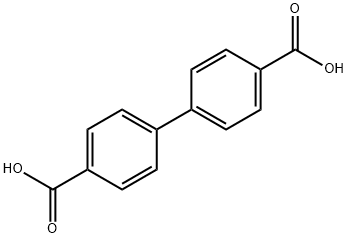 |
| | Biphenyl-4,4'-dicarboxylic acid Chemical Properties |
| Melting point | >300 °C(lit.) | | Boiling point | 482.5±38.0 °C(Predicted) | | density | 1.347±0.06 g/cm3(Predicted) | | storage temp. | Sealed in dry,Room Temperature | | pka | 3.77±0.10(Predicted) | | form | Powder | | color | White to light beige | | BRN | 523308 | | InChI | InChI=1S/C14H10O4/c15-13(16)11-5-1-9(2-6-11)10-3-7-12(8-4-10)14(17)18/h1-8H,(H,15,16)(H,17,18) | | InChIKey | NEQFBGHQPUXOFH-UHFFFAOYSA-N | | SMILES | C1(C2=CC=C(C(O)=O)C=C2)=CC=C(C(O)=O)C=C1 | | CAS DataBase Reference | 787-70-2(CAS DataBase Reference) | | EPA Substance Registry System | [1,1'-Biphenyl]-4,4'-dicarboxylic acid (787-70-2) |
| Hazard Codes | Xi,Xn | | Risk Statements | 36/37/38-20/21/22 | | Safety Statements | 26-37/39-36 | | WGK Germany | 3 | | RTECS | DV2975000 | | TSCA | TSCA listed | | HS Code | 29173990 | | Storage Class | 11 - Combustible Solids | | Hazard Classifications | Eye Irrit. 2
Skin Irrit. 2
STOT SE 3 |
| | Biphenyl-4,4'-dicarboxylic acid Usage And Synthesis |
| Synthesis | Biphenyl-4,4'-dicarboxylic acid can be synthesized in multiple steps by biphenyl chloromethylation oxidation or in one step using dimethylbiphenyl as a raw material.
(1) Biphenyl chloromethylation oxidation method: Using biphenyl as a raw material, chloromethylation is used to generate 4,4'-di(chloromethyl)biphenyl, which is then hydrolyzed to 4,4'-biphenyldiethanol, and finally oxidized with equivalent nitric acid to obtain 4,4'-biphenyl dicarboxylic acid.

(2) Potassium dichromate oxidation method
Using dimethylbiphenyl as a raw material, potassium dichromate is added to react and biphenyl dicarboxylic acid is obtained. The yield is 75%, but this process has high production costs and generates a large amount of chromium-containing wastewater, polluting the environment. A novel catalytic oxidation system using air as an oxidant and high catalytic activity can improve the reaction conversion rate and selectivity, reduce reaction costs, and is more conducive to industrial production. | | Description | Biphenyl-4,4′-dicarboxylic acid (BPDC) belongs to the class of monomers
known as aromatic dicarboxylic acids. It is used to prepare BPDC-based
polymers, which exhibit excellent thermal stability, making them
suitable for applications where high-temperature resistance is required.
These polymers also demonstrate high electrical insulation properties
due to their low dielectric constant and high breakdown strength. They
find applications in the electrical and electronics industry for
insulation, encapsulation, and fabrication of high-performance
electronic devices. | | Chemical Properties | White to light beige powder | | Uses | Dendrimer building block. | | Application | Biphenyl-4,4′-dicarboxylic acid can be used:
As a key component
In the synthesis of nematic aromatic polyesters which are valuable in
the development of liquid crystal polymers with potential applications
in electronics, optical devices automotive, and textiles.
As a
linker or ligand in the synthesis of metal-organic frameworks (MOFs) for
a wide range of potential applications in areas such as gas storage,
catalysis, sensing, and separation technology.
As a building
block in biomedical applications for the synthesis of various
pharmaceutical compounds and materials with biological activity. It can
also be utilized in the development of drug delivery systems and
biomaterials due to its chemical properties. | | Purification Methods | The dicarboxylic acid is a white amorphous or microcrystalline substance which does not melt or sublime. It is best purified by precipitation of an aqueous alkaline solution with mineral acid, washing well with H2O and drying in vacuo at 100o. It is characterized by conversion to diphenyl-4,4’-dicarbonyl chloride (with PCl5 [Work J Chem Soc 1317 1940], or by phase transfer catalysis with SOCl2 + BuEt3N+Cl-in 1,2-dichloroethane [Burdett Synthesis 441 1991]) which crystallises from *C6H6 with m 184o. The di-acid chloride gives the dimethyl ester with MeOH, and has m 215-217o (plates from MeOH, m’s of 214o and 224o were also reported). The diethyl ester is similarly prepared with EtOH and has m 122o (from EtOH). [Beilstein 9 II 665, 9 III 4519, 9 IV 3563.] |
| | Biphenyl-4,4'-dicarboxylic acid Preparation Products And Raw materials |
|