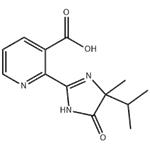
- Imazapyr acid
-
- $32.00
-
2026-09-02
- CAS:81334-34-1
- Min. Order: 1kg
- Purity: 99%
- Imazapyr acid
-
-
2024-12-24
- CAS:81334-34-1
- Min. Order: 1Kg
- Purity: 99.99%
- Supply Ability: 20 tons
- Imazapyr acid
-

- $1.00
-
2019-12-31
- CAS:81334-34-1
- Min. Order: 1KG
- Purity: 95-99%
- Supply Ability: 1ton
|
| | Imazapyr acid Basic information |
| | Imazapyr acid Chemical Properties |
| Melting point | 169-173°C | | Boiling point | 404.53°C (rough estimate) | | density | 1.1923 (rough estimate) | | vapor pressure | 0-0Pa at 20-25℃ | | refractive index | 1.5600 (estimate) | | storage temp. | 0-6°C | | pka | 1.9, 3.6(at 25℃) | | BRN | 5442754 | | Stability: | Stable. Incompatible with strong oxidizing agents. | | Major Application | agriculture
environmental | | InChI | InChI=1S/C13H15N3O3/c1-7(2)13(3)12(19)15-10(16-13)9-8(11(17)18)5-4-6-14-9/h4-7H,1-3H3,(H,17,18)(H,15,16,19) | | InChIKey | CLQMBPJKHLGMQK-UHFFFAOYSA-N | | SMILES | C1(C2NC(=O)C(C)(C(C)C)N=2)=NC=CC=C1C(O)=O | | LogP | -3.97-0.04 at 20℃ and pH3-9.9 | | Dissociation constant | 1.7-11.1 at 20℃ | | CAS DataBase Reference | 81334-34-1(CAS DataBase Reference) | | EPA Substance Registry System | Imazapyr (81334-34-1) |
| Hazard Codes | Xi | | Risk Statements | 36-52/53 | | Safety Statements | 26-61 | | WGK Germany | 2 | | RTECS | US5682500 | | HS Code | 29333990 | | Storage Class | 11 - Combustible Solids | | Hazard Classifications | Eye Irrit. 2 | | Hazardous Substances Data | 81334-34-1(Hazardous Substances Data) | | Toxicity | LD50 orally in rats: >5000 mg/kg; dermally in rabbits: >2000 mg/kg (Paxman) |
| | Imazapyr acid Usage And Synthesis |
| Chemical Properties | solid | | Uses | Imazapyr is an analytical standard used for proteomics research. | | Definition | ChEBI: 2-(4-isopropyl-4-methyl-5-oxo-4,5-dihydro-1H-imidazol-2-yl)nicotinic acid is a pyridinemonocarboxylic acid that is nicotinic acid which is substituted at position 2 by a 4,5-dihydro-imidazol-2-yl group, which in turn is substituted at positions 4, 4, and 5 by isopropyl, ethyl, and oxo groups, respectively. It is a member of pyridines, a member of imidazolines, an imidazolone and a pyridinemonocarboxylic acid. | | Production Methods | The commercial production of imazapyr involves the synthesis of its imidazolinone core through a series of well-controlled chemical reactions. The process typically starts with the preparation of key intermediates such as substituted pyridine or imidazole derivatives, which are then subjected to condensation reactions with carboxylic acid precursors to form the imidazolinone ring system. This core structure is further functionalised with alkyl and carboxylic acid groups to enhance its herbicidal activity and systemic mobility. | | Mechanism of action | Non-selective, absorbed by foliage and rapidly translocated. Controls vegetation by interfering with an enzyme pathway. Inhibits plant amino acid synthesis - acetohydroxyacid synthase AHAS. | | Pharmacology | Imazapyr kills plants by inhibiting acetolactate synthase
(ALS) (I50 = 5 μM), which is the first common enzyme in
the biosynthesis of the branched chain amino acids, valine,
leucine, and isoleucine. Imazapyr is rapidly absorbed
through the leaves of plants. Once it enters the plant,
imazapyr rapidly translocates to the growing points and
growth ceases within 1 day after herbicide application
followed by chlorosis and then necrosis of the growing
points. Total plant death will occur within 2 to 3 weeks
after treatment. | | Environmental Fate | Imazapyr is weakly to moderately adsorbed on sandy loam
and silt loam soils. The Freundlich adsorption coefficient ranges from 0 to 7.8 (15). Because imazapyr is a weak acid
and exists in different ionic states, soil pH has an effect on
soil binding properties. The anionic form predominates at
soil pH as low as 5.5, and this form bindsweakly to soil. The
neutral or molecular form is important at soil pH from 4
to 6.5. This form binds to soil organic matter and clay. The
cationic form is important at pH less than 4. Because the
soil is a heterogeneous mixture of acid and base chemical
groups, there may be sites within a particular soil that are
2 to 3 pH units higher or lower than the average pH. The
cationic form will bind tightly to the lower pH components.
Because of these interactions, small decreases in pH below 6 will result in large increases in binding. The half-life of
imazapyr in the soil is 25–142 d (14). Imazapyr remains
in the top 30 cm of the soil with low leaching potential.
The degradation route of imazapyr in the soil has not been
determined. | | Metabolism | Plant Metabolism. The selectivity of imazapyr is due to
differential rates and routes of metabolism in tolerant
crops versus susceptible weeds (3). The half-life
of imazapyr in tolerant crops has not been accurately
determined. The metabolic route of imazapyr is not clear.
The parent compound can be metabolized to a tricyclic
compound (33, Fig. 15) in some species, but the primary
metabolite is an imidazopyrrolo-pyridine derivative (34,
Fig. 15). This compound does not inhibit acetolactate
synthase, the target site for the imidazolinones, and it
is immobile in the plant (4).
Animal Metabolism. Metabolism studies in the rat
showed that imazapyr is rapidly excreted in the urine (5).
There was no accumulation of imazapyr or any of its
derivatives in the liver, kidney, muscle, fat, or blood. | | Toxicity evaluation | Imazapyr has shown no mutagenic or genotoxic activity
in the Ames assay, mammalian cell gene mutation assay,
in vitro chromosome aberration assay, in vitro unscheduled
DNA synthesis (URS) assay, or the in vivo dominant
lethal assay in male rats.This herbicide also has a low potential for bioaccumulation
in fish. | | Pesticide Type | Herbicide |
| | Imazapyr acid Preparation Products And Raw materials |
|